Pau Massimiliano, Corona Federica, Pili Roberta, Casula Carlo, Sors Fabrizio, Agostini Tiziano, Cossu Giovanni, Guicciardi Marco, Murgia Mauro
Department of Mechanical, Chemical and Materials Engineering, University of Cagliari , Cagliari , Italy.
Department of Surgical Sciences, University of Cagliari , Cagliari , Italy.
Front Neurol. 2016 Aug 11;7:126. doi: 10.3389/fneur.2016.00126. eCollection 2016.
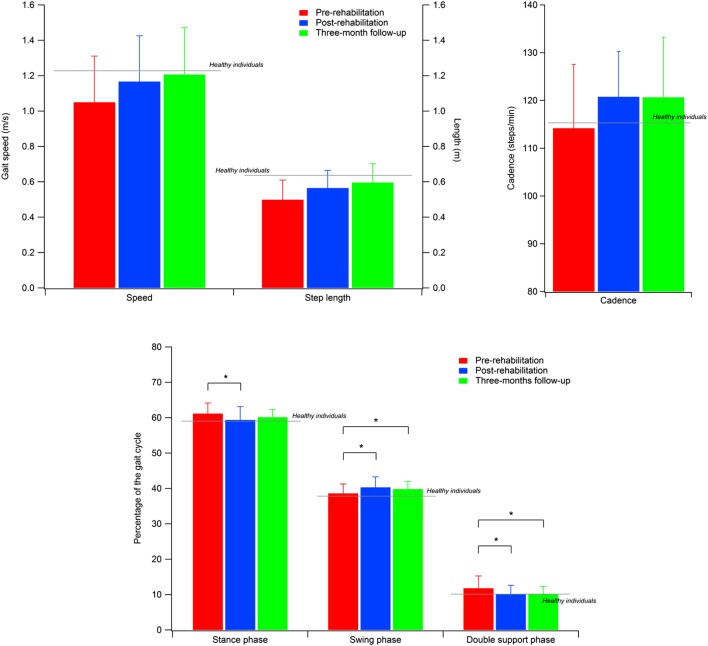
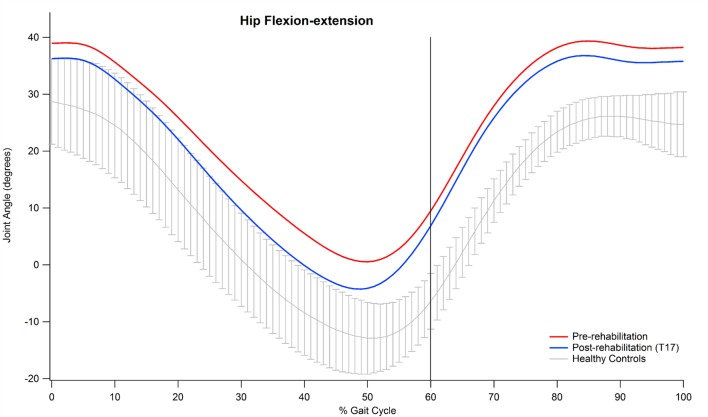
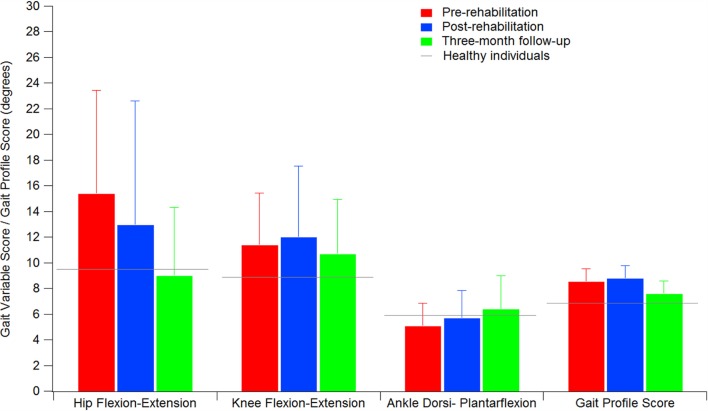
Movement rehabilitation by means of physical therapy represents an essential tool in the management of gait disturbances induced by Parkinson's disease (PD). In this context, the use of rhythmic auditory stimulation (RAS) has been proven useful in improving several spatio-temporal parameters, but concerning its effect on gait patterns, scarce information is available from a kinematic viewpoint. In this study, we used three-dimensional gait analysis based on optoelectronic stereophotogrammetry to investigate the effects of 5 weeks of supervised rehabilitation, which included gait training integrated with RAS on 26 individuals affected by PD (age 70.4 ± 11.1, Hoehn and Yahr 1-3). Gait kinematics was assessed before and at the end of the rehabilitation period and after a 3-month follow-up, using concise measures (Gait Profile Score and Gait Variable Score, GPS and GVS, respectively), which are able to describe the deviation from a physiologic gait pattern. The results confirm the effectiveness of gait training assisted by RAS in increasing speed and stride length, in regularizing cadence and correctly reweighting swing/stance phase duration. Moreover, an overall improvement of gait quality was observed, as demonstrated by the significant reduction of the GPS value, which was created mainly through significant decreases in the GVS score associated with the hip flexion-extension movement. Future research should focus on investigating kinematic details to better understand the mechanisms underlying gait disturbances in people with PD and the effects of RAS, with the aim of finding new or improving current rehabilitative treatments.
通过物理治疗进行运动康复是帕金森病(PD)所致步态障碍管理中的一项重要手段。在这一背景下,节律性听觉刺激(RAS)已被证明有助于改善多个时空参数,但从运动学角度来看,关于其对步态模式的影响,相关信息却很匮乏。在本研究中,我们采用基于光电立体摄影测量法的三维步态分析,来探究为期5周的有监督康复训练的效果,该训练包括将步态训练与RAS相结合,训练对象为26名PD患者(年龄70.4±11.1,Hoehn和Yahr分级为1 - 3级)。在康复期开始前、结束时以及3个月随访后,使用简明测量指标(分别为步态轮廓评分和步态变量评分,即GPS和GVS)对步态运动学进行评估,这些指标能够描述与生理步态模式的偏差。结果证实,RAS辅助的步态训练在提高速度和步长、使步频规律化以及正确调整摆动/支撑相持续时间方面是有效的。此外,观察到步态质量有了整体改善,这体现在GPS值显著降低,这主要是由于与髋关节屈伸运动相关的GVS评分显著下降所致。未来的研究应侧重于调查运动学细节,以更好地理解PD患者步态障碍的潜在机制以及RAS的作用效果,旨在找到新的或改进现有的康复治疗方法。