Amadou Amina, Biessy Carine, Rinaldi Sabina, Fedirko Veronika, Assi Nada, Lajous Martin, Ortiz-Panozo Eduardo, Yunes Elsa, Lopez-Ridaura Ruy, Torres-Mejia Gabriela, Romieu Isabelle
Nutrition and Metabolism Section, International Agency for Research on Cancer (IARC), Lyon, France.
Department of Epidemiology, Rollins School of Public Health, Winship Cancer Institute, Emory University, Atlanta, GA, United States of America.
PLoS One. 2016 Aug 26;11(8):e0161686. doi: 10.1371/journal.pone.0161686. eCollection 2016.
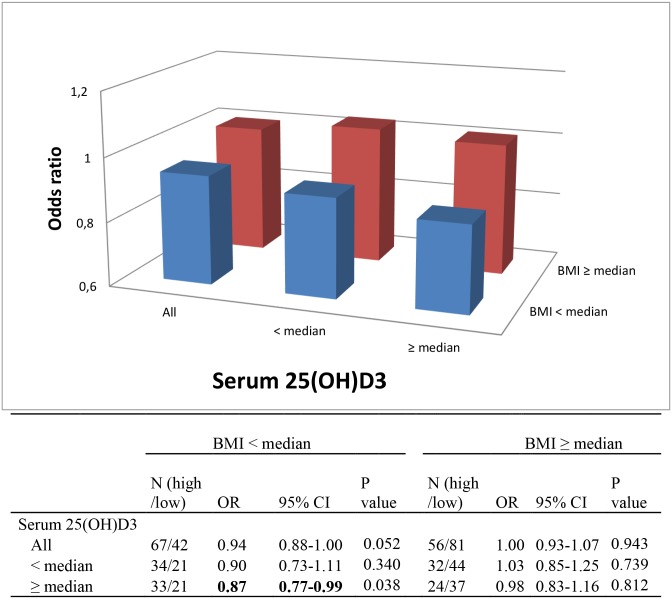
Low circulating levels of vitamin D and high mammographic density (MD) have been associated with higher risk of breast cancer. Although some evidence suggested an inverse association between circulating vitamin D and MD, no studies have investigated this association among Mexican women. We examined whether serum 25-hydroxyvitamin D3 [25(OH)D3] levels were associated with MD in a cross-sectional study nested within the large Mexican Teacher's Cohort. This study included 491 premenopausal women with a mean age of 42.9 years. Serum 25(OH)D3 levels were measured by liquid chromatography/tandem mass spectrometry. Linear regression and non-linear adjusted models were used to estimate the association of MD with serum 25(OH)D3. Median serum 25(OH)D3 level was 27.3 (23.3-32.8) (ng/ml). Forty one (8%) women had 25(OH)D3 levels in the deficient range (< 20 ng/ml). Body mass index (BMI) and total physical activity were significantly correlated with 25(OH)D3 (r = -0.109, P = 0.019 and r = 0.095, P = 0.003, respectively). In the multivariable linear regression, no significant association was observed between 25(OH)D3 levels and MD overall. However, in stratified analyses, higher serum 25(OH)D3 levels (≥27.3 ng/ml) were significantly inversely associated with percent MD among women with BMI below the median (β = -0.52, P = 0.047). Although no significant association was observed between serum 25(OH)D3 and percent MD in the overall population, specific subgroups of women may benefit from higher serum 25(OH)D3 levels.
循环维生素D水平低和乳腺X线密度(MD)高与乳腺癌风险较高有关。尽管一些证据表明循环维生素D与MD之间存在负相关,但尚无研究在墨西哥女性中调查这种关联。在一项嵌套于大型墨西哥教师队列中的横断面研究中,我们检验了血清25-羟基维生素D3[25(OH)D3]水平是否与MD相关。该研究纳入了491名平均年龄为42.9岁的绝经前女性。血清25(OH)D3水平通过液相色谱/串联质谱法测量。采用线性回归和非线性调整模型来估计MD与血清25(OH)D3的关联。血清25(OH)D3水平中位数为27.3(23.3 - 32.8)(纳克/毫升)。41名(8%)女性的25(OH)D3水平处于缺乏范围(<20纳克/毫升)。体重指数(BMI)和总身体活动与25(OH)D3显著相关(分别为r = -0.109,P = 0.019和r = 0.095,P = 0.003)。在多变量线性回归中,总体上未观察到25(OH)D3水平与MD之间存在显著关联。然而,在分层分析中,血清25(OH)D3水平较高(≥27.3纳克/毫升)与BMI低于中位数的女性的MD百分比显著负相关(β = -0.52,P = 0.047)。尽管在总体人群中未观察到血清25(OH)D3与MD百分比之间存在显著关联,但特定亚组的女性可能从较高的血清25(OH)D3水平中获益。