van Reesema Lauren L Siewertsz, Zheleva Vasilena, Winston Janet S, Jansen Rick J, O'Connor Carolyn F, Isbell Andrew J, Bian Minglei, Qin Rui, Bassett Patricia T, Hinson Virginia J, Dorsch Kimberly A, Kirby Brad W, Van Sciver Robert E, Tang-Tan Angela M, Harden Elizabeth A, Chang David Z, Allen Cynthia A, Perry Roger R, Hoefer Richard A, Tang Amy H
Department of Microbiology and Molecular Cell Biology, Leroy T. Canoles Jr. Cancer Research Center, Eastern Virginia Medical School, Norfolk, VA 23507, United States.
Department of Surgery, Leroy T. Canoles Jr. Cancer Research Center, Eastern Virginia Medical School, Norfolk, VA 23507, United States.
EBioMedicine. 2016 Sep;11:183-198. doi: 10.1016/j.ebiom.2016.08.014. Epub 2016 Aug 14.
Metastatic breast cancer exhibits diverse and rapidly evolving intra- and inter-tumor heterogeneity. Patients with similar clinical presentations often display distinct tumor responses to standard of care (SOC) therapies. Genome landscape studies indicate that EGFR/HER2/RAS "pathway" activation is highly prevalent in malignant breast cancers. The identification of therapy-responsive and prognostic biomarkers is paramount important to stratify patients and guide therapies in clinical oncology and personalized medicine.
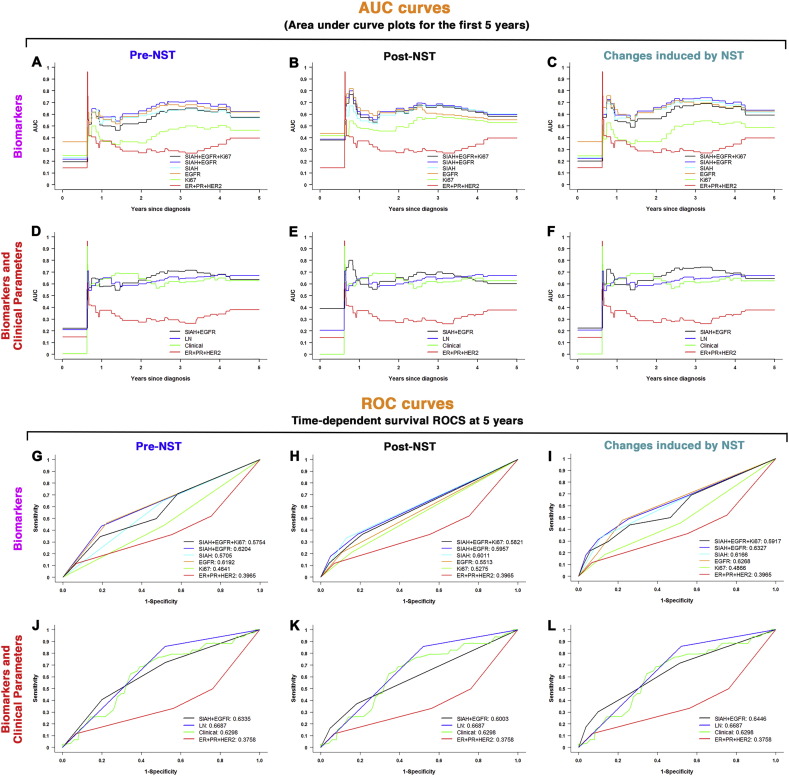
In this study, we analyzed matched pairs of tumor specimens collected from 182 patients who received neoadjuvant systemic therapies (NST). Statistical analyses were conducted to determine whether EGFR/HER2/RAS pathway biomarkers and clinicopathological predictors, alone and in combination, are prognostic in breast cancer.
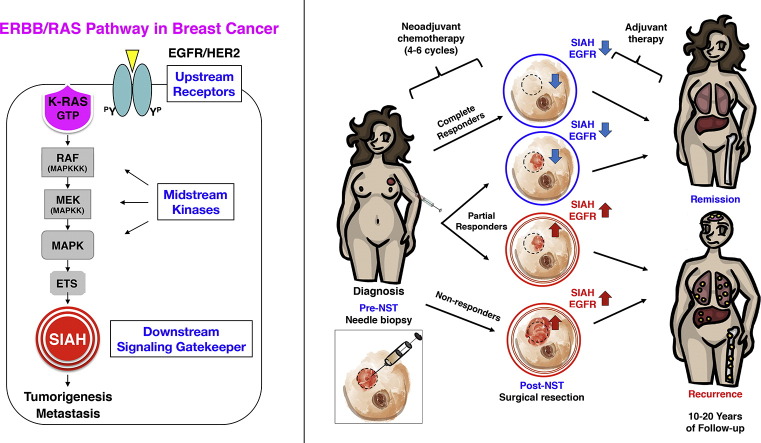
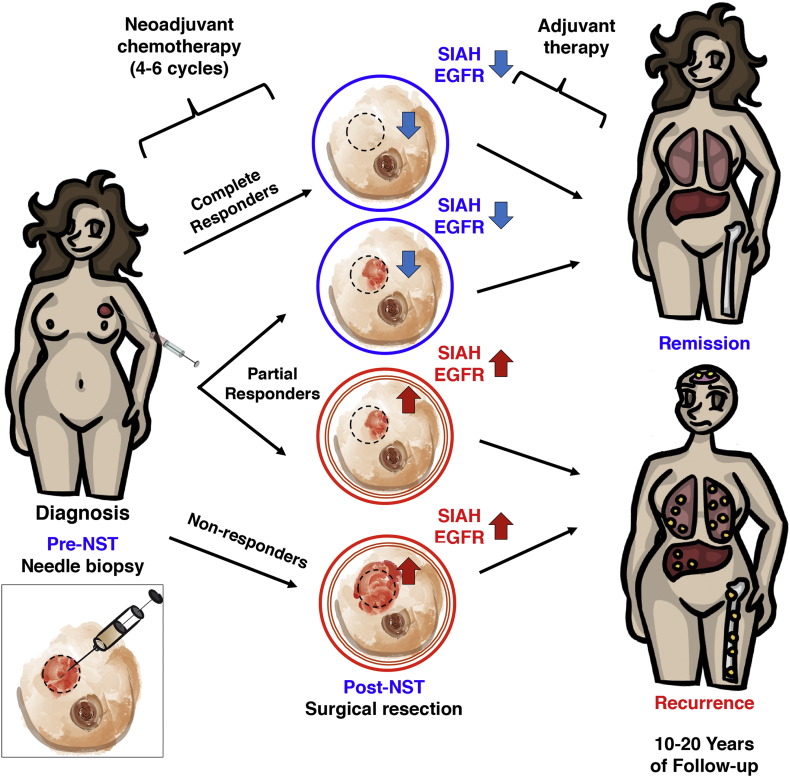
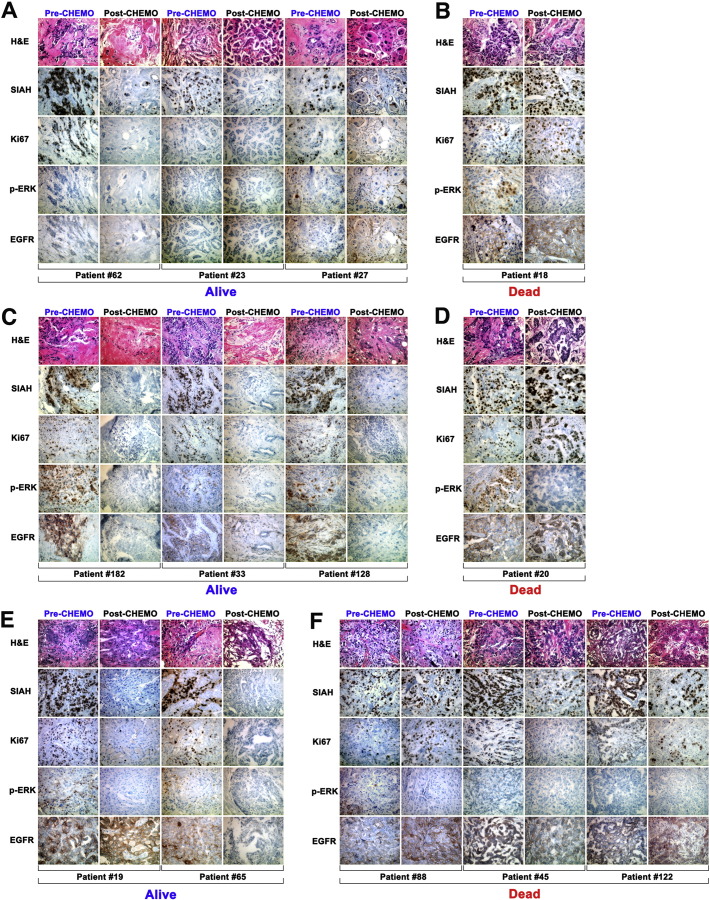
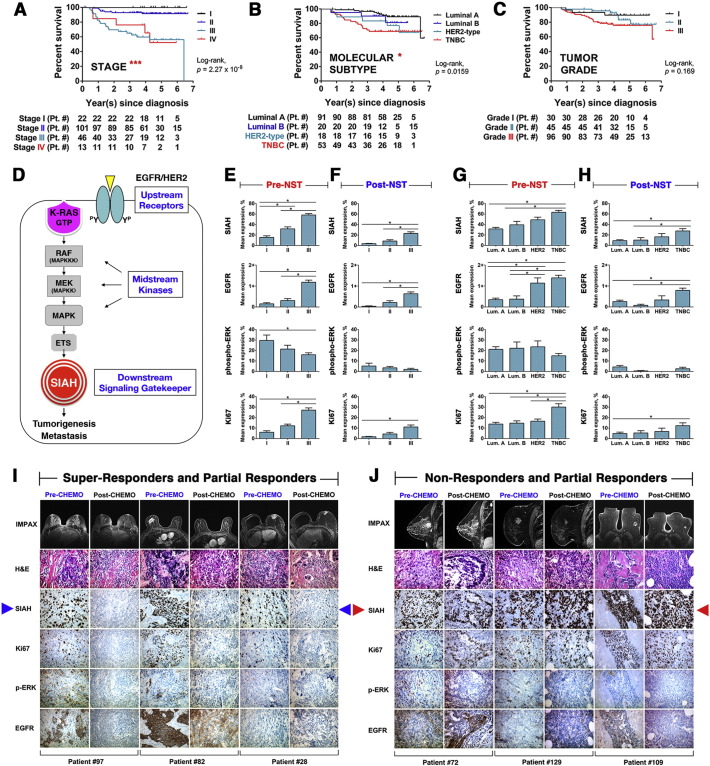
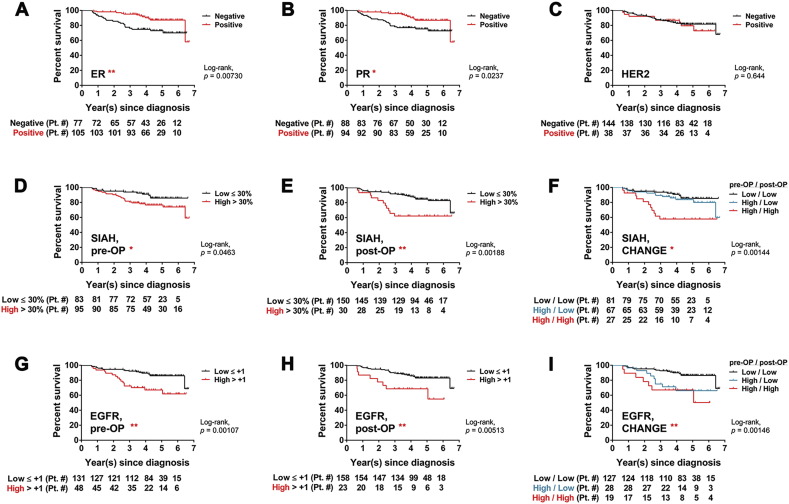
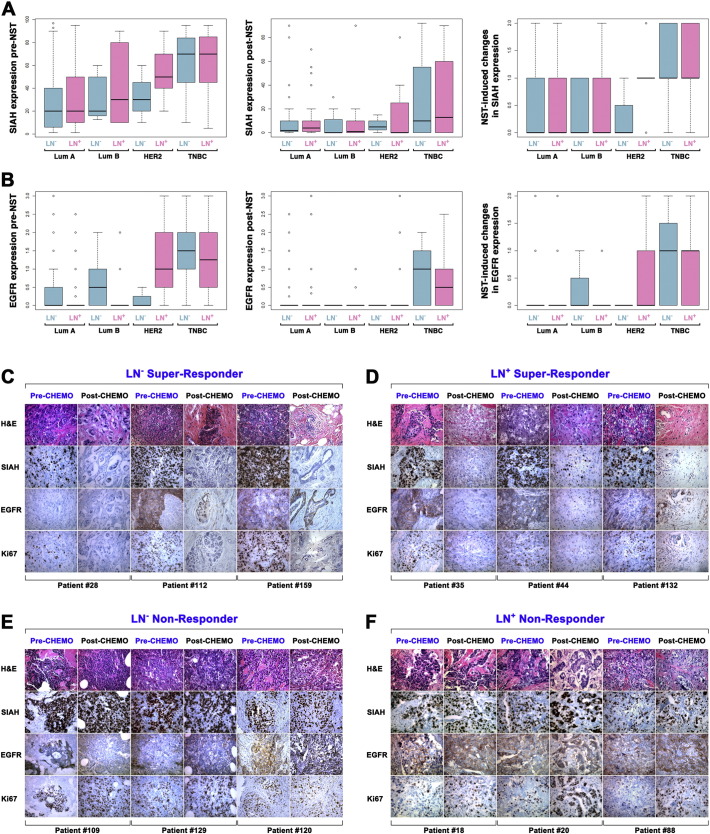
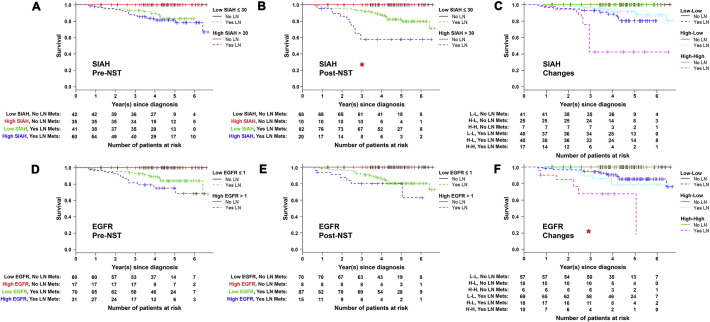
SIAH and EGFR outperform ER, PR, HER2 and Ki67 as two logical, sensitive and prognostic biomarkers in metastatic breast cancer. We found that increased SIAH and EGFR expression correlated with advanced pathological stage and aggressive molecular subtypes. Both SIAH expression post-NST and NST-induced changes in EGFR expression in invasive mammary tumors are associated with tumor regression and increased survival, whereas ER, PR, and HER2 were not. These results suggest that SIAH and EGFR are two prognostic biomarkers in breast cancer with lymph node metastases.
The discovery of incorporating tumor heterogeneity-independent and growth-sensitive RAS pathway biomarkers, SIAH and EGFR, whose altered expression can be used to estimate therapeutic efficacy, detect emergence of resistant clones, forecast tumor regression, differentiate among partial responders, and predict patient survival in the neoadjuvant setting, has a clear clinical implication in personalizing breast cancer therapy.
This work was supported by the Dorothy G. Hoefer Foundation for Breast Cancer Research (A.H. Tang); Center for Innovative Technology (CIT)-Commonwealth Research Commercialization Fund (CRCF) (MF14S-009-LS to A.H. Tang), and National Cancer Institute (CA140550 to A.H. Tang).
转移性乳腺癌表现出多样且迅速演变的肿瘤内和肿瘤间异质性。临床表现相似的患者对标准治疗(SOC)疗法往往表现出不同的肿瘤反应。基因组图谱研究表明,EGFR/HER2/RAS“通路”激活在恶性乳腺癌中非常普遍。识别治疗反应性和预后生物标志物对于在临床肿瘤学和个性化医学中对患者进行分层并指导治疗至关重要。
在本研究中,我们分析了从182例接受新辅助全身治疗(NST)的患者中收集的配对肿瘤标本。进行统计分析以确定EGFR/HER2/RAS通路生物标志物和临床病理预测指标单独或联合使用时是否可预测乳腺癌的预后。
在转移性乳腺癌中,SIAH和EGFR作为两个合理、敏感且具有预后价值的生物标志物,其表现优于ER、PR、HER2和Ki67。我们发现SIAH和EGFR表达增加与晚期病理分期和侵袭性分子亚型相关。新辅助全身治疗后SIAH的表达以及侵袭性乳腺肿瘤中EGFR表达的新辅助全身治疗诱导变化均与肿瘤退缩和生存期延长相关,而ER、PR和HER2则不然。这些结果表明,SIAH和EGFR是有淋巴结转移的乳腺癌中的两个预后生物标志物。
发现纳入不依赖肿瘤异质性且对生长敏感的RAS通路生物标志物SIAH和EGFR,其表达改变可用于评估治疗效果、检测耐药克隆的出现、预测肿瘤退缩、区分部分缓解者以及预测新辅助治疗环境下的患者生存情况,这对乳腺癌治疗的个性化具有明确的临床意义。
本研究得到了多萝西·G·霍弗乳腺癌研究基金会(A.H.唐);创新技术中心(CIT)-英联邦研究商业化基金(CRCF)(给A.H.唐的MF14S - 009 - LS)以及美国国立癌症研究所(给A.H.唐的CA140550)的支持。