Claeson Amy A, Barocas Victor H
Department of Biomedical Engineering, University of Minnesota - Twin Cities, Minneapolis, MN, USA.
Department of Biomedical Engineering, University of Minnesota - Twin Cities, Minneapolis, MN, USA.
J Mech Behav Biomed Mater. 2017 Jan;65:127-136. doi: 10.1016/j.jmbbm.2016.08.019. Epub 2016 Aug 20.
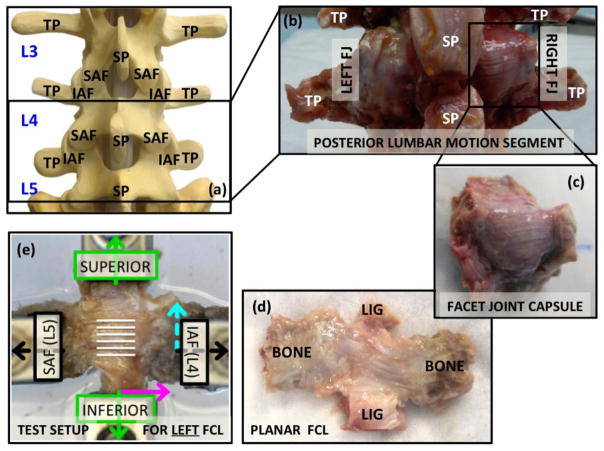
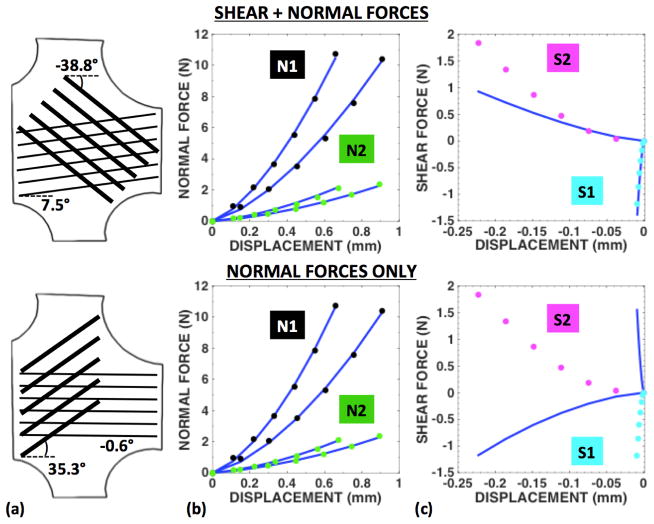
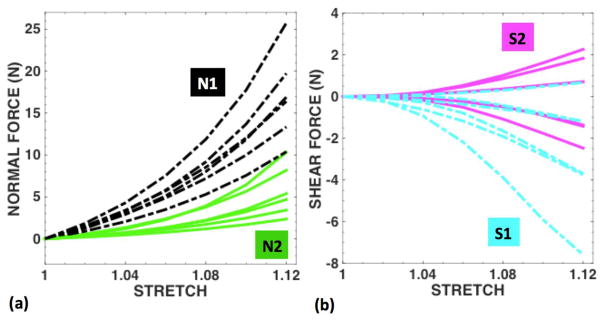
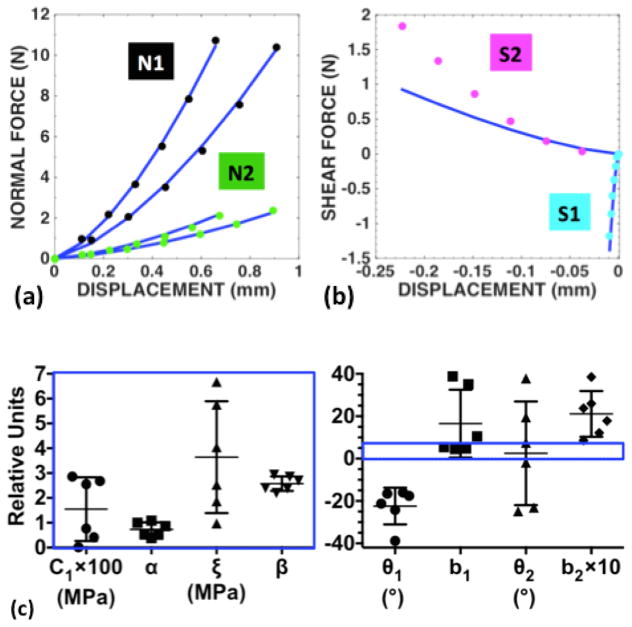
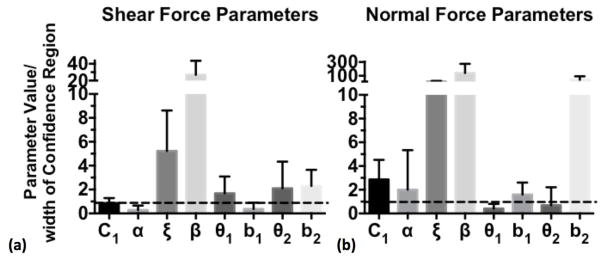
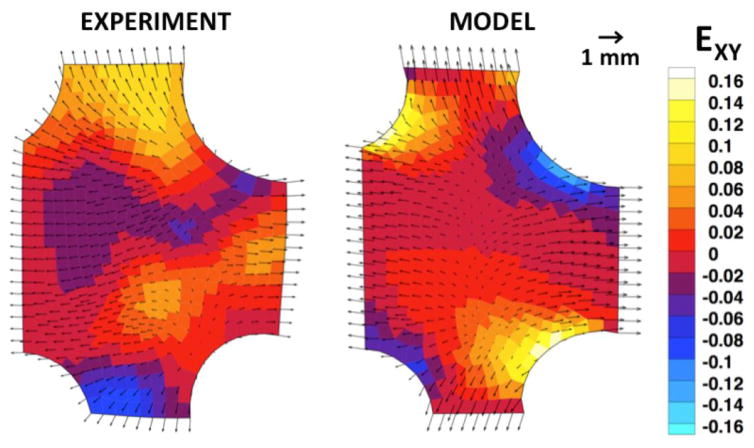
The lumbar facet capsular ligament (FCL) articulates with six degrees of freedom during spinal motions of flexion/extension, lateral bending, and axial rotation. The lumbar FCL is composed of highly aligned collagen fiber bundles on the posterior surface (oriented primarily laterally between the rigid articular facets) and irregularly oriented elastin on the anterior surface. Because the FCL is a capsule, it has multiple insertion sites across the lumbar facet joint, which, along with its material structure, give rise to complicated deformations in vivo. We performed planar equibiaxial mechanical tests on excised healthy cadaveric lumbar FCLs (n=6) to extract normal and shear reaction forces, and fit sample-specific two-fiber-family finite element models to the experimental force data. An eight-parameter anisotropic, hyperelastic model was used. Shear forces at maximum extension (mean values of 1.68N and 3.01N in the two directions) were of comparable magnitude to the normal forces perpendicular to the aligned collagen fiber bundles (4.67N) but smaller than normal forces in the fiber direction (16.11N). Inclusion of the experimental shear forces in the model optimization yielded fits with highly aligned fibers oriented at a specific angle across all samples, typically with one fiber population aligned nearly horizontally and the other at an oblique angle. Conversely, models fit to only the normal force data resulted in a broad range of fiber angles with low specificity. We found that shear forces generated through planar equibiaxial extension aided the model fit in describing the anisotropic nature of the FCL surface.
腰椎小关节囊韧带(FCL)在脊柱屈伸、侧屈和轴向旋转运动中以六个自由度进行关节活动。腰椎FCL由后表面高度排列的胶原纤维束(主要在刚性关节面之间横向排列)和前表面不规则排列的弹性蛋白组成。由于FCL是一个囊,它在腰椎小关节上有多个附着点,这与其材料结构一起,在体内引起复杂的变形。我们对切除的健康尸体腰椎FCL(n = 6)进行了平面双轴力学测试,以提取法向力和剪切力,并将特定样本的双纤维族有限元模型与实验力数据进行拟合。使用了一个八参数各向异性超弹性模型。最大伸展时的剪切力(两个方向的平均值分别为1.68N和3.01N)与垂直于排列的胶原纤维束的法向力(4.67N)大小相当,但小于纤维方向的法向力(16.11N)。在模型优化中纳入实验剪切力,得到的拟合结果是所有样本中纤维以特定角度高度排列,通常一个纤维群体几乎水平排列,另一个倾斜排列。相反,仅拟合法向力数据的模型导致纤维角度范围广泛且特异性较低。我们发现,通过平面双轴伸展产生的剪切力有助于模型拟合描述FCL表面的各向异性性质。