Ma Xuelei, Wang Xiaoshan, Huang Jingwen, Chen Yingtai, Zhang Jing, Zhang Binglan, Shi Changle, Liu Lei
State Key Laboratory of Biotherapy and Cancer Center, West China Hospital, West China Medical School, Sichuan University, Chengdu, Sichuan, China.
Department of Clinical Oncology, Sichuan Provincial People's Hospital, Chengdu, Sichuan, China.
PLoS One. 2016 Aug 31;11(8):e0160148. doi: 10.1371/journal.pone.0160148. eCollection 2016.
Neoadjuvant therapy is administered to breast cancer patients as an induction process before surgery or radiotherapy to reduce tumor size. Human epidermal growth factor receptor-2 (HER-2) negative breast cancer lacks effective standard target therapy. Bevacizumab has a controversial role in the treatment of breast cancer and we conduct a meta-analysis to evaluate the value of adding bevacizumab in neoadjuvant regimen.
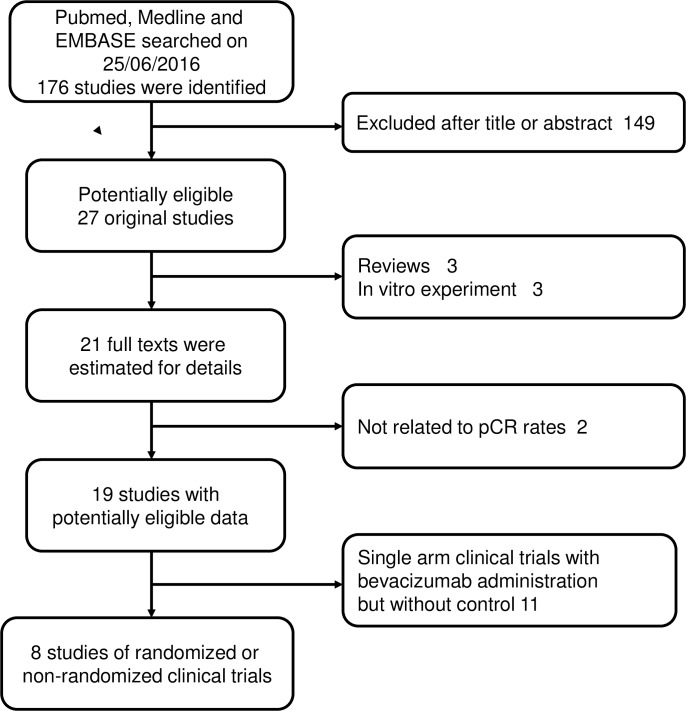
Potentially eligible studies were retrieved using PubMed, EMBASE and Medline. Clinical characteristics of patients and statistical data with pathological complete response (pCR) data were collected. Then a meta-analysis model was established to investigate the correlation between administration of bevacizumab in neoadjuvant therapy and pCR rates in HER-2 negative breast cancer.
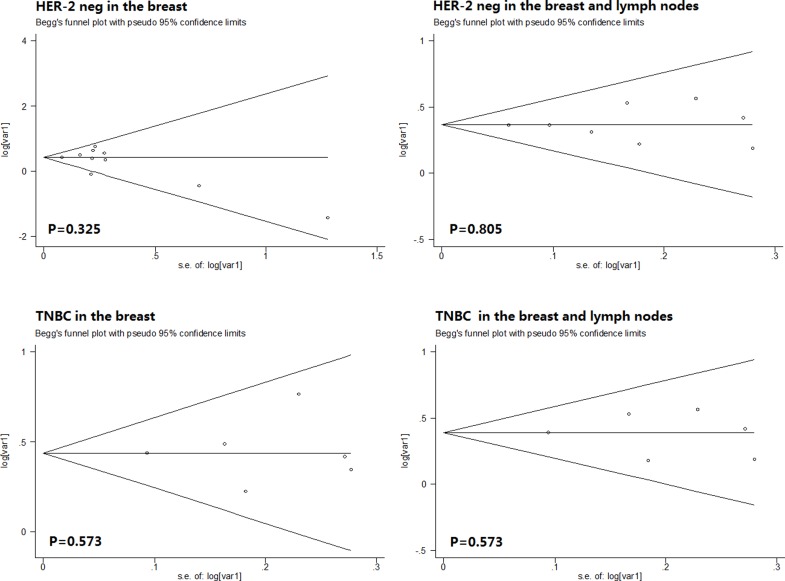
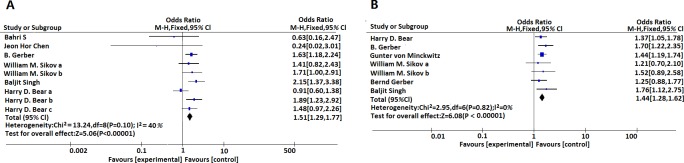
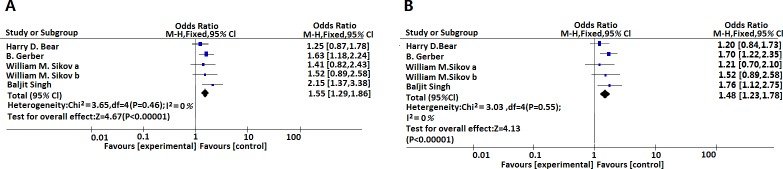
Seven eligible studies and 5408 patients were yielded. The pCR rates for "breast" or "breast plus lymph node" were similar. In subgroup analysis, we emphasized on patients with triple-negative breast cancer (TNBC). In the criterion of "lesions in breast" the pooled ORs was 1.55 [1.29, 1.86], P<0.00001 and regarding to the evaluation criterion of "lesions in breast and lymph nodes", the pooled ORs was 1.48 [1.23, 1.78], P<0.0001, in favor of bevacizumab administration.
According to our pooled results, we finally find that bevacizumab addition as a neoadjuvant chemotherapy component, for induction use with limited cycle to improve the pCR rates and patients may avoid long-term adverse event and long-term invalid survival improvement. Especially in subgroup analysis, pCR rates could be improved significantly and physicians could consider bevacizumab with caution. As patients could avoid the adverse event caused by long-term using of bevacizumab, long-term quality of life improvement may be achieved, especially in TNBC.
新辅助治疗是在手术或放疗前给予乳腺癌患者的一种诱导治疗,以缩小肿瘤大小。人表皮生长因子受体2(HER-2)阴性乳腺癌缺乏有效的标准靶向治疗。贝伐单抗在乳腺癌治疗中的作用存在争议,我们进行一项荟萃分析以评估在新辅助治疗方案中添加贝伐单抗的价值。
通过PubMed、EMBASE和Medline检索潜在符合条件的研究。收集患者的临床特征以及具有病理完全缓解(pCR)数据的统计数据。然后建立荟萃分析模型,以研究新辅助治疗中使用贝伐单抗与HER-2阴性乳腺癌pCR率之间的相关性。
获得了7项符合条件的研究和5408例患者。“乳腺”或“乳腺加淋巴结”的pCR率相似。在亚组分析中,我们重点关注三阴性乳腺癌(TNBC)患者。在“乳腺病变”标准下,合并OR为1.55[1.29,1.86],P<0.00001;在“乳腺和淋巴结病变”评估标准下,合并OR为1.48[1.23,1.78]P<0.0001,支持使用贝伐单抗。
根据我们的汇总结果,我们最终发现,添加贝伐单抗作为新辅助化疗的组成部分,进行有限周期的诱导使用可提高pCR率,患者可避免长期不良事件和长期无效的生存改善。特别是在亚组分析中,pCR率可显著提高,医生可谨慎考虑使用贝伐单抗。由于患者可避免长期使用贝伐单抗引起的不良事件,可能实现长期生活质量的改善,尤其是在TNBC患者中。