Solomon Benjamin L, Whitman Todd, Wood Marie E
University of Vermont Medical Center, 111 Colchester Ave, Burlington, VT, 05401, USA.
Champlain Valley Physicians Hospital, 75 Beekman St, Plattsburgh, NY, 12901, USA.
BMC Fam Pract. 2016 Sep 1;17(1):126. doi: 10.1186/s12875-016-0521-0.
Family history is important for identifying candidates for high risk cancer screening and referral for genetic counseling. We sought to determine the percentage of individuals who would be eligible for high risk cancer screening or genetic referral and testing if family history includes an extended (vs limited) family history.
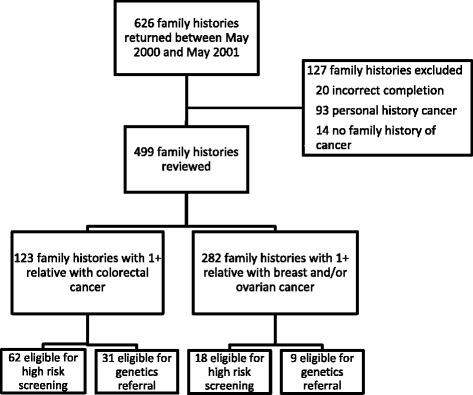
Family histories were obtained from 626 women at UVMMC associated mammography centers from 2001 to 2002. ACS guidelines were used to determine eligibility for high risk breast or colon cancer screening. Eligibility for referral for genetic counseling for hereditary breast and colon cancer was determined using the Referral Screening Tool and Amsterdam II screening criteria, respectively. All family histories were assessed for eligibility by a limited history (first degree relatives only) and extended history (first and second degree relatives).
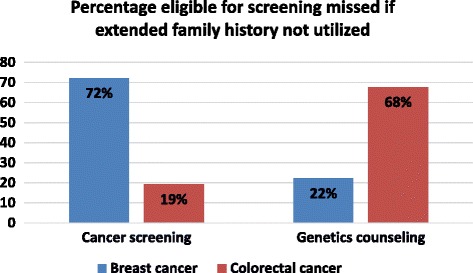
Four hundred ninety-nine histories were eligible for review. 18/282 (3.6 %) and 62/123 (12 %) individuals met criteria for high risk breast and colon cancer screening, respectively. 13/18 (72 %) in the high risk breast cancer screening group and 12/62 (19 %) in the high risk colon cancer screening group met criteria based upon an extended family history. 9/282 (1.8 %) and 31/123 (6.2 %) individuals met criteria for genetic counseling referral and testing for breast and colon cancer, respectively. 2/9 (22 %) of individuals in the genetic breast cancer screening group and 21/31 (68 %) individuals in the genetic colon cancer screening group met criteria based upon extended family history.
This is one of the first studies to suggest that first degree family history alone is not adequate for identification of candidates for high risk screening and referral for genetic counseling for hereditary breast and colon cancer syndromes. A larger population is needed to further validate this data.
家族史对于识别高风险癌症筛查的候选者以及转介进行遗传咨询非常重要。我们试图确定如果家族史包括扩展(相对于有限)家族史,符合高风险癌症筛查或遗传转介及检测条件的个体百分比。
2001年至2002年期间,从UVMMC相关乳腺摄影中心的626名女性中获取家族史。采用美国癌症协会(ACS)指南来确定高风险乳腺癌或结肠癌筛查的资格。分别使用转诊筛查工具和阿姆斯特丹II筛查标准来确定遗传性乳腺癌和结肠癌遗传咨询转诊的资格。所有家族史均通过有限家族史(仅一级亲属)和扩展家族史(一级和二级亲属)评估其资格。
499份家族史符合审查条件。分别有18/282(3.6%)和62/123(12%)的个体符合高风险乳腺癌和结肠癌筛查标准。高风险乳腺癌筛查组中13/18(72%)以及高风险结肠癌筛查组中12/62(19%)的个体基于扩展家族史符合标准。分别有9/282(1.8%)和31/123(6.2%)的个体符合乳腺癌和结肠癌遗传咨询转诊及检测标准。遗传性乳腺癌筛查组中2/9(22%)的个体以及遗传性结肠癌筛查组中21/31(68%)的个体基于扩展家族史符合标准。
这是首批表明仅一级家族史不足以识别遗传性乳腺癌和结肠癌综合征高风险筛查及遗传咨询转诊候选者的研究之一。需要更大规模的人群来进一步验证该数据。