Cheungpasitporn Wisit, Thongprayoon Charat, Mao Michael A, Kittanamongkolchai Wonngarm, Sathick Insara J J, Erickson Stephen B
Division of Nephrology and Hypertension, Mayo Clinic, Rochester, Minnesota, USA.
N Am J Med Sci. 2016 Jul;8(7):291-6. doi: 10.4103/1947-2714.187141.
The use of renin-angiotensin system (RAS) inhibitors in patients with chronic kidney disease, and especially in diabetic kidney disease, has been shown to provide renoprotective effects and slow progression to end-stage renal disease. However, this protective effect in kidney transplant patient populations is unclear.
The objective of this systematic review and meta-analysis was to evaluate the effect of RAS inhibitors on kidney allograft survival.
A literature search for randomized controlled trials (RCTs) was performed from inception through February 2016. Studies that reported relative risks or hazard ratios comparing the risks of renal graft loss in renal transplant recipients who received RAS inhibitors vs. controls were included. Pooled risk ratios (RRs) and 95% confidence intervals (CIs) were calculated using a random-effect, generic inverse variance method.
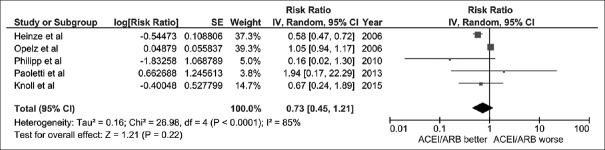
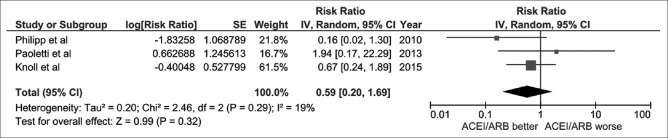
Five studies (3 RCTs and 2 cohort studies) with 20024 kidney transplant patients were included in the meta-analysis. Pooled RR of allograft failure in recipients who received RAS inhibitors was 0.73 (95% CI: 0.45-1.21). When meta-analysis was limited only to RCTs, the pooled RR of allograft failure in patients using RAS inhibitors was 0.59 (95%: CI 0.20-1.69). The risk for mortality (RR: 1.13 [95% CI: 0.62-2.07]) in patients using RAS inhibitors compared to controls was not significantly reduced.
This meta-analysis demonstrated insignificant reduced risks of renal graft loss among renal transplant recipients who received RAS inhibitors. Future studies assessing the potential benefits of RAS inhibitors on allograft survival in specific kidney transplant patient populations are needed.
已证明在慢性肾脏病患者,尤其是糖尿病肾病患者中使用肾素 - 血管紧张素系统(RAS)抑制剂可提供肾脏保护作用,并延缓进展至终末期肾病。然而,这种保护作用在肾移植患者群体中尚不清楚。
本系统评价和荟萃分析的目的是评估RAS抑制剂对肾移植存活率的影响。
从创刊至2016年2月进行了随机对照试验(RCT)的文献检索。纳入报告了比较接受RAS抑制剂与对照组的肾移植受者肾移植丢失风险的相对风险或风险比的研究。使用随机效应、通用逆方差法计算合并风险比(RRs)和95%置信区间(CIs)。
荟萃分析纳入了5项研究(3项RCT和2项队列研究),共20024例肾移植患者。接受RAS抑制剂的受者移植失败的合并RR为0.73(95%CI:0.45 - 1.21)。当荟萃分析仅限于RCT时,使用RAS抑制剂的患者移植失败的合并RR为0.59(95%:CI 0.20 - 1.69)。与对照组相比,使用RAS抑制剂的患者死亡率风险(RR:1.13 [95%CI:0.62 - 2.07])没有显著降低。
这项荟萃分析表明,接受RAS抑制剂的肾移植受者肾移植丢失风险降低不显著。需要未来的研究评估RAS抑制剂对特定肾移植患者群体移植存活率的潜在益处。