Ziros Panos, Zagoriti Zoi, Lagoumintzis George, Kyriazopoulou Venetsana, Iskrenova Ralitsa P, Habeos Evagelia I, Sykiotis Gerasimos P, Chartoumpekis Dionysios V, Habeos Ioannis G
Department of Internal Medicine, Division of Endocrinology, School of Medicine, University of Patras, Patras, Greece.
Department of Pharmacy, University of Patras, Patras, Greece.
PLoS One. 2016 Sep 1;11(9):e0162024. doi: 10.1371/journal.pone.0162024. eCollection 2016.
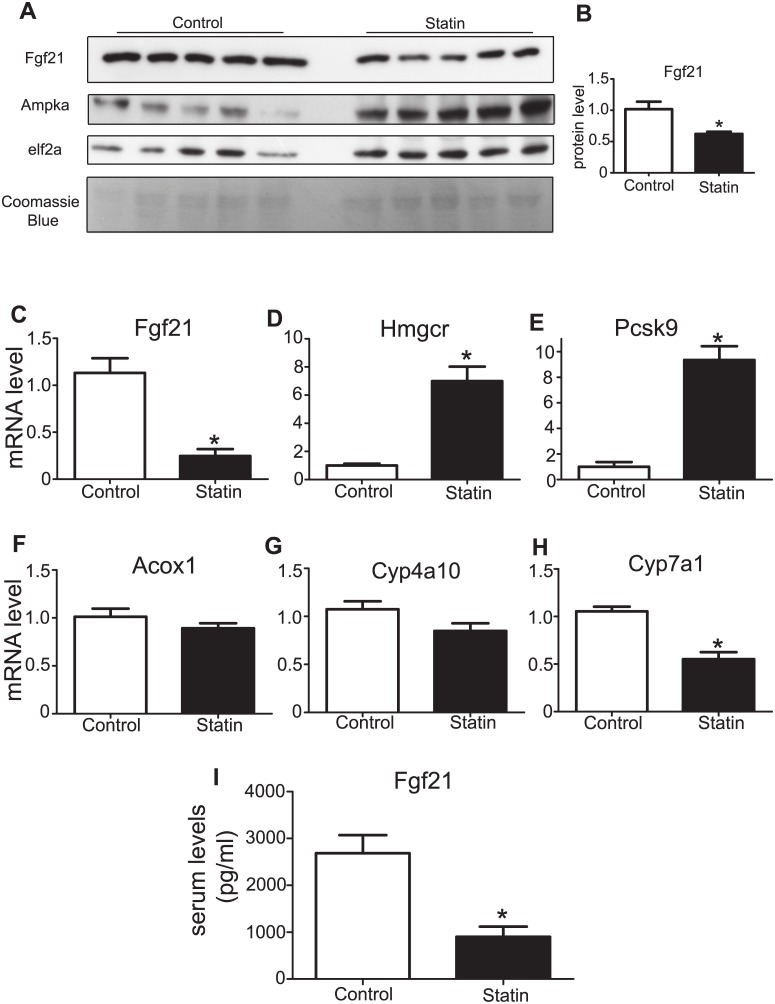
Fibroblast growth factor 21 (Fgf21) is a hormone with emerging beneficial roles in glucose and lipid homeostasis. The interest in Fgf21 as a potential antidiabetic drug and the factors that regulate its production and secretion is growing. Statins are the most widely prescribed drug for the treatment of dyslipidemia. However, the function of statins is not limited to the lowering of cholesterol as they are associated with pleiotropic actions such as antioxidant, anti-inflammatory and cytoprotective effects. The recently described effect of statins on mitochondrial function and the induction of Fgf21 by mitochondrial stress prompted us to investigate the effect of statin treatment on Fgf21 expression in the liver. To this end, C57BL6J male mice and primary mouse hepatocytes were treated with simvastatin, and Fgf21 expression was subsequently assessed by immunoblotting and quantitative real-time PCR. Hepatic Fgf21 protein and mRNA and circulating levels of FGF21significantly decreased in mice that had received simvastatin in their food (0.1% w/w) for 1 week. This effect was also observed with simvastatin doses as low as 0.01% w/w for 1 week or following 2 intraperitoneal injections within a single day. The reduction in Fgf21 mRNA levels was further verified in primary mouse hepatocytes, indicating that the effect of simvastatin is cell autonomous. In conclusion, simvastatin treatment reduced the circulating and hepatic Fgf21 levels and this effect warrants further investigation with reference to its role in metabolism.
成纤维细胞生长因子21(Fgf21)是一种在葡萄糖和脂质稳态中发挥着越来越重要有益作用的激素。人们对Fgf21作为一种潜在的抗糖尿病药物以及调节其产生和分泌的因素的兴趣与日俱增。他汀类药物是治疗血脂异常最常用的药物。然而,他汀类药物的作用并不局限于降低胆固醇,因为它们还具有多效性作用,如抗氧化、抗炎和细胞保护作用。最近描述的他汀类药物对线粒体功能的影响以及线粒体应激诱导Fgf21的作用促使我们研究他汀类药物治疗对肝脏中Fgf21表达的影响。为此,用辛伐他汀处理C57BL6J雄性小鼠和原代小鼠肝细胞,随后通过免疫印迹和定量实时PCR评估Fgf21的表达。在食物中添加辛伐他汀(0.1% w/w)1周的小鼠中,肝脏Fgf21蛋白、mRNA以及循环中的FGF21水平显著降低。在低至0.01% w/w的辛伐他汀剂量处理1周或在一天内进行2次腹腔注射后也观察到了这种效果。在原代小鼠肝细胞中进一步证实了Fgf21 mRNA水平的降低,表明辛伐他汀的作用是细胞自主性的。总之,辛伐他汀治疗降低了循环和肝脏中的Fgf21水平,鉴于其在代谢中的作用,这一效应值得进一步研究。