Lafita-Navarro Maria Del Carmen, Blanco Rosa, Mata-Garrido Jorge, Liaño-Pons Judit, Tapia Olga, García-Gutiérrez Lucía, García-Alegría Eva, Berciano María T, Lafarga Miguel, León Javier
Instituto de Biomedicina y Biotecnología de Cantabria (IBBTEC), CSIC-Universidad de Cantabria, and Department of Molecular Biology, University of Cantabria, Santander, Spain.
Present address: Department of Cell Biology, UT Southwestern Medical Center, Dallas, Texas, USA.
Oncotarget. 2016 Oct 25;7(43):69536-69548. doi: 10.18632/oncotarget.11766.
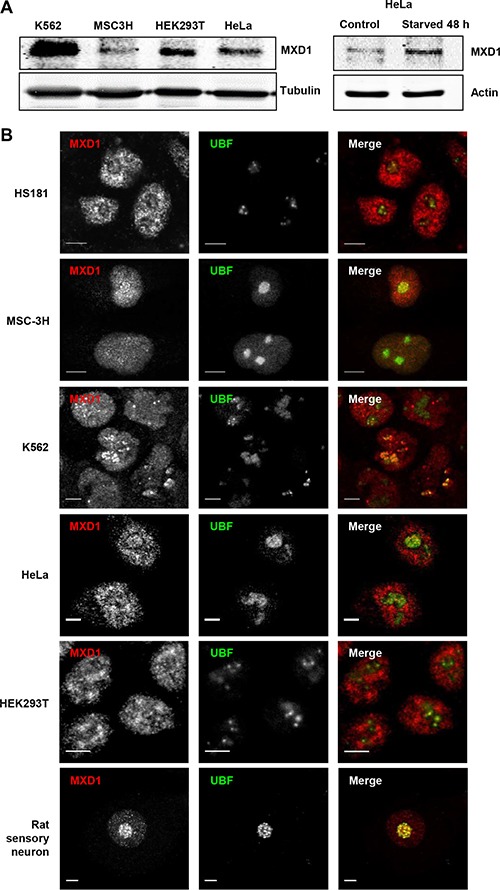
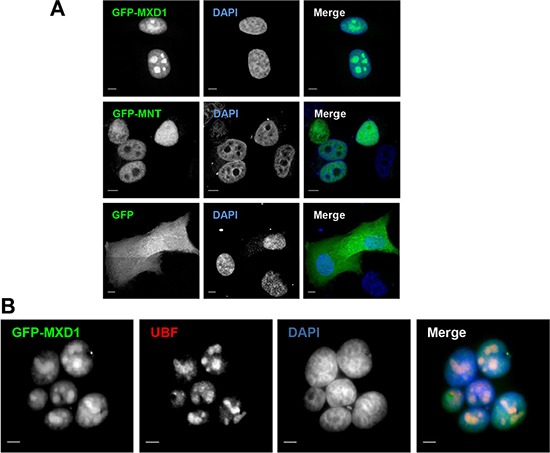
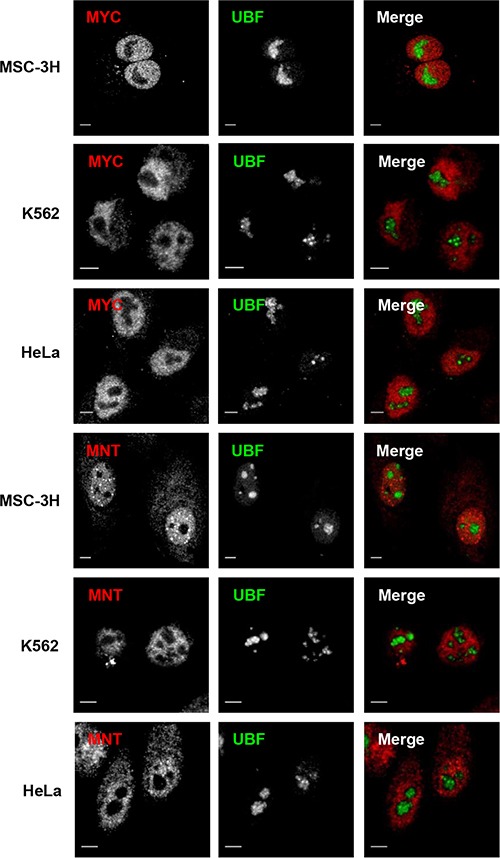
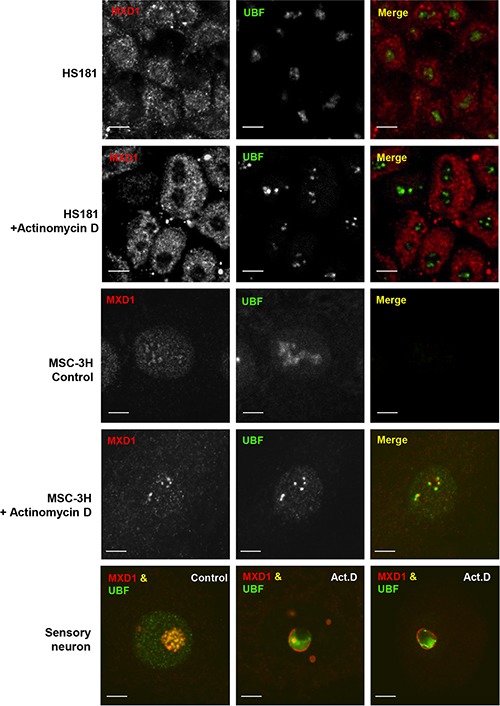
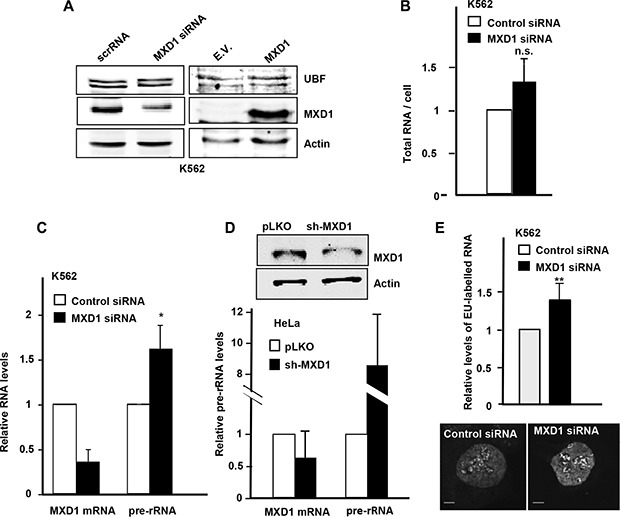
MXD1 is a protein that interacts with MAX, to form a repressive transcription factor. MXD1-MAX binds E-boxes. MXD1-MAX antagonizes the transcriptional activity of the MYC oncoprotein in most models. It has been reported that MYC overexpression leads to augmented RNA synthesis and ribosome biogenesis, which is a relevant activity in MYC-mediated tumorigenesis. Here we describe that MXD1, but not MYC or MNT, localizes to the nucleolus in a wide array of cell lines derived from different tissues (carcinoma, leukemia) as well as in embryonic stem cells. MXD1 also localizes in the nucleolus of primary tissue cells as neurons and Sertoli cells. The nucleolar localization of MXD1 was confirmed by co-localization with UBF. Co-immunoprecipitation experiments showed that MXD1 interacted with UBF and proximity ligase assays revealed that this interaction takes place in the nucleolus. Furthermore, chromatin immunoprecipitation assays showed that MXD1 was bound in the transcribed rDNA chromatin, where it co-localizes with UBF, but also in the ribosomal intergenic regions. The MXD1 involvement in rRNA synthesis was also suggested by the nucleolar segregation upon rRNA synthesis inhibition by actinomycin D. Silencing of MXD1 with siRNAs resulted in increased synthesis of pre-rRNA while enforced MXD1 expression reduces it. The results suggest a new role for MXD1, which is the control of ribosome biogenesis. This new MXD1 function would be important to curb MYC activity in tumor cells.
MXD1是一种与MAX相互作用以形成抑制性转录因子的蛋白质。MXD1 - MAX结合E - 盒。在大多数模型中,MXD1 - MAX拮抗MYC癌蛋白的转录活性。据报道,MYC过表达导致RNA合成和核糖体生物发生增加,这是MYC介导的肿瘤发生中的一种相关活动。在此我们描述,在源自不同组织(癌、白血病)的多种细胞系以及胚胎干细胞中,MXD1而非MYC或MNT定位于核仁。MXD1也定位于原代组织细胞如神经元和支持细胞的核仁中。MXD1与UBF共定位证实了其核仁定位。免疫共沉淀实验表明MXD1与UBF相互作用,邻近连接分析显示这种相互作用发生在核仁中。此外,染色质免疫沉淀分析表明MXD1结合在转录的rDNA染色质中,在那里它与UBF共定位,也结合在核糖体基因间区域。放线菌素D抑制rRNA合成后核仁分离也提示MXD1参与rRNA合成。用小干扰RNA沉默MXD1导致前体rRNA合成增加,而强制表达MXD1则降低其合成。这些结果提示MXD1有一个新作用,即控制核糖体生物发生。MXD1的这一新功能对于抑制肿瘤细胞中的MYC活性可能很重要。