• 文献检索
  • 文档翻译
  • 深度研究
  • 学术资讯
  • Suppr Zotero 插件Zotero 插件
  • 邀请有礼
  • 套餐&价格
  • 历史记录
应用&插件
Suppr Zotero 插件Zotero 插件浏览器插件Mac 客户端Windows 客户端微信小程序
定价
高级版会员购买积分包购买API积分包
服务
文献检索文档翻译深度研究API 文档MCP 服务
关于我们
关于 Suppr公司介绍联系我们用户协议隐私条款
关注我们

Suppr 超能文献

核心技术专利:CN118964589B侵权必究
粤ICP备2023148730 号-1Suppr @ 2026

文献检索

告别复杂PubMed语法,用中文像聊天一样搜索,搜遍4000万医学文献。AI智能推荐,让科研检索更轻松。

立即免费搜索

文件翻译

保留排版,准确专业,支持PDF/Word/PPT等文件格式,支持 12+语言互译。

免费翻译文档

深度研究

AI帮你快速写综述,25分钟生成高质量综述,智能提取关键信息,辅助科研写作。

立即免费体验

人类病原体在室内空气传播的一般情况及新兴空气净化技术。

Generic aspects of the airborne spread of human pathogens indoors and emerging air decontamination technologies.

作者信息

Ijaz M Khalid, Zargar Bahram, Wright Kathryn E, Rubino Joseph R, Sattar Syed A

机构信息

RB, Montvale, NJ; Department of Biology, Medgar Evers College of the City University of New York (CUNY), Brooklyn, NY.

Department of Biochemistry, Microbiology, and Immunology, University of Ottawa, Ottawa, ON, Canada.

出版信息

Am J Infect Control. 2016 Sep 2;44(9 Suppl):S109-20. doi: 10.1016/j.ajic.2016.06.008.

DOI:10.1016/j.ajic.2016.06.008
PMID:27590695
原文链接:https://pmc.ncbi.nlm.nih.gov/articles/PMC7115269/
Abstract

Indoor air can be an important vehicle for a variety of human pathogens. This review provides examples of airborne transmission of infectious agents from experimental and field studies and discusses how airborne pathogens can contaminate other parts of the environment to give rise to secondary vehicles leading air-surface-air nexus with possible transmission to susceptible hosts. The following groups of human pathogens are covered because of their known or potential airborne spread: vegetative bacteria (staphylococci and legionellae), fungi (Aspergillus, Penicillium, and Cladosporium spp and Stachybotrys chartarum), enteric viruses (noro- and rotaviruses), respiratory viruses (influenza and coronaviruses), mycobacteria (tuberculous and nontuberculous), and bacterial spore formers (Clostridium difficile and Bacillus anthracis). An overview of methods for experimentally generating and recovering airborne human pathogens is included, along with a discussion of factors that influence microbial survival in indoor air. Available guidelines from the U.S. Environmental Protection Agency and other global regulatory bodies for the study of airborne pathogens are critically reviewed with particular reference to microbial surrogates that are recommended. Recent developments in experimental facilities to contaminate indoor air with microbial aerosols are presented, along with emerging technologies to decontaminate indoor air under field-relevant conditions. Furthermore, the role that air decontamination may play in reducing the contamination of environmental surfaces and its combined impact on interrupting the risk of pathogen spread in both domestic and institutional settings is discussed.

摘要

室内空气可能是多种人类病原体的重要传播媒介。本综述提供了来自实验研究和现场研究的病原体空气传播实例,并讨论了空气传播的病原体如何污染环境的其他部分,从而产生二次传播媒介,形成空气-表面-空气联系,并有可能传播给易感宿主。由于已知或潜在的空气传播,以下几类人类病原体被纳入讨论范围:营养细菌(葡萄球菌和军团菌)、真菌(曲霉属、青霉属、枝孢属和炭疽杆菌)、肠道病毒(诺如病毒和轮状病毒)、呼吸道病毒(流感病毒和冠状病毒)、分枝杆菌(结核分枝杆菌和非结核分枝杆菌)以及产芽孢细菌(艰难梭菌和炭疽芽孢杆菌)。本文还概述了实验性生成和回收空气传播的人类病原体的方法,以及对影响室内空气中微生物存活因素的讨论。对美国环境保护局和其他全球监管机构提供的关于空气传播病原体研究的现有指南进行了批判性审查,特别提及了推荐的微生物替代物。介绍了用微生物气溶胶污染室内空气的实验设施的最新进展,以及在实际环境条件下净化室内空气的新兴技术。此外,还讨论了空气净化在减少环境表面污染方面可能发挥的作用,以及其对中断家庭和机构环境中病原体传播风险的综合影响。
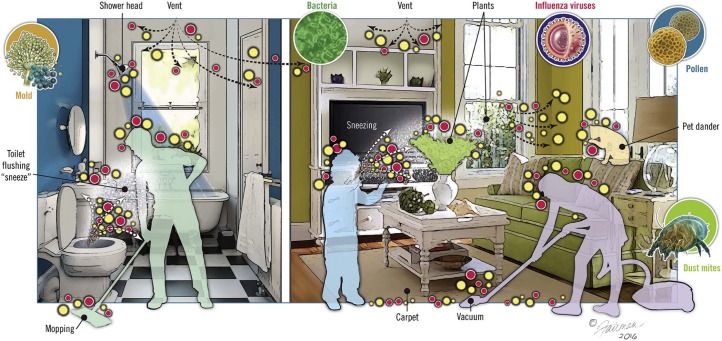
https://cdn.ncbi.nlm.nih.gov/pmc/blobs/75ca/7115269/00c6dbf8fff8/ymic4059-fig-0006_lrg.jpg
https://cdn.ncbi.nlm.nih.gov/pmc/blobs/75ca/7115269/232969f59697/ymic4059-fig-0001_lrg.jpg
https://cdn.ncbi.nlm.nih.gov/pmc/blobs/75ca/7115269/7b047835ab85/ymic4059-fig-0002_lrg.jpg
https://cdn.ncbi.nlm.nih.gov/pmc/blobs/75ca/7115269/70ca810045a9/ymic4059-fig-0003_lrg.jpg
https://cdn.ncbi.nlm.nih.gov/pmc/blobs/75ca/7115269/df704a7a5f9d/ymic4059-fig-0004_lrg.jpg
https://cdn.ncbi.nlm.nih.gov/pmc/blobs/75ca/7115269/5d507618c59f/ymic4059-fig-0005_lrg.jpg
https://cdn.ncbi.nlm.nih.gov/pmc/blobs/75ca/7115269/00c6dbf8fff8/ymic4059-fig-0006_lrg.jpg
https://cdn.ncbi.nlm.nih.gov/pmc/blobs/75ca/7115269/232969f59697/ymic4059-fig-0001_lrg.jpg
https://cdn.ncbi.nlm.nih.gov/pmc/blobs/75ca/7115269/7b047835ab85/ymic4059-fig-0002_lrg.jpg
https://cdn.ncbi.nlm.nih.gov/pmc/blobs/75ca/7115269/70ca810045a9/ymic4059-fig-0003_lrg.jpg
https://cdn.ncbi.nlm.nih.gov/pmc/blobs/75ca/7115269/df704a7a5f9d/ymic4059-fig-0004_lrg.jpg
https://cdn.ncbi.nlm.nih.gov/pmc/blobs/75ca/7115269/5d507618c59f/ymic4059-fig-0005_lrg.jpg
https://cdn.ncbi.nlm.nih.gov/pmc/blobs/75ca/7115269/00c6dbf8fff8/ymic4059-fig-0006_lrg.jpg

相似文献

1
Generic aspects of the airborne spread of human pathogens indoors and emerging air decontamination technologies.人类病原体在室内空气传播的一般情况及新兴空气净化技术。
Am J Infect Control. 2016 Sep 2;44(9 Suppl):S109-20. doi: 10.1016/j.ajic.2016.06.008.
2
Assessing microbial decontamination of indoor air with particular focus on human pathogenic viruses.评估室内空气中的微生物净化情况,特别关注人类致病病毒。
Am J Infect Control. 2016 Sep 2;44(9 Suppl):S121-6. doi: 10.1016/j.ajic.2016.06.009.
3
Indoor air as a vehicle for human pathogens: Introduction, objectives, and expectation of outcome.室内空气作为人类病原体的传播媒介:引言、目标及预期结果
Am J Infect Control. 2016 Sep 2;44(9 Suppl):S95-S101. doi: 10.1016/j.ajic.2016.06.010.
4
Decontamination of indoor air to reduce the risk of airborne infections: Studies on survival and inactivation of airborne pathogens using an aerobiology chamber.室内空气净化以降低空气传播感染风险:利用空气生物学舱对空气传播病原体的存活和灭活研究
Am J Infect Control. 2016 Oct 1;44(10):e177-e182. doi: 10.1016/j.ajic.2016.03.067. Epub 2016 Jun 30.
5
A quantitative method to assess the role of indoor air decontamination to simultaneously reduce contamination of environmental surfaces: testing with vegetative and spore-forming bacteria.一种评估室内空气净化对同时减少环境表面污染作用的定量方法:使用营养型细菌和产芽孢细菌进行测试
Lett Appl Microbiol. 2019 Mar;68(3):206-211. doi: 10.1111/lam.13109. Epub 2019 Jan 21.
6
Airborne spread of infectious agents in the indoor environment.室内环境中传染源的空气传播。
Am J Infect Control. 2016 Sep 2;44(9 Suppl):S102-8. doi: 10.1016/j.ajic.2016.06.003.
7
Direct and quantitative capture of viable bacteriophages from experimentally contaminated indoor air: A model for the study of airborne vertebrate viruses including SARS-CoV-2.从实验污染的室内空气中直接定量捕获有活力的噬菌体:研究包括 SARS-CoV-2 在内的空气传播脊椎动物病毒的模型。
J Appl Microbiol. 2022 Feb;132(2):1489-1495. doi: 10.1111/jam.15262. Epub 2021 Aug 28.
8
Relation of indoor and outdoor airborne fungal spore levels in the Kansas City metropolitan area.堪萨斯城都会区室内外空气传播真菌孢子水平的关系。
Allergy Asthma Proc. 2017 Mar 1;38(2):130-135. doi: 10.2500/aap.2017.38.4030.
9
Airborne Pathogens inside Automobiles for Domestic Use: Assessing In-Car Air Decontamination Devices Using Staphylococcus aureus as the Challenge Bacterium.家用汽车内的空气传播病原体:以金黄色葡萄球菌为挑战细菌评估车内空气净化装置
Appl Environ Microbiol. 2017 May 1;83(10). doi: 10.1128/AEM.00258-17. Print 2017 May 15.
10
[Airborne fungal community composition in indoor environments in Beijing].[北京室内环境中的空气传播真菌群落组成]
Huan Jing Ke Xue. 2013 May;34(5):2031-7.

引用本文的文献

1
Virucidal Efficacy of Organic Acids and Plant Essential Oils.有机酸和植物精油的杀病毒效果
Food Environ Virol. 2025 Aug 29;17(3):47. doi: 10.1007/s12560-025-09660-4.
2
Bioaerosols and Airway Diseases: Mechanisms of Epithelial Dysfunction, Immune Activation, and Strategies for Exposure Mitigation.生物气溶胶与气道疾病:上皮功能障碍、免疫激活机制及暴露缓解策略
Arch Intern Med Res. 2025;8(3):178-191. doi: 10.26502/aimr.0210. Epub 2025 Jul 3.
3
Effects and health risk assessments of different spray disinfectants on microbial aerosols in chicken houses.

本文引用的文献

1
Decontamination of indoor air to reduce the risk of airborne infections: Studies on survival and inactivation of airborne pathogens using an aerobiology chamber.室内空气净化以降低空气传播感染风险:利用空气生物学舱对空气传播病原体的存活和灭活研究
Am J Infect Control. 2016 Oct 1;44(10):e177-e182. doi: 10.1016/j.ajic.2016.03.067. Epub 2016 Jun 30.
2
Evaporation and dispersion of respiratory droplets from coughing.咳嗽时呼吸道飞沫的蒸发与扩散。
Indoor Air. 2017 Jan;27(1):179-190. doi: 10.1111/ina.12297. Epub 2016 Mar 23.
3
Profile and Morphology of Fungal Aerosols Characterized by Field Emission Scanning Electron Microscopy (FESEM).
不同喷雾消毒剂对鸡舍微生物气溶胶的影响及健康风险评估
Poult Sci. 2025 May;104(5):105083. doi: 10.1016/j.psj.2025.105083. Epub 2025 Mar 21.
4
Resuspension and Dissemination of MS2 Virus from Flooring After Human Activities in Built Environment: Impact of Dust Particles.室内环境中人类活动后地板上MS2病毒的再悬浮与传播:尘埃颗粒的影响
Microorganisms. 2024 Dec 12;12(12):2564. doi: 10.3390/microorganisms12122564.
5
Rapid virucidal activity of an air sanitizer against aerosolized MS2 and Phi6 phage surrogates for non-enveloped and enveloped vertebrate viruses, including SARS-CoV-2.一种空气消毒剂对雾化的MS2和Phi6噬菌体替代物具有快速杀病毒活性,这些替代物可代表包括SARS-CoV-2在内的无包膜和有包膜脊椎动物病毒。
Appl Environ Microbiol. 2025 Jan 31;91(1):e0142624. doi: 10.1128/aem.01426-24. Epub 2024 Dec 6.
6
The Determination of the Rapid and Effective Activity of an Air Sanitizer against Aerosolized Bacteria Using a Room-Sized Aerobiology Chamber.使用房间大小的空气生物学舱测定空气消毒剂对雾化细菌的快速有效活性
Microorganisms. 2024 Oct 16;12(10):2072. doi: 10.3390/microorganisms12102072.
7
Evaluate the safety of a novel photohydrolysis technology used to clean and disinfect indoor air: A murine study.评价一种新型光水解技术用于室内空气清洁和消毒的安全性:一项鼠类研究。
PLoS One. 2024 Oct 9;19(10):e0307031. doi: 10.1371/journal.pone.0307031. eCollection 2024.
8
Recent progress in online detection methods of bioaerosols.生物气溶胶在线检测方法的最新进展。
Fundam Res. 2023 Jun 4;4(3):442-454. doi: 10.1016/j.fmre.2023.05.012. eCollection 2024 May.
9
A comprehensive review of microbial contamination in the indoor environment: sources, sampling, health risks, and mitigation strategies.室内环境中微生物污染的综合评述:来源、采样、健康风险和缓解策略。
Front Public Health. 2023 Nov 23;11:1285393. doi: 10.3389/fpubh.2023.1285393. eCollection 2023.
10
Environmental dissemination of respiratory viruses: dynamic interdependencies of respiratory droplets, aerosols, aerial particulates, environmental surfaces, and contribution of viral re-aerosolization.呼吸道病毒的环境传播:呼吸道飞沫、气溶胶、空气颗粒、环境表面的动态相互依存关系,以及病毒再气溶胶化的作用。
PeerJ. 2023 Nov 24;11:e16420. doi: 10.7717/peerj.16420. eCollection 2023.
用场发射扫描电子显微镜(FESEM)表征的真菌气溶胶的轮廓和形态
Aerosol Sci Technol. 2015;49(6):423-435. doi: 10.1080/02786826.2015.1040486. Epub 2015 Apr 18.
4
Release and characteristics of fungal fragments in various conditions.不同条件下真菌碎片的释放及特征
Sci Total Environ. 2016 Mar 15;547:234-243. doi: 10.1016/j.scitotenv.2015.12.095. Epub 2016 Jan 11.
5
Sources of airborne microorganisms in the built environment.建筑环境中空气传播微生物的来源。
Microbiome. 2015 Dec 22;3:78. doi: 10.1186/s40168-015-0144-z.
6
Influenza virus emitted by naturally-infected hosts in a healthcare setting.在医疗环境中,由自然感染宿主释放的流感病毒。
J Clin Virol. 2015 Dec;73:105-107. doi: 10.1016/j.jcv.2015.11.002. Epub 2015 Nov 4.
7
Humans differ in their personal microbial cloud.人类的个人微生物云各不相同。
PeerJ. 2015 Sep 22;3:e1258. doi: 10.7717/peerj.1258. eCollection 2015.
8
Influenza virus survival in aerosols and estimates of viable virus loss resulting from aerosolization and air-sampling.流感病毒在气溶胶中的存活情况,以及气溶胶化和空气采样导致有活力的病毒损失的估计。
J Hosp Infect. 2015 Nov;91(3):278-81. doi: 10.1016/j.jhin.2015.08.004. Epub 2015 Aug 24.
9
Aerosol transmission of infectious disease.传染病的气溶胶传播
J Occup Environ Med. 2015 May;57(5):501-8. doi: 10.1097/JOM.0000000000000448.
10
Transmission of Ebola viruses: what we know and what we do not know.埃博拉病毒的传播:我们已知与未知的情况
mBio. 2015 Feb 19;6(2):e00137. doi: 10.1128/mBio.00137-15.