Loret de Mola Christian, Hartwig Fernando Pires, Gonçalves Helen, Quevedo Luciana de Avila, Pinheiro Ricardo, Gigante Denise Petrucci, Motta Janaína Vieira Dos Santos, Pereira Alexandre C, Barros Fernando C, Horta Bernardo Lessa
Postgraduate Program in Epidemiology, Federal University of Pelotas, Rua Marechal Deodoro, 1160 - 3° Piso, Bairro Centro. Cep: 96020-220, Caixa Postal 464, Pelotas, RS, Brazil.
Health and Behavior Postgraduate Program, Universidade Católica de Pelotas - UCPEL, Rua Gonçalves Chaves, 377 - sala 411, prédio C. CEP: 96015-560, Pelotas, RS, Brazil.
BMC Psychiatry. 2016 Sep 5;16(1):308. doi: 10.1186/s12888-016-1015-2.
Evidence suggests that there is an association between ethnicity/skin color and depression; however, many contextual and individual variables, like sense of discrimination and socioeconomic position (SEP), might influence the direction of this association. We assessed the association between African ancestry and major depression among young adults that have been followed-up since birth in a Southern Brazilian city, and the mediating effect of SEP and discrimination.
In 1982, all hospital deliveries in Pelotas (Southern Brazil) were identified; liveborns were examined and their mothers interviewed (n = 5914). In 2012-13, at 30 years of age, we used the Mini International Neuropsychiatric Interview (MINI) for major depression diagnosis. In addition, DNA samples were genotyped for approximately 2.5 million single nucleotide polymorphisms (SNPs) using Illumina (CA, USA) HumanOmni2.5-8v1 array. Genomic ancestry estimation was based on approximately 370 000 single nucleotide polymorphisms (SNPs) mutually available for the Pelotas cohort and selected samples (used as reference panels) of the HapMap and Human Genome Diversity (HGDP). We estimated prevalence ratios (PR) using Poisson regression models and evaluated the association between percentage of African ancestry and major depression. We used G-computation for mediation analysis.
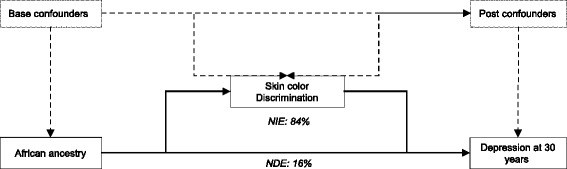
At 30 years, 3576 individuals were evaluated for major depression (prevalence = 7.9 %). Only individuals in the highest SEP, who had a percentage of African ancestry between >5-30 % and >30 % had a prevalence of major depression 2.16 (PR = 2.16 95 % CI [1.05-4.45]) and 2.74 (PR = 2.74 95 % CI [1.06-7.06]) times higher, than those with 5 % or less, respectively. Among these subjects, sense of discrimination by skin color, captured 84 % of the association between African ancestry and major depression.
SEP is an important effect modifier of the positive association between African ancestry and major depression. In addition, this association is predominantly mediated by the sense of feeling discriminated by skin color.
有证据表明种族/肤色与抑郁症之间存在关联;然而,许多背景和个体变量,如歧视感和社会经济地位(SEP),可能会影响这种关联的方向。我们评估了巴西南部一个城市自出生起就接受随访的年轻人中非洲血统与重度抑郁症之间的关联,以及SEP和歧视的中介作用。
1982年,确定了佩洛塔斯(巴西南部)所有的医院分娩情况;对活产婴儿进行了检查,并对其母亲进行了访谈(n = 5914)。2012 - 2013年,在这些婴儿30岁时,我们使用迷你国际神经精神病学访谈(MINI)进行重度抑郁症诊断。此外,使用Illumina(美国加利福尼亚州)HumanOmni2.5 - 8v1芯片对DNA样本进行约250万个单核苷酸多态性(SNP)的基因分型。基因组血统估计基于佩洛塔斯队列和约37万个可与HapMap和人类基因组多样性(HGDP)的选定样本(用作参考面板)共同使用的单核苷酸多态性(SNP)。我们使用泊松回归模型估计患病率比(PR),并评估非洲血统百分比与重度抑郁症之间的关联。我们使用G计算进行中介分析。
在30岁时,对3576名个体进行了重度抑郁症评估(患病率 = 7.9%)。只有社会经济地位最高的个体,其非洲血统百分比在>5 - 30%和>30%之间时,重度抑郁症患病率分别比非洲血统百分比为5%或更低的个体高2.16倍(PR = 2.16,95%可信区间[1.05 - 4.45])和2.74倍(PR = 2.74,95%可信区间[1.06 - 7.06])。在这些受试者中,肤色歧视感占非洲血统与重度抑郁症之间关联的84%。
SEP是非洲血统与重度抑郁症之间正相关的重要效应修饰因素。此外,这种关联主要由肤色歧视感介导。