Kipanyula Maulilio John, Kimaro Wahabu Hamisi, Seke Etet Paul F
Department of Veterinary Anatomy, Faculty of Veterinary Medicine, Sokoine University of Agriculture, P.O. Box 3016, Chuo Kikuu, Morogoro, Tanzania.
Department of Basic Health Sciences, Qassim University, Buraydah, Al-Qassim 51452, Saudi Arabia.
J Aging Res. 2016;2016:5081021. doi: 10.1155/2016/5081021. Epub 2016 Aug 15.
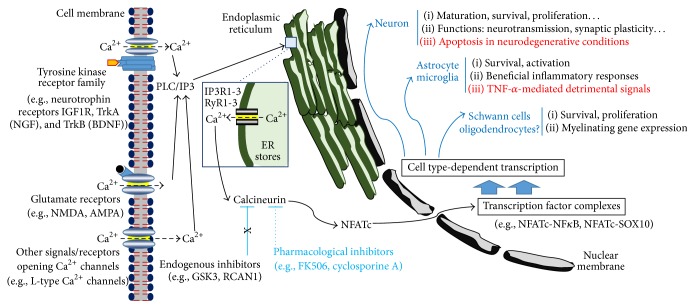
The ongoing epidemics of metabolic diseases and increase in the older population have increased the incidences of neurodegenerative diseases. Evidence from murine and cell line models has implicated calcineurin-nuclear factor of activated T-lymphocytes (NFAT) signaling pathway, a Ca(2+)/calmodulin-dependent major proinflammatory pathway, in the pathogenesis of these diseases. Neurotoxins such as amyloid-β, tau protein, and α-synuclein trigger abnormal calcineurin/NFAT signaling activities. Additionally increased activities of endogenous regulators of calcineurin like plasma membrane Ca(2+)-ATPase (PMCA) and regulator of calcineurin 1 (RCAN1) also cause neuronal and glial loss and related functional alterations, in neurodegenerative diseases, psychotic disorders, epilepsy, and traumatic brain and spinal cord injuries. Treatment with calcineurin/NFAT inhibitors induces some degree of neuroprotection and decreased reactive gliosis in the central and peripheral nervous system. In this paper, we summarize and discuss the current understanding of the roles of calcineurin/NFAT signaling in physiology and pathologies of the adult and developing nervous system, with an emphasis on recent reports and cutting-edge findings. Calcineurin/NFAT signaling is known for its critical roles in the developing and adult nervous system. Its role in physiological and pathological processes is still controversial. However, available data suggest that its beneficial and detrimental effects are context-dependent. In view of recent reports calcineurin/NFAT signaling is likely to serve as a potential therapeutic target for neurodegenerative diseases and conditions. This review further highlights the need to characterize better all factors determining the outcome of calcineurin/NFAT signaling in diseases and the downstream targets mediating the beneficial and detrimental effects.
代谢疾病的持续流行以及老年人口的增加,使得神经退行性疾病的发病率上升。来自小鼠和细胞系模型的证据表明,钙调神经磷酸酶-活化T淋巴细胞核因子(NFAT)信号通路,一种Ca(2+)/钙调蛋白依赖性主要促炎途径,参与了这些疾病的发病机制。淀粉样β蛋白、tau蛋白和α-突触核蛋白等神经毒素会引发异常的钙调神经磷酸酶/NFAT信号活动。此外,钙调神经磷酸酶内源性调节因子如质膜Ca(2+)-ATP酶(PMCA)和钙调神经磷酸酶调节因子1(RCAN1)的活性增加,在神经退行性疾病、精神障碍、癫痫以及脑和脊髓创伤性损伤中,也会导致神经元和神经胶质细胞丢失以及相关功能改变。用钙调神经磷酸酶/NFAT抑制剂进行治疗可在中枢和外周神经系统中诱导一定程度的神经保护作用,并减少反应性胶质增生。在本文中,我们总结并讨论了目前对钙调神经磷酸酶/NFAT信号在成年和发育中神经系统的生理和病理作用的理解,重点关注近期报道和前沿发现。钙调神经磷酸酶/NFAT信号在发育中和成年神经系统中发挥着关键作用,这是众所周知的。其在生理和病理过程中的作用仍存在争议。然而,现有数据表明其有益和有害作用取决于具体情况。鉴于近期的报道,钙调神经磷酸酶/NFAT信号可能成为神经退行性疾病和病症的潜在治疗靶点。本综述进一步强调了更好地表征所有决定疾病中钙调神经磷酸酶/NFAT信号结果的因素以及介导有益和有害作用的下游靶点的必要性。