Jandhyala Dakshina M, Wong John, Mantis Nicholas J, Magun Bruce E, Leong John M, Thorpe Cheleste M
Department of Molecular Biology and Microbiology, Tufts University School of Medicine, Boston, MA 02111, USA.
Division of Geographic Medicine and Infectious Diseases, Tufts Medical Center, Boston, MA 02111, USA.
Toxins (Basel). 2016 Sep 2;8(9):259. doi: 10.3390/toxins8090259.
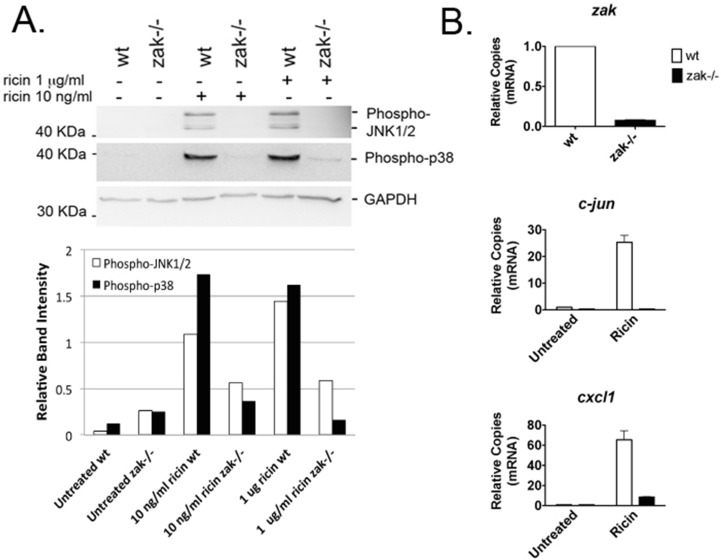
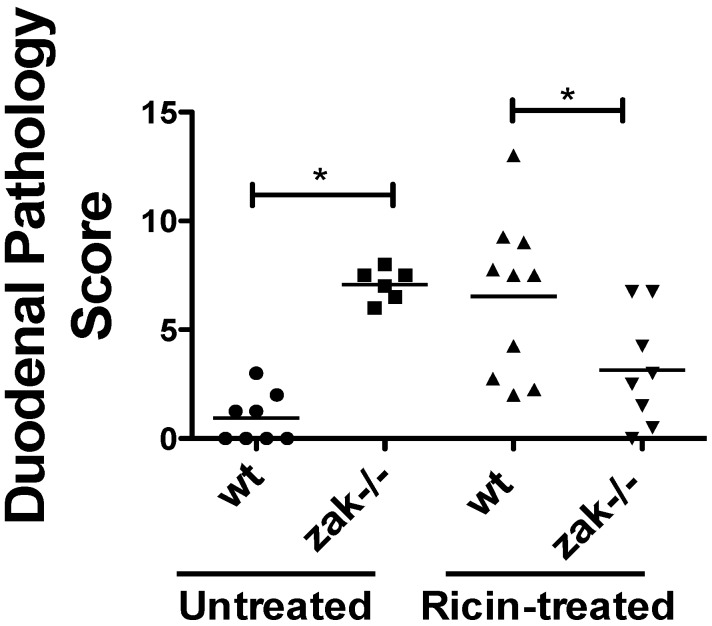
Ricin activates the proinflammatory ribotoxic stress response through the mitogen activated protein 3 kinase (MAP3K) ZAK, resulting in activation of mitogen activated protein kinases (MAPKs) p38 and JNK1/2. We had a novel zak-/- mouse generated to study the role of ZAK signaling in vivo during ricin intoxication. To characterize this murine strain, we intoxicated zak-/- and zak+/+ bone marrow-derived murine macrophages with ricin, measured p38 and JNK1/2 activation by Western blot, and measured zak, c-jun, and cxcl-1 expression by qRT-PCR. To determine whether zak-/- mice differed from wild-type mice in their in vivo response to ricin, we performed oral ricin intoxication experiments with zak+/+ and zak-/- mice, using blinded histopathology scoring of duodenal tissue sections to determine differences in tissue damage. Unlike macrophages derived from zak+/+ mice, those derived from the novel zak-/- strain fail to activate p38 and JNK1/2 and have decreased c-jun and cxcl-1 expression following ricin intoxication. Furthermore, compared with zak+/+ mice, zak-/- mice have decreased duodenal damage following in vivo ricin challenge. zak-/- mice demonstrate a distinct ribotoxic stress-associated phenotype in response to ricin and therefore provide a new animal model for in vivo studies of ZAK signaling.
蓖麻毒素通过丝裂原活化蛋白3激酶(MAP3K)ZAK激活促炎性核糖体毒性应激反应,导致丝裂原活化蛋白激酶(MAPK)p38和JNK1/2活化。我们培育了一种新型的zak-/-小鼠,以研究ZAK信号在蓖麻毒素中毒体内过程中的作用。为了表征该小鼠品系,我们用蓖麻毒素处理zak-/-和zak+/+骨髓来源的小鼠巨噬细胞,通过蛋白质印迹法检测p38和JNK1/2的活化情况,并通过qRT-PCR检测zak、c-jun和cxcl-1的表达。为了确定zak-/-小鼠在体内对蓖麻毒素的反应是否与野生型小鼠不同,我们对zak+/+和zak-/-小鼠进行了口服蓖麻毒素中毒实验,使用十二指肠组织切片的盲法组织病理学评分来确定组织损伤的差异。与源自zak+/+小鼠的巨噬细胞不同,源自新型zak-/-品系的巨噬细胞在蓖麻毒素中毒后未能激活p38和JNK1/2,且c-jun和cxcl-1表达降低。此外,与zak+/+小鼠相比,zak-/-小鼠在体内蓖麻毒素攻击后十二指肠损伤减轻。zak-/-小鼠在对蓖麻毒素的反应中表现出独特的核糖体毒性应激相关表型,因此为ZAK信号的体内研究提供了一种新的动物模型。