Wei Kuo-Chen, Lin Feng-Wei, Huang Chiung-Yin, Ma Chen-Chi M, Chen Ju-Yu, Feng Li-Ying, Yang Hung-Wei
Department of Neurosurgery, Chang Gung Memorial Hospital, School of Medicine, Chang Gung University, Taoyuan.
Institute of Medical Science and Technology, National Sun Yat-sen University, Kaohsiung.
Int J Nanomedicine. 2016 Aug 23;11:4065-75. doi: 10.2147/IJN.S113589. eCollection 2016.
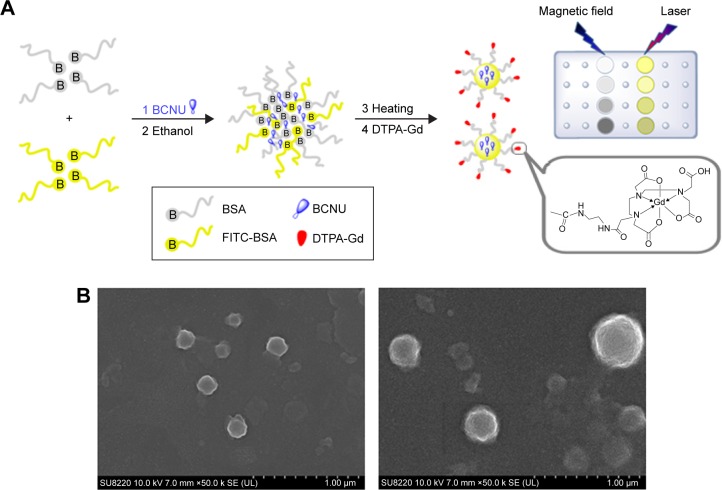
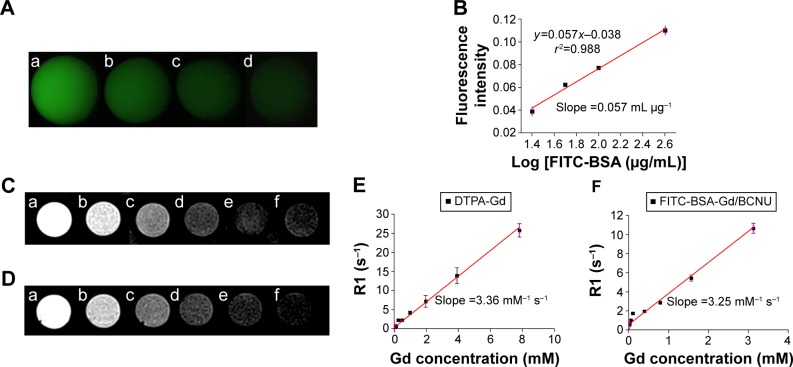
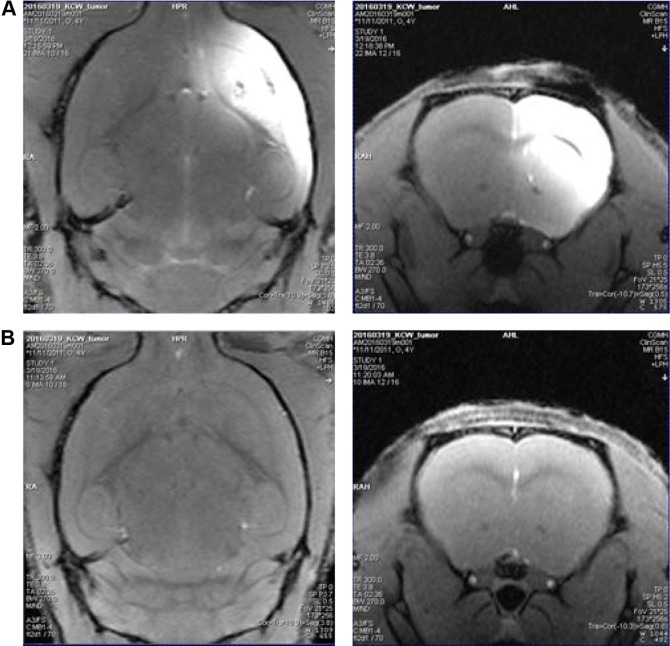
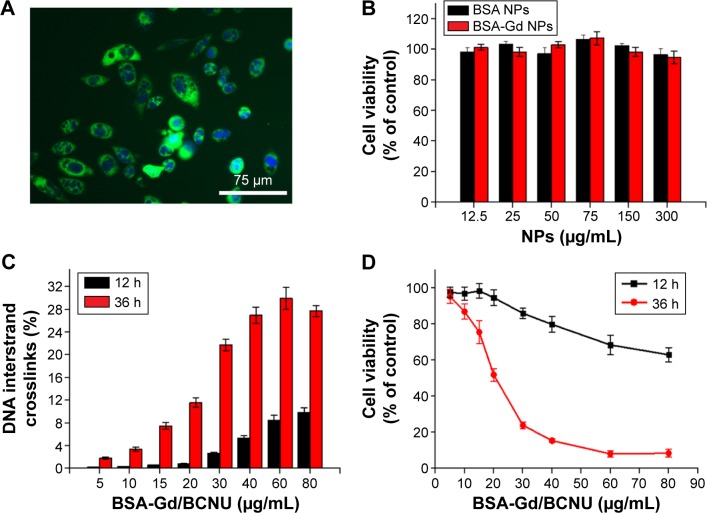
To date, knowing how to identify the location of chemotherapeutic agents in the human body after injection is still a challenge. Therefore, it is urgent to develop a drug delivery system with molecular imaging tracking ability to accurately understand the distribution, location, and concentration of a drug in living organisms. In this study, we developed bovine serum albumin (BSA)-based nanoparticles (NPs) with dual magnetic resonance (MR) and fluorescence imaging modalities (fluorescein isothiocyanate [FITC]-BSA-Gd/1,3-bis(2-chloroethyl)-1-nitrosourea [BCNU] NPs) to deliver BCNU for inhibition of brain tumor cells (MBR 261-2). These BSA-based NPs are water dispersible, stable, and biocompatible as confirmed by XTT cell viability assay. In vitro phantoms and in vivo MR and fluorescence imaging experiments show that the developed FITC-BSA-Gd/BCNU NPs enable dual MR and fluorescence imaging for monitoring cellular uptake and distribution in tumors. The T1 relaxivity (R1) of FITC-BSA-Gd/BCNU NPs was 3.25 mM(-1) s(-1), which was similar to that of the commercial T1 contrast agent (R1 =3.36 mM(-1) s(-1)). The results indicate that this multifunctional drug delivery system has potential bioimaging tracking of chemotherapeutic agents ability in vitro and in vivo for cancer therapy.
迄今为止,注射后如何确定化疗药物在人体内的位置仍是一项挑战。因此,迫切需要开发一种具有分子成像追踪能力的药物递送系统,以准确了解药物在生物体中的分布、位置和浓度。在本研究中,我们开发了具有双磁共振(MR)和荧光成像模式的基于牛血清白蛋白(BSA)的纳米颗粒(NPs)(异硫氰酸荧光素[FITC]-BSA-钆/1,3-双(2-氯乙基)-1-亚硝基脲[BCNU] NPs)来递送BCNU以抑制脑肿瘤细胞(MBR 261-2)。如XTT细胞活力测定所证实,这些基于BSA的NPs具有水分散性、稳定性和生物相容性。体外模型以及体内MR和荧光成像实验表明,所开发的FITC-BSA-Gd/BCNU NPs能够进行双MR和荧光成像,以监测细胞对肿瘤的摄取和分布情况。FITC-BSA-Gd/BCNU NPs的T1弛豫率(R1)为3.25 mM(-1) s(-1),与商用T1造影剂的弛豫率(R1 = 3.36 mM(-1) s(-1))相似。结果表明,这种多功能药物递送系统在体外和体内对化疗药物具有潜在的生物成像追踪能力,可用于癌症治疗。