Gu Ronghe, Liu Ning, Luo Simin, Huang Weiguo, Zha Zhengang, Yang Jie
Department of Orthopedics, The First Affiliated Hospital of Jinan University, Guangzhou Department of Orthopedics, The First People's Hospital of Nanning, Nanning, China.
Medicine (Baltimore). 2016 Sep;95(36):e4315. doi: 10.1097/MD.0000000000004315.
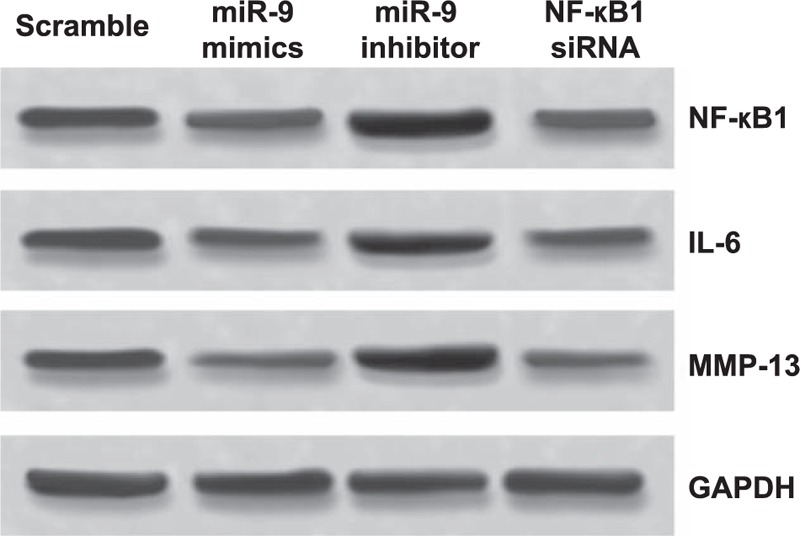
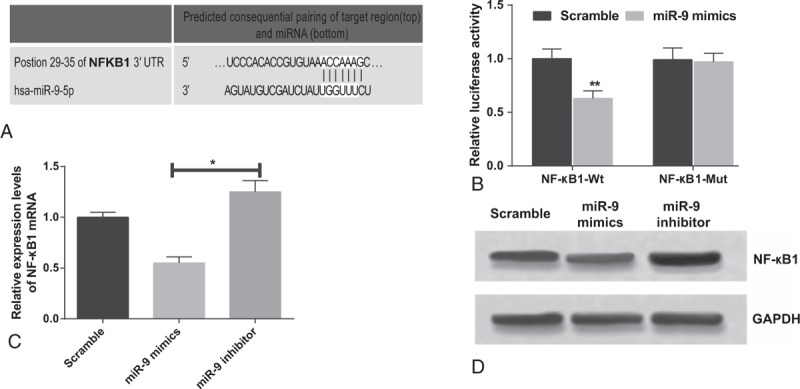
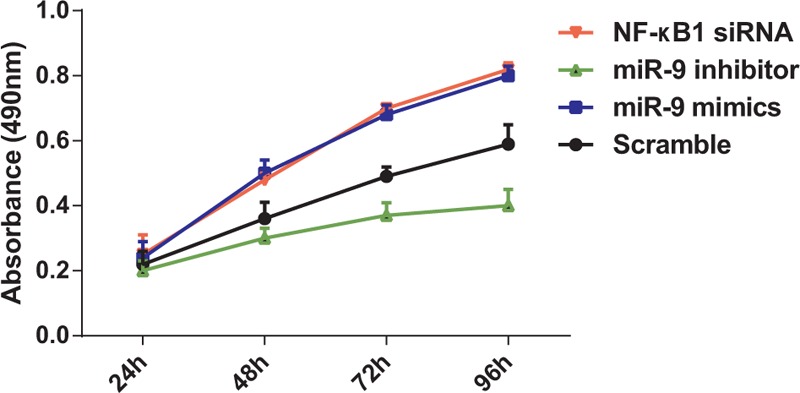
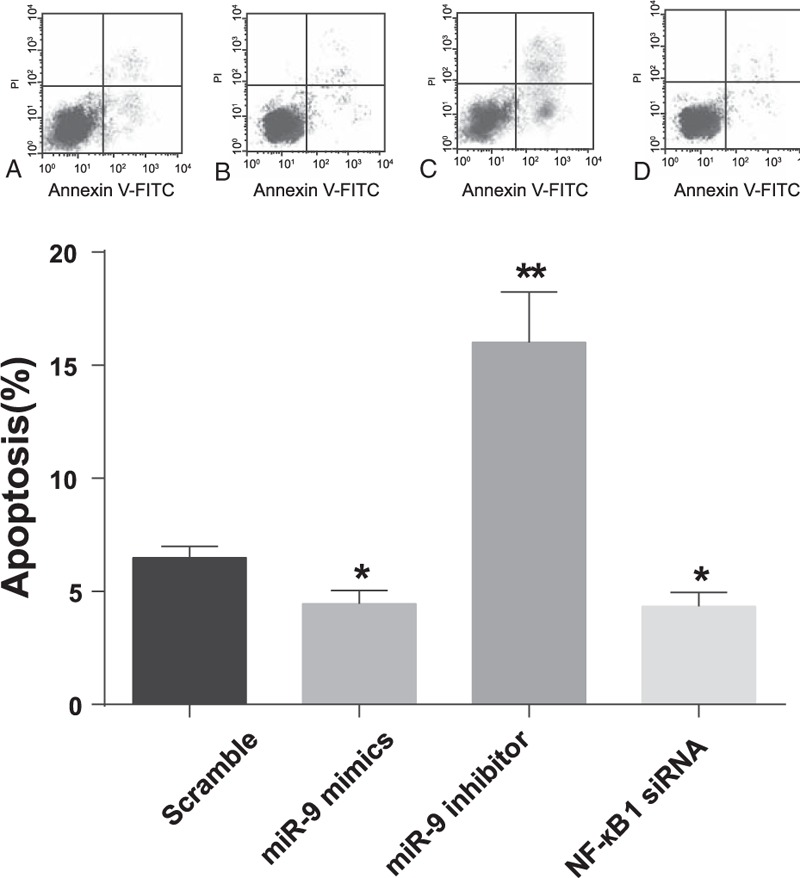
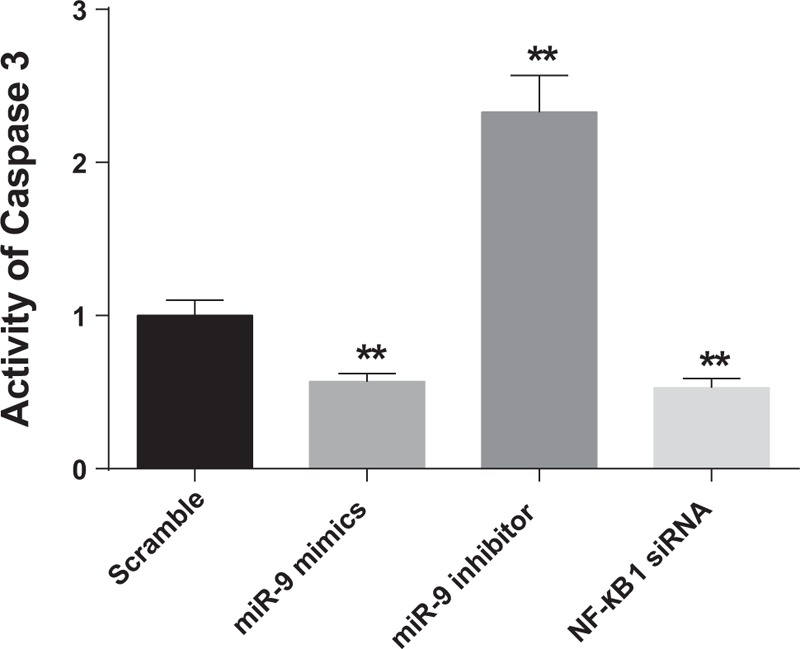
It has been suggested that microRNA-9 (miR-9) is associated with the development of knee osteoarthritis (OA). This study was aimed to investigate the association between the mechanism of miR-9 targeting nuclear factor kappa-B1 (NF-κB1) and the proliferation and apoptosis of knee OA chondrocytes.Cartilage samples were collected from 25 patients with knee OA and 10 traumatic amputees, and another 15 OA rat models, together with 15 rats without knee OA lesions were also established. MiR-9 expressions in both knee OA cartilage and normal cartilage samples were detected using quantitative real-time PCR. The expressions of related genes (NF-κB1, IL-6, and MMP-13) in the two groups were also detected. Dual luciferase reporter gene assay was employed to examine the effect of miR-9 on the luciferase activity of NF-κB1 3'UTR. Knee OA chondrocytes were transfected with miR-9 mimics, miR-9 inhibitor, and NF-κB1 siRNA, respectively, and changes in cellular proliferation and apoptosis were detected via MTT assay and flow cytometric analysis, respectively. Western blotting assay was used to detect the expressions of NF-κB1, interleukin-6 (IL-6), and matrix metalloproteinase-13 (MMP-13).According to results from human OA samples and rat OA models, miR-9 was significantly downregulated in knee OA cartilage tissues compared with normal cartilage tissues (P < 0.01). The expressions of NF-κB1, IL-6, and MMP-13 in knee OA cartilage tissues were significantly higher than those in normal cartilage tissues (P < 0.01). Dual luciferase reporter gene assay showed that miR-9 could bind to the 3'UTR of NF-κB1 and significantly inhibit the luciferase activity by 37% (P < 0.01). Upregulation of miR-9 or downregulation of NF-κB1 could promote cell proliferation and suppress cell apoptosis.Conclusively, downregulated miR-9 can facilitate proliferation and antiapoptosis of knee OA chondrocytes by directly binding to NF-kB1, implying that stimulating miR-9 expressions might assist in treatment of knee OA.
有人提出,微小RNA-9(miR-9)与膝关节骨关节炎(OA)的发展有关。本研究旨在探讨miR-9靶向核因子κB1(NF-κB1)的机制与膝关节OA软骨细胞增殖和凋亡之间的关系。收集了25例膝关节OA患者和10例创伤截肢者的软骨样本,另外还建立了15个OA大鼠模型以及15个无膝关节OA损伤的大鼠模型。使用定量实时PCR检测膝关节OA软骨和正常软骨样本中miR-9的表达。还检测了两组中相关基因(NF-κB1、白细胞介素-6(IL-6)和基质金属蛋白酶-13(MMP-13))的表达。采用双荧光素酶报告基因检测法检测miR-9对NF-κB1 3'UTR荧光素酶活性的影响。分别用miR-9模拟物、miR-9抑制剂和NF-κB1 siRNA转染膝关节OA软骨细胞,分别通过MTT法和流式细胞术分析检测细胞增殖和凋亡的变化。采用蛋白质免疫印迹法检测NF-κB1、白细胞介素-6(IL-6)和基质金属蛋白酶-13(MMP-13)的表达。根据人OA样本和大鼠OA模型的结果,与正常软骨组织相比,膝关节OA软骨组织中miR-9明显下调(P<0.01)。膝关节OA软骨组织中NF-κB1、IL-6和MMP-13的表达明显高于正常软骨组织(P<0.01)。双荧光素酶报告基因检测显示,miR-9可与NF-κB1的3'UTR结合,并显著抑制荧光素酶活性达37%(P<0.01)。上调miR-9或下调NF-κB1可促进细胞增殖并抑制细胞凋亡。总之,miR-9下调可通过直接结合NF-κB1促进膝关节OA软骨细胞的增殖和抗凋亡,这意味着刺激miR-9表达可能有助于膝关节OA的治疗。