Biological and Soft Systems, Cavendish Laboratory, University of Cambridge, JJ Thomson Avenue, Cambridge CB3 0HE, United Kingdom.
Department of Mechanical and Process Engineering, ETH Zurich, CLA H 1.1 Tannenstrasse 3, 8092 Zurich, Switzerland.
Sci Rep. 2016 Sep 8;6:32824. doi: 10.1038/srep32824.
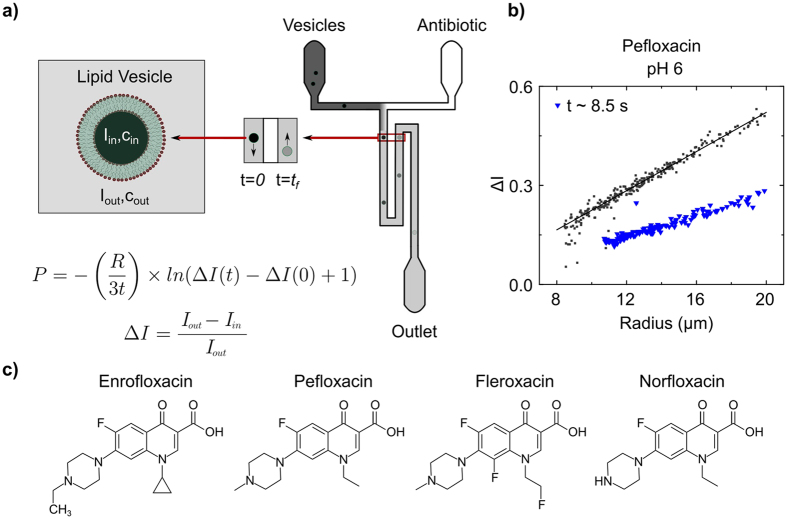
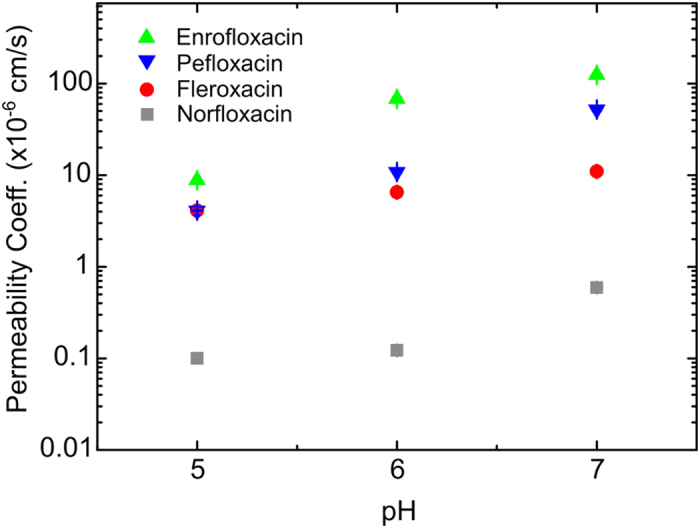
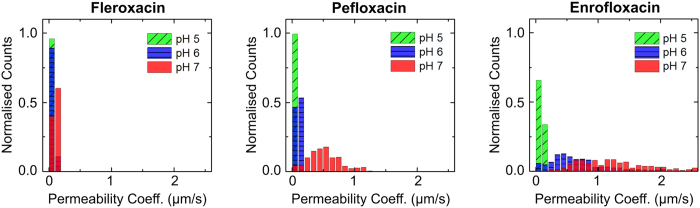
Quantifying drug permeability across lipid membranes is crucial for drug development. In addition, reduced membrane permeability is a leading cause of antibiotic resistance in bacteria, and hence there is a need for new technologies that can quantify antibiotic transport across biological membranes. We recently developed an optofluidic assay that directly determines the permeability coefficient of autofluorescent drug molecules across lipid membranes. Using ultraviolet fluorescence microscopy, we directly track drug accumulation in giant lipid vesicles as they traverse a microfluidic device while exposed to the drug. Importantly, our measurement does not require the knowledge of the octanol partition coefficient of the drug - we directly determine the permeability coefficient for the specific drug-lipid system. In this work, we report measurements on a range of fluoroquinolone antibiotics and find that their pH dependent lipid permeability can span over two orders of magnitude. We describe various technical improvements for our assay, and provide a new graphical user interface for data analysis to make the technology easier to use for the wider community.
量化药物穿过脂膜的渗透性对于药物开发至关重要。此外,膜通透性降低是细菌对抗生素产生耐药性的主要原因,因此需要新的技术来量化抗生素在生物膜中的转运。我们最近开发了一种光流控测定法,可以直接测定自发荧光药物分子穿过脂膜的渗透系数。我们使用紫外荧光显微镜,直接跟踪药物在穿过微流控装置时在巨大脂质囊泡中的积累,同时暴露于药物中。重要的是,我们的测量不需要药物的辛醇分配系数的知识 - 我们直接确定特定药物 - 脂质系统的渗透系数。在这项工作中,我们报告了一系列氟喹诺酮类抗生素的测量结果,发现它们的 pH 依赖性脂质通透性可以跨越两个数量级。我们描述了我们测定法的各种技术改进,并提供了一个新的图形用户界面用于数据分析,使该技术更容易被更广泛的社区使用。