Department of Neurology, Leiden University Medical Centre, Leiden, The Netherlands.
Department of Medicine, Division of Rheumatology, Washington University School of Medicine, St. Louis, Missouri 63110, USA.
Brain. 2016 Nov 1;139(11):2909-2922. doi: 10.1093/brain/aww217.
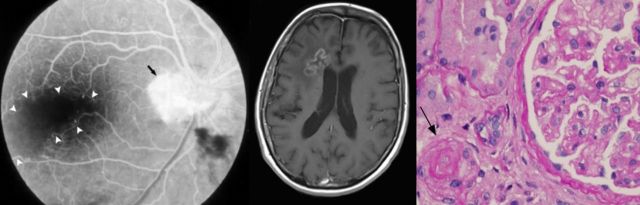
. Cerebroretinal vasculopathy, hereditary vascular retinopathy, and hereditary endotheliopathy, retinopathy, nephropathy and stroke are neurovascular syndromes initially described as distinct entities. Recently they were shown to be one disease caused by C-terminal frame-shift mutations in , which was termed ‘retinal vasculopathy with cerebral leukodystrophy’. Here we defined the genetic and clinicopathologic spectrum of this clinically and pathophysiologically poorly characterized and frequently misdiagnosed fatal neurovascular disorder. We identified five different mutations in 78 members from 11 unrelated families and by using a standardized study protocol we retrospectively reviewed and aggregated the associated clinical, neuroimaging, and pathology data. Findings were similar across mutations and families. Sixty-four mutation carriers had vascular retinopathy. Neuroimaging revealed (i) punctate, hyperintense, white matter lesions with or without nodular enhancement in 97% of them; (ii) rim-enhancing mass lesions in 84%; and (iii) calcifications in the white matter in 52%. Ninety per cent had clinical manifestations of brain disease, including focal neurological deficits (68%), migraine (59%), cognitive impairment (56%), psychiatric disturbances (42%), and seizures (17%). One mutation carrier had enhancing brain lesions and neurological features but unknown retinopathy status. Additional systemic features included liver disease (78%), anaemia (74%), nephropathy (61%), hypertension (60%), mild Raynaud’s phenomenon (40%), and gastro-intestinal bleeding (27%). Mean (± standard deviation) age at diagnosis was 42.9 ± 8.3 years and at death 53.1 ± 9.6 years. Pathological examination revealed systemic vasculopathy with luminal narrowing and multi-laminated basement membranes. The 13 mutation carriers without retinopathy or brain lesions were on average 8 years younger (mean age: 35.1 ± 10.6 years). Of them, 54% had mild Raynaud’s phenomenon, 42% had migraine, and 23% had psychiatric disturbances. Retinal vasculopathy with cerebral leukodystrophy is an autosomal dominant systemic small-vessel disease due to specific mutations and clinically primarily characterized by (i) visual impairment from vascular retinopathy; and (ii) neurological decline and premature death due to progressive enhancing cerebral white matter lesions. Impaired liver and kidney function, anaemia sometimes associated with gastrointestinal bleeding, hypertension, migraine, and Raynaud’s phenomenon appear to be part of the clinical spectrum as well. Penetrance seems high. Because of the pathogenetic basis and the emerging clinical picture with systemic manifestations and conspicuous absence of leukodystrophy, we renamed the disease ‘retinal vasculopathy with cerebral leukoencephalopathy and systemic manifestations’. We propose diagnostic criteria to facilitate clinical recognition and future studies.
. 脑视网膜血管病变、遗传性血管性视网膜病变和遗传性内皮病、视网膜病变、肾病和中风是最初被描述为不同实体的神经血管综合征。最近,它们被证明是由 C 末端移码突变引起的一种疾病,被称为“伴有脑白质营养不良的视网膜血管病变”。在这里,我们定义了这种临床上和病理生理学上特征不明显且经常被误诊的致命性神经血管疾病的遗传和临床病理谱。我们在 11 个无关家族的 78 名成员中发现了 5 种不同的 突变,并通过使用标准化研究方案,回顾性地回顾和汇总了相关的临床、神经影像学和病理学数据。在突变和家族中都发现了相似的发现。64 名突变携带者有血管性视网膜病变。神经影像学显示(i)97%的患者存在点状、高信号、白质病变,伴或不伴结节样增强;(ii)84%的患者存在边缘增强的肿块病变;(iii)52%的患者存在白质钙化。90%的患者有脑部疾病的临床表现,包括局灶性神经功能缺损(68%)、偏头痛(59%)、认知障碍(56%)、精神障碍(42%)和癫痫发作(17%)。一名突变携带者有增强的脑部病变和神经学特征,但未知的视网膜病变状态。其他全身特征包括肝脏疾病(78%)、贫血(74%)、肾病(61%)、高血压(60%)、轻度雷诺现象(40%)和胃肠道出血(27%)。诊断时的平均(±标准差)年龄为 42.9±8.3 岁,死亡时的平均年龄为 53.1±9.6 岁。病理学检查显示全身小血管病变,管腔狭窄,多层基底膜。13 名无视网膜病变或脑部病变的突变携带者平均年轻 8 岁(平均年龄:35.1±10.6 岁)。其中,54%有轻度雷诺现象,42%有偏头痛,23%有精神障碍。伴有脑白质营养不良的视网膜血管病变是一种常染色体显性遗传的系统性小血管疾病,由特定的 突变引起,临床上主要表现为(i)血管性视网膜病变导致视力障碍;(ii)进行性增强的脑白质病变导致神经功能下降和过早死亡。肝功能和肾功能不全、贫血(有时伴有胃肠道出血)、高血压、偏头痛和雷诺现象似乎也是临床谱的一部分。外显率似乎很高。由于发病机制和出现的临床表现伴有全身表现和明显缺乏白质营养不良,我们将该疾病重新命名为“伴有脑白质脑病和全身表现的视网膜血管病变”。我们提出了诊断标准,以方便临床识别和未来的研究。