
因情绪和行为失调而接受临床转诊的儿童中,基于儿童行为量表衍生量表的比较评估
Comparative Evaluation of Child Behavior Checklist-Derived Scales in Children Clinically Referred for Emotional and Behavioral Dysregulation.
作者信息
Papachristou Efstathios, Schulz Kurt, Newcorn Jeffrey, Bédard Anne-Claude V, Halperin Jeffrey M, Frangou Sophia
机构信息
Department of Primary Care and Population Health, University College London (UCL) , London , UK.
Department of Psychiatry, Icahn School of Medicine at Mount Sinai , New York, NY , USA.
出版信息
Front Psychiatry. 2016 Aug 24;7:146. doi: 10.3389/fpsyt.2016.00146. eCollection 2016.
BACKGROUND
We recently developed the Child Behavior Checklist-Mania Scale (CBCL-MS), a novel and short instrument for the assessment of mania-like symptoms in children and adolescents derived from the CBCL item pool and have demonstrated its construct validity and temporal stability in a longitudinal general population sample.
OBJECTIVE
The aim of this study was to evaluate the construct validity of the 19-item CBCL-MS in a clinical sample and to compare its discriminatory ability to that of the 40-item CBCL-dysregulation profile (CBCL-DP) and the 34-item CBCL-Externalizing Scale.
METHODS
The study sample comprised 202 children, aged 7-12 years, diagnosed with DSM-defined attention deficit hyperactivity disorder (ADHD), conduct disorder (CD), oppositional defiant disorder (ODD), and mood and anxiety disorders based on the Diagnostic Interview Schedule for Children. The construct validity of the CBCL-MS was tested by means of a confirmatory factor analysis. Receiver operating characteristics (ROC) curves and logistic regression analyses adjusted for sex and age were used to assess the discriminatory ability relative to that of the CBCL-DP and the CBCL-Externalizing Scale.
RESULTS
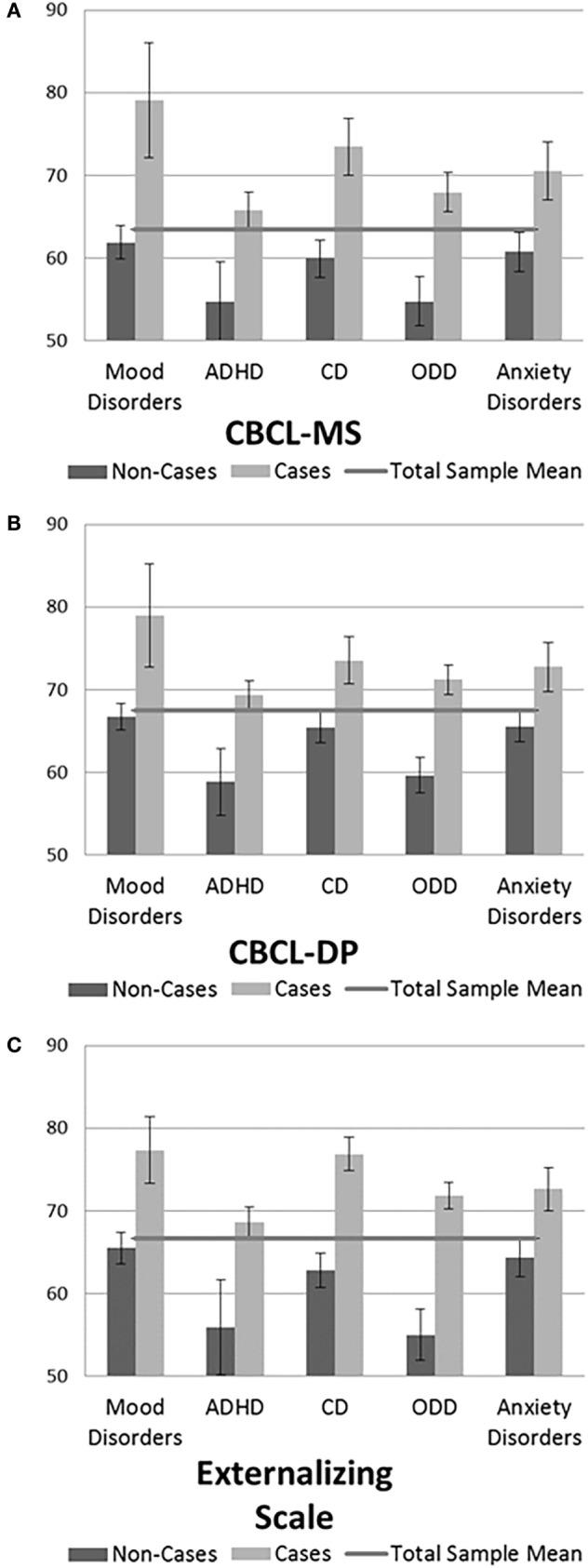
The CBCL-MS had excellent construct validity (comparative fit index = 0.97; Tucker-Lewis index = 0.96; root mean square error of approximation = 0.04). Despite similar overall performance across scales, the clinical range scores of the CBCL-DP and the CBCL-Externalizing Scale were associated with higher odds for ODD and CD, while the clinical range scores of the CBCL-MS were associated with higher odds for mood disorders. The concordance rate among the children who scored within the clinical range of each scale was over 90%.
CONCLUSION
CBCL-MS has good construct validity in general population and clinical samples and is therefore suitable for both clinical practice and research.
背景
我们最近开发了儿童行为检查表-躁狂量表(CBCL-MS),这是一种新颖且简短的工具,用于评估源自儿童行为检查表项目库的儿童和青少年的躁狂样症状,并已在纵向普通人群样本中证明了其结构效度和时间稳定性。
目的
本研究的目的是评估19项CBCL-MS在临床样本中的结构效度,并将其区分能力与40项儿童行为检查表-失调概况(CBCL-DP)和34项儿童行为检查表-外化量表的区分能力进行比较。
方法
研究样本包括202名7至12岁的儿童,他们根据儿童诊断访谈表被诊断为DSM定义的注意力缺陷多动障碍(ADHD)、品行障碍(CD)、对立违抗性障碍(ODD)以及情绪和焦虑障碍。通过验证性因素分析测试了CBCL-MS的结构效度。使用受试者工作特征(ROC)曲线和针对性别和年龄进行调整的逻辑回归分析来评估相对于CBCL-DP和CBCL-外化量表的区分能力。
结果
CBCL-MS具有出色的结构效度(比较拟合指数 = 0.97;塔克-刘易斯指数 = 0.96;近似均方根误差 = 0.04)。尽管各量表的总体表现相似,但CBCL-DP和CBCL-外化量表的临床范围得分与ODD和CD的较高几率相关,而CBCL-MS的临床范围得分与情绪障碍的较高几率相关。各量表临床范围内得分的儿童之间的一致性率超过90%。
结论
CBCL-MS在普通人群和临床样本中具有良好的结构效度,因此适用于临床实践和研究。
 Zotero 插件