Kim Jong Heon, Kim Sung-Hoon, Cho Sung-Rae, Lee Ji Yong, Kim Ji Hyun, Baek Ahreum, Jung Hong Sun
Department of Rehabilitation Medicine, Wonju Severance Christian Hospital, Yonsei University Wonju College of Medicine, Wonju, Korea.
Department of Rehabilitation Medicine, Yonsei University College of Medicine, Seoul, Korea.
Ann Rehabil Med. 2016 Aug;40(4):559-67. doi: 10.5535/arm.2016.40.4.559. Epub 2016 Aug 24.
To investigate alterations in the expression of the main regulators of neuronal survival and death related to astrocytes and neuronal cells in the brain in a mouse model of spinal cord injury (SCI).
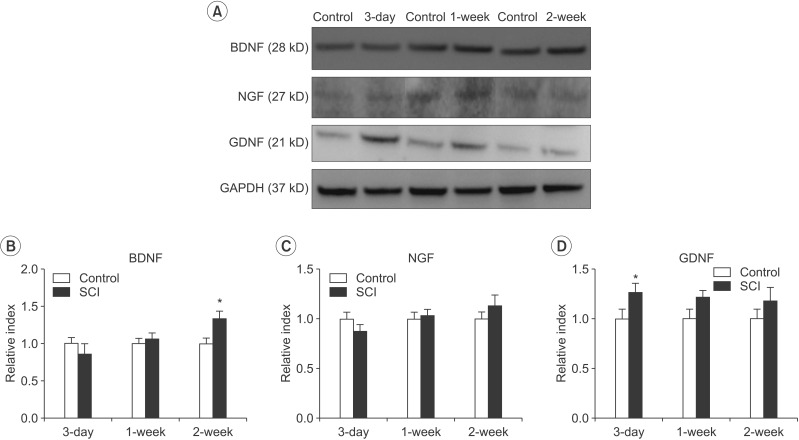
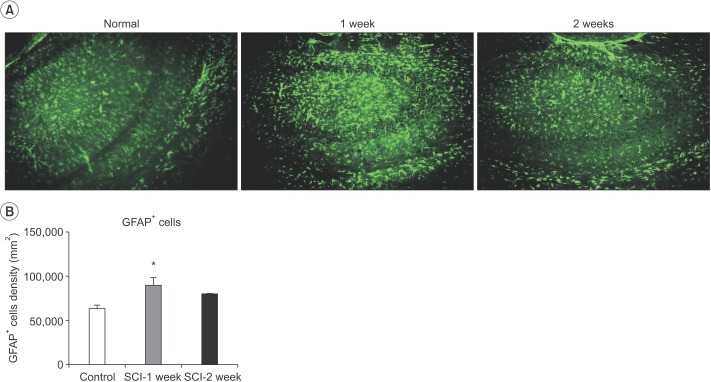
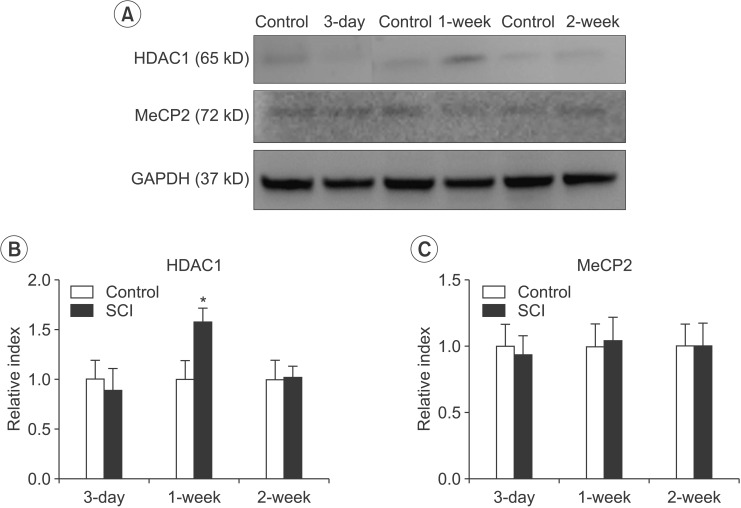
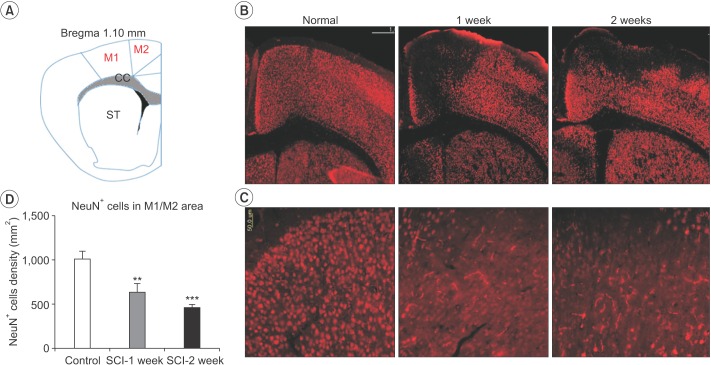
Eight-week-old male imprinting control region mice (n=36; 30-35 g) were used in this study and randomly assigned to two groups: the naïve control group (n=18) and SCI group (n=18). The mice in both groups were randomly allocated to the following three time points: 3 days, 1 week, and 2 weeks (n=6 each). The expression levels of regulators such as brain-derived neurotrophic factor (BDNF), glial cell line-derived neurotrophic factor (GDNF), nerve growth factor (NGF), histone deacetylase 1 (HDAC1), and methyl-CpG-binding protein 2 (MeCP 2) in the brain were evaluated following thoracic contusive SCI. In addition, the number of neuronal cells in the motor cortex (M1 and M2 areas) and the number of astrocytes in the hippocampus were determined by immunohistochemistry.
BDNF expression was significantly elevated at 2 weeks after injury (p=0.024). The GDNF level was significantly elevated at 3 days (p=0.042). The expression of HDAC1 was significantly elevated at 1 week (p=0.026). Following SCI, compared with the control the number of NeuN-positive cells in the M1 and M2 areas gradually and consistently decreased at 2 weeks after injury. In contrast, the number of astrocytes was significantly increased at 1 week (p=0.029).
These results demonstrate that the upregulation of BDNF, GDNF and HDAC1 might play on important role in brain reorganization after SCI.
在脊髓损伤(SCI)小鼠模型中,研究与脑内星形胶质细胞和神经元细胞相关的神经元存活与死亡主要调节因子的表达变化。
本研究使用8周龄雄性印记控制区小鼠(n = 36;体重30 - 35克),随机分为两组:未损伤对照组(n = 18)和SCI组(n = 18)。两组小鼠再随机分配至以下三个时间点:3天、1周和2周(每组n = 6)。在胸段挫伤性SCI后,评估脑内脑源性神经营养因子(BDNF)、胶质细胞源性神经营养因子(GDNF)、神经生长因子(NGF)、组蛋白去乙酰化酶1(HDAC1)和甲基化CpG结合蛋白2(MeCP 2)等调节因子的表达水平。此外,通过免疫组织化学法测定运动皮质(M1和M2区)的神经元细胞数量以及海马区的星形胶质细胞数量。
损伤后2周BDNF表达显著升高(p = 0.024)。GDNF水平在3天时显著升高(p = 0.042)。HDAC1的表达在1周时显著升高(p = 0.026)。SCI后,与对照组相比,损伤后2周M1和M2区NeuN阳性细胞数量逐渐且持续减少。相反,星形胶质细胞数量在1周时显著增加(p = 0.029)。
这些结果表明,BDNF、GDNF和HDAC1的上调可能在SCI后脑重组中起重要作用。