Pauer Frédéric, Schmidt Katharina, Babac Ana, Damm Kathrin, Frank Martin, von der Schulenburg J-Matthias Graf
Center for Health Economics Research Hannover (CHERH), Leibniz University of Hannover, Otto-Brenner-Straße 1, Hannover, 30159, Germany.
BMC Med Inform Decis Mak. 2016 Sep 9;16(1):117. doi: 10.1186/s12911-016-0346-8.
The Analytic Hierarchy Process (AHP) is increasingly used to measure patient priorities. Studies have shown that there are several different approaches to data acquisition and data aggregation. The aim of this study was to measure the information needs of patients having a rare disease and to analyze the effects of these different AHP approaches. The ranking of information needs is then used to display information categories on a web-based information portal about rare diseases according to the patient's priorities.
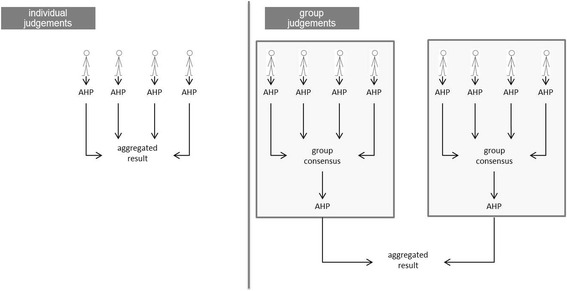
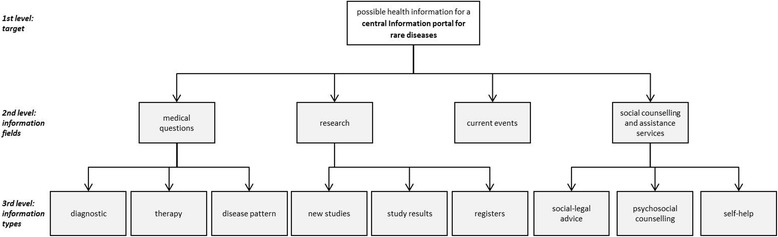
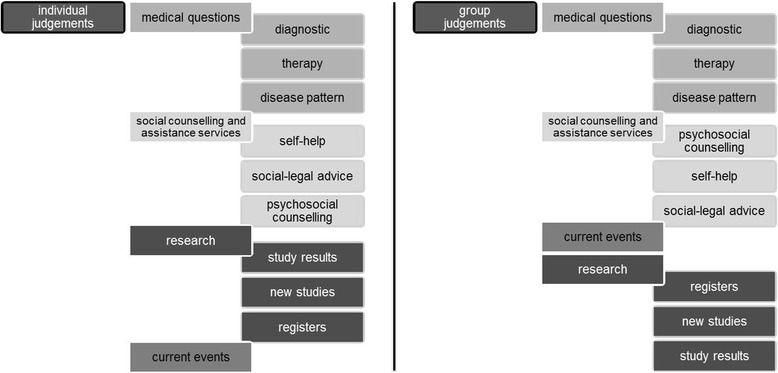
The information needs of patients suffering from rare diseases were identified by an Internet research study and a preliminary qualitative study. Hence, we designed a three-level hierarchy containing 13 criteria. For data acquisition, the differences in outcomes were investigated using individual versus group judgements separately. Furthermore, we analyzed the different effects when using the median and arithmetic and geometric means for data aggregation. A consistency ratio ≤0.2 was determined to represent an acceptable consistency level.
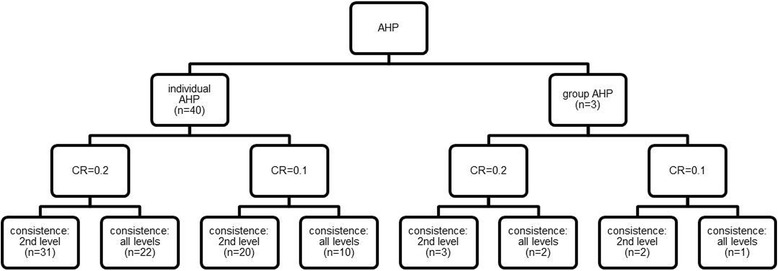
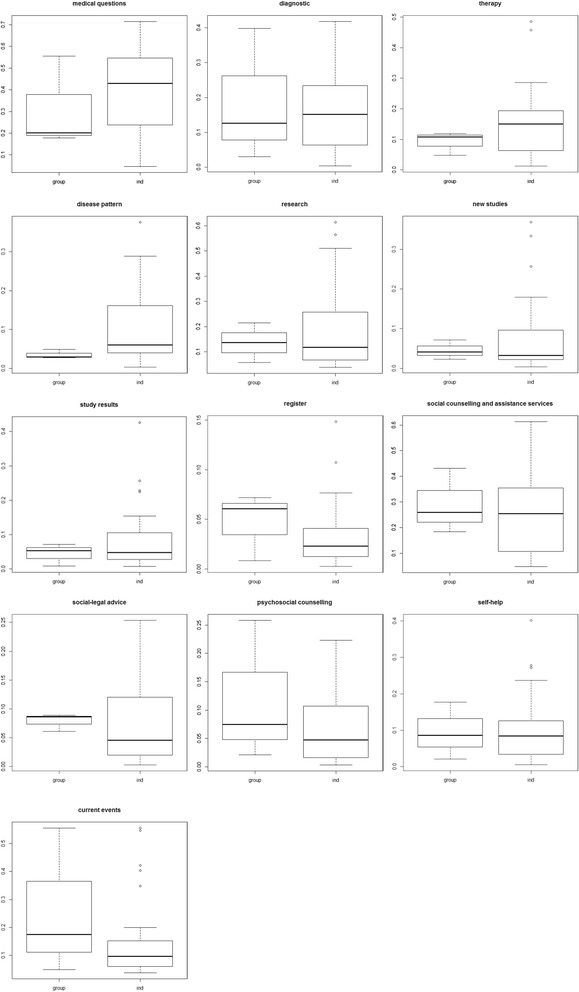
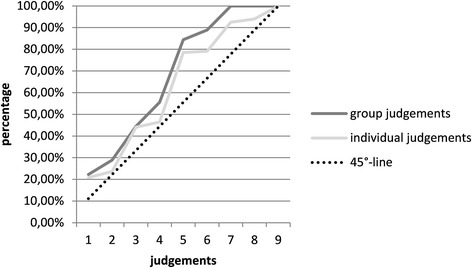
Forty individual and three group judgements were collected from patients suffering from a rare disease and their close relatives. The consistency ratio of 31 individual and three group judgements was acceptable and thus these judgements were included in the study. To a large extent, the local ranks for individual and group judgements were similar. Interestingly, group judgements were in a significantly smaller range than individual judgements. According to our data, the ranks of the criteria differed slightly according to the data aggregation method used.
It is important to explain and justify the choice of an appropriate method for data acquisition because response behaviors differ according to the method. We conclude that researchers should select a suitable method based on the thematic perspective or investigated topics in the study. Because the arithmetic mean is very vulnerable to outliers, the geometric mean and the median seem to be acceptable alternatives for data aggregation. Overall, using the AHP to identify patient priorities and enhance the user-friendliness of information websites offers an important contribution to medical informatics.
层次分析法(AHP)越来越多地用于衡量患者的优先事项。研究表明,数据采集和数据汇总有几种不同的方法。本研究的目的是衡量患有罕见病患者的信息需求,并分析这些不同层次分析法的效果。然后,根据患者的优先事项,将信息需求的排名用于在基于网络的罕见病信息门户上显示信息类别。
通过一项互联网研究和一项初步定性研究,确定了患有罕见病患者的信息需求。因此,我们设计了一个包含13个标准的三级层次结构。对于数据采集,分别使用个人判断与小组判断来研究结果差异。此外,我们分析了在数据汇总时使用中位数、算术平均数和几何平均数的不同效果。确定一致性比率≤0.2表示可接受的一致性水平。
从患有罕见病的患者及其近亲那里收集了40份个人判断和3份小组判断。31份个人判断和3份小组判断的一致性比率是可接受的,因此这些判断被纳入研究。在很大程度上,个人判断和小组判断的局部排名相似。有趣的是,小组判断的范围明显小于个人判断。根据我们的数据,根据所使用的数据汇总方法,标准的排名略有不同。
解释并说明选择适当数据采集方法的理由很重要,因为响应行为会因方法而异。我们得出结论,研究人员应根据研究的主题视角或所调查的主题选择合适的方法。由于算术平均数非常容易受到异常值的影响,几何平均数和中位数似乎是数据汇总的可接受替代方法。总体而言,使用层次分析法来确定患者的优先事项并提高信息网站的用户友好性,对医学信息学做出了重要贡献。