Jung Sung-Hoon, Kim Su-Min, Lee Choong-Eun
Department of Biological Science, College of Science, Sungkyunkwan University, Suwon 440-746, Korea.
Oncotarget. 2016 Sep 20;7(38):62559-62571. doi: 10.18632/oncotarget.11537.
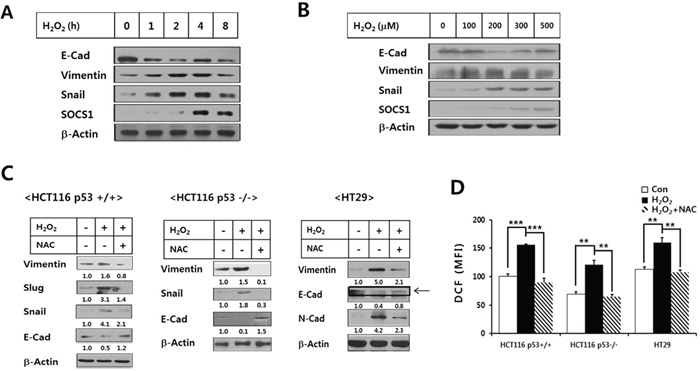
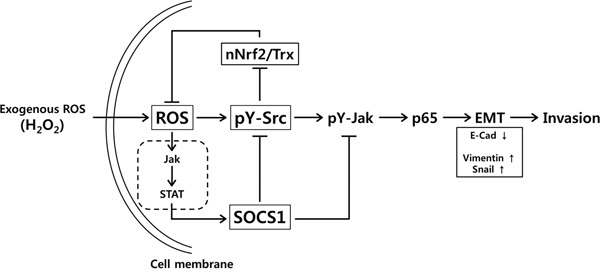
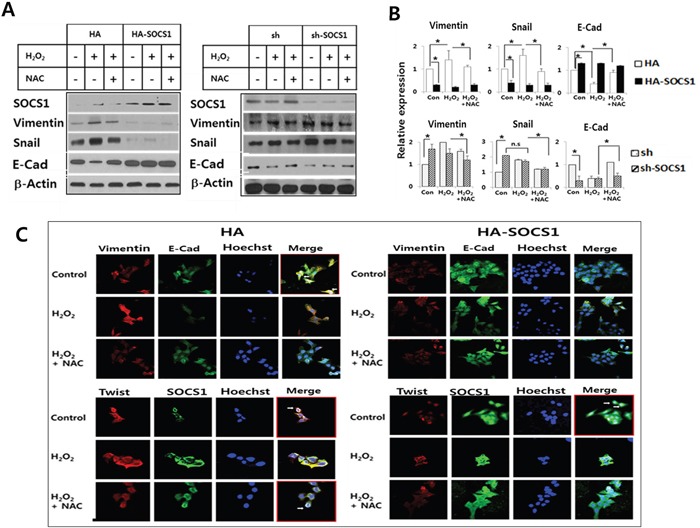
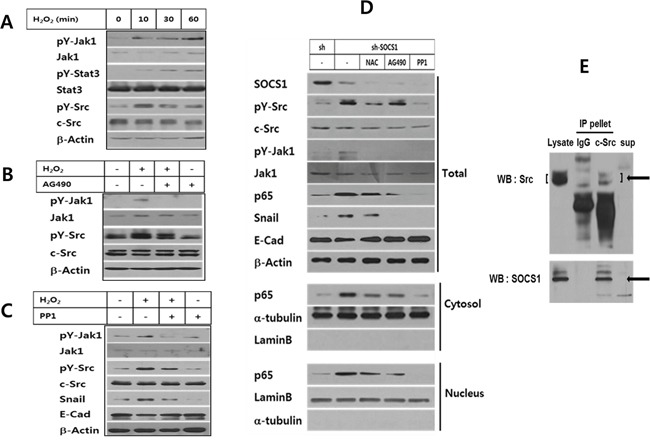
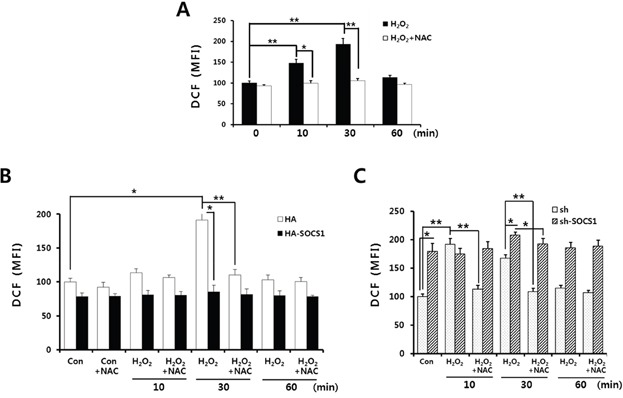
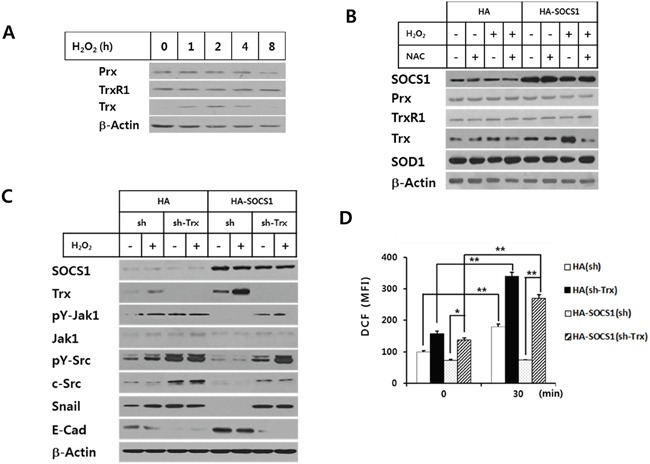
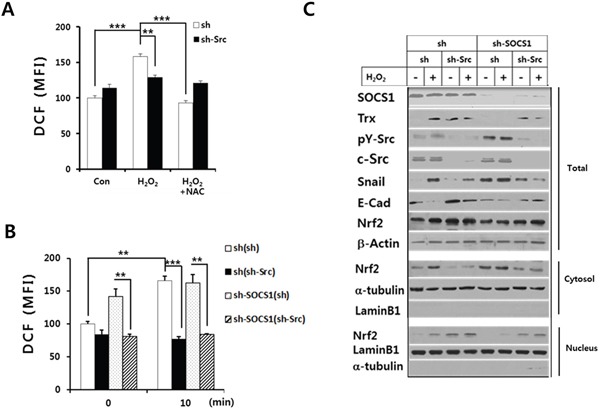
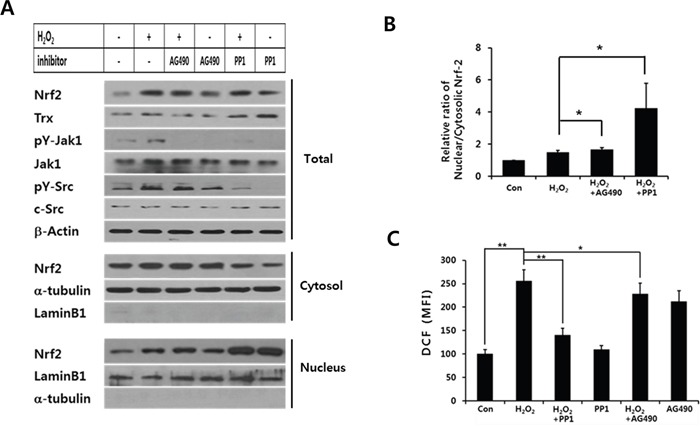
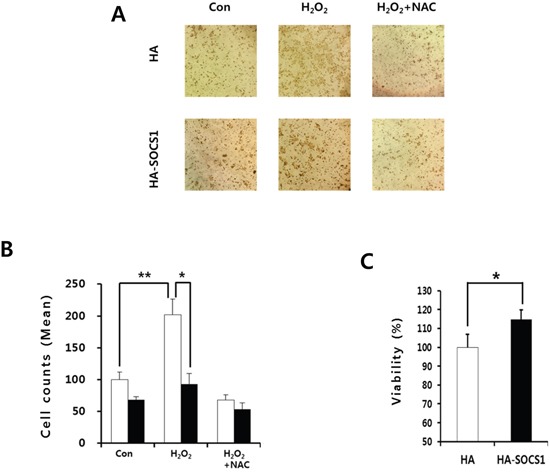
Reactive oxygen species (ROS) participate in malignant progression of cancers including epithelial-mesenchymal transition (EMT). We have investigated the role of suppressors of cytokine signaling (SOCS)1 as an inhibitor of ROS-induced EMT using colon cancer cell lines transduced with SOCS1 and shSOCS1. Hydrogen peroxide treatment induced EMT features such as elevation of vimentin and Snail with a corresponding reduction of E-cadherin. The EMT markers are significantly decreased upon SOCS1 over-expression while increased under SOCS1 knock-down. SOCS1 inhibited ROS signaling pathways associated with EMT such as Src, Jak, and p65. Of note, strong up-regulation of Src activity in SOCS1-ablated cells was responsible for the elevated signaling leading to EMT, as shSrc or Src inhibitor abolished the shSOCS1-induced promotion of EMT response. Suppression of ROS-inducible EMT markers and invasion in SOCS1 over-expressing cells correlated with significantly low intracellular ROS levels in these cells. Analysis of antioxidant enzymes in SOCS1-transduced cells revealed a selective up-regulation of thioredoxin (Trx1), while thioredoxin ablation restored ROS levels and the associated EMT markers. As a mechanism of thioredoxin up-regulation by SOCS1, inhibition of Src activity promoting nuclear translocation of Nrf-2 is proposed. Taken together, our data strongly indicate that SOCS1 antagonizes EMT by suppressing Src activity, leading to thioredoxin expression and down-regulation of ROS levels in colon cancer cells.
活性氧(ROS)参与包括上皮-间质转化(EMT)在内的癌症恶性进展。我们使用转导了SOCS1和shSOCS1的结肠癌细胞系,研究了细胞因子信号转导抑制因子(SOCS)1作为ROS诱导的EMT抑制剂的作用。过氧化氢处理诱导了EMT特征,如波形蛋白和Snail升高,同时E-钙黏蛋白相应减少。SOCS1过表达时,EMT标志物显著降低,而在SOCS1敲低时则升高。SOCS1抑制了与EMT相关的ROS信号通路,如Src、Jak和p65。值得注意的是,SOCS1缺失细胞中Src活性的强烈上调导致了导致EMT的信号升高,因为shSrc或Src抑制剂消除了shSOCS1诱导的EMT反应促进作用。SOCS1过表达细胞中ROS诱导的EMT标志物和侵袭的抑制与这些细胞中显著低的细胞内ROS水平相关。对转导了SOCS1的细胞中的抗氧化酶分析显示,硫氧还蛋白(Trx1)选择性上调,而硫氧还蛋白缺失恢复了ROS水平和相关的EMT标志物。作为SOCS1上调硫氧还蛋白的一种机制,有人提出抑制促进Nrf-2核转位的Src活性。综上所述,我们的数据强烈表明,SOCS1通过抑制Src活性拮抗EMT,导致硫氧还蛋白表达和结肠癌细胞中ROS水平下调。