Ruth Katherine S, Bennett Claire E, Schoemaker Minouk J, Weedon Michael N, Swerdlow Anthony J, Murray Anna
Genetics of Complex Traits, University of Exeter Medical School, RILD Level 3, Royal Devon & Exeter Hospital, Barrack Road, Exeter, EX2 5DW, UK.
Division of Genetics and Epidemiology, The Institute of Cancer Research, London, UK.
Hum Reprod. 2016 Oct;31(10):2396-403. doi: 10.1093/humrep/dew204. Epub 2016 Sep 9.
Is the length of FMR1 repeat alleles within the normal range associated with the risk of early menopause?
The length of repeat alleles within the normal range does not substantially affect risk of early menopause.
There is a strong, well-established relationship between length of premutation FMR1 alleles and age at menopause, suggesting that this relationship could continue into the normal range. Within the normal range, there is conflicting evidence; differences in ovarian reserve have been identified with FMR1 repeat allele length, but a recent population-based study did not find any association with age at menopause as a quantitative trait.
STUDY DESIGN, SIZE, DURATION: We analysed cross-sectional baseline survey data collected at recruitment from 2004 to 2010 from a population-based, prospective epidemiological cohort study of >110 000 women to investigate whether repeat allele length was associated with early menopause.
PARTICIPANTS/MATERIALS, SETTING, METHOD: We included 4333 women from the Breakthrough Generations Study (BGS), of whom 2118 were early menopause cases (menopause under 46 years) and 2215 were controls. We analysed the relationship between length of FMR1 alleles and early menopause using logistic regression with allele length as continuous and categorical variables. We also conducted analyses with the outcome age at menopause as a quantitative trait as well as appropriate sensitivity and exploratory analyses.
There was no association of the shorter or longer FMR1 allele or their combined genotype with the clinically relevant end point of early menopause in our main analysis. Likewise, there were no associations with age at menopause as a quantitative trait in our secondary analysis.
LIMITATIONS, REASONS FOR CAUTION: Women with homozygous alleles in the normal range may have undetected FMR1 premutation alleles, although there was no evidence to suggest this. We estimate minor dilution of risk of early menopause from the likely inclusion of some women with menopause at over 45 years in the early menopause cases due to age-rounding bias in self-reports.
There is no robust evidence in this large study that variation within the normal range of FMR1 repeat alleles influences timing of menopause in the general population, which contradicts findings from some earlier, mainly smaller studies. The FMR1 CGG repeat polymorphism in the normal range is unlikely to contribute to genetic susceptibility to early menopause.
STUDY FUNDING/COMPETING INTERESTS: We thank Breast Cancer Now and The Institute of Cancer Research for funding the BGS. The Institute of Cancer Research acknowledges NHS funding to the NIHR Biomedical Research Centre. The study was funded by the Wellcome Trust (grant number 085943). There are no competing interests.
Not applicable.
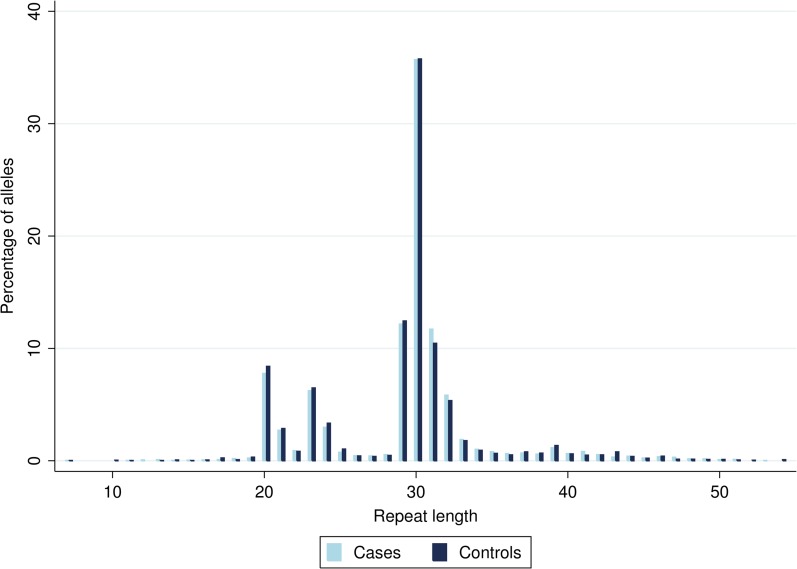
脆性X智力低下基因1(FMR1)重复等位基因的长度在正常范围内是否与早期绝经风险相关?
正常范围内的重复等位基因长度对早期绝经风险没有实质性影响。
前突变FMR1等位基因的长度与绝经年龄之间存在着一种强烈且已确定的关系,这表明这种关系可能会延伸至正常范围。在正常范围内,证据存在矛盾;已发现卵巢储备与FMR1重复等位基因长度存在差异,但最近一项基于人群的研究未发现其与作为定量性状的绝经年龄有任何关联。
研究设计、规模、持续时间:我们分析了2004年至2010年从一项针对超过110,000名女性的基于人群的前瞻性队列研究中招募时收集的横断面基线调查数据,以调查重复等位基因长度是否与早期绝经相关。
参与者/材料、环境、方法:我们纳入了来自“突破世代研究”(BGS)的4333名女性,其中2118例为早期绝经病例(46岁之前绝经),2215例为对照。我们使用逻辑回归分析FMR1等位基因长度与早期绝经之间的关系,将等位基因长度作为连续变量和分类变量。我们还对绝经年龄作为定量性状的结果进行了分析,以及适当的敏感性分析和探索性分析。
在我们的主要分析中,较短或较长的FMR1等位基因或其组合基因型与早期绝经这一临床相关终点之间没有关联。同样,在我们的次要分析中,也未发现其与作为定量性状的绝经年龄存在关联。
局限性、需谨慎的原因:正常范围内纯合等位基因的女性可能存在未被检测到的FMR1前突变等位基因,尽管没有证据表明情况如此。由于自我报告中的年龄舍入偏差,我们估计早期绝经病例中可能纳入了一些45岁以上绝经的女性,这会轻微稀释早期绝经风险。
在这项大型研究中,没有确凿证据表明FMR1重复等位基因正常范围内的变异会影响普通人群的绝经时间,这与一些早期(主要是规模较小的)研究结果相矛盾。正常范围内的FMR1 CGG重复多态性不太可能导致早期绝经的遗传易感性。
研究资金/利益冲突:我们感谢“乳腺癌现在”组织和癌症研究所对BGS的资助。癌症研究所认可英国国家医疗服务体系(NHS)对国家健康研究所生物医学研究中心的资助。该研究由惠康信托基金会资助(资助编号085943)。不存在利益冲突。
不适用。
