Gajbhiye Rahul, Fung Jenny N, Montgomery Grant W
1Institute for Molecular Bioscience, University of Queensland, St. Lucia, QLD 4072 Australia.
2Department of Clinical Research, ICMR-National Institute for Research in Reproductive Health, J. M. Street, Parel Mumbai, 400012 India.
NPJ Genom Med. 2018 Oct 12;3:29. doi: 10.1038/s41525-018-0068-1. eCollection 2018.
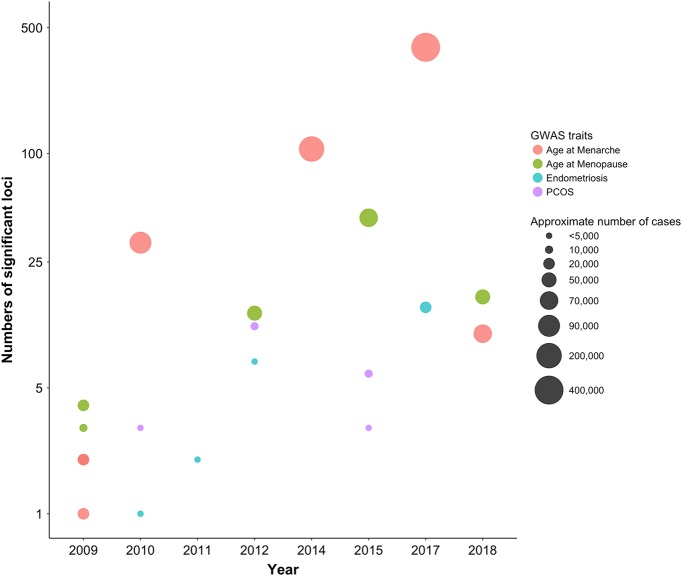
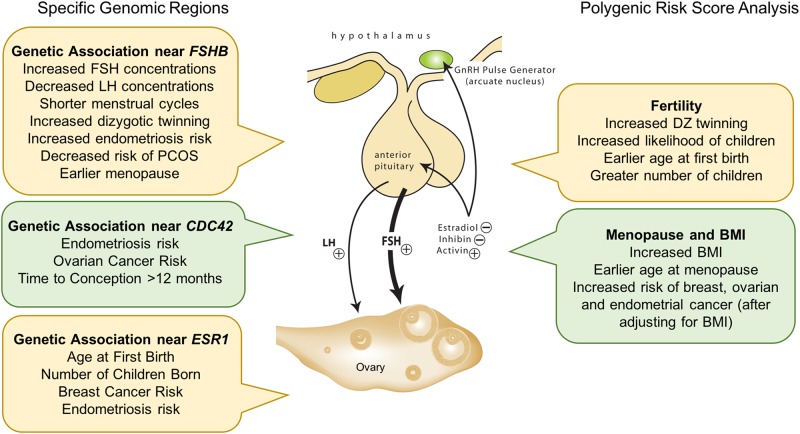
Variation in reproductive lifespan and female fertility have implications for health, population size and ageing. Fertility declines well before general signs of menopause and is also adversely affected by common reproductive diseases, including polycystic ovarian syndrome (PCOS) and endometriosis. Understanding the factors that regulate the timing of puberty and menopause, and the relationships with fertility are important for individuals and for policy. Substantial genetic variation exists for common traits associated with reproductive lifespan and for common diseases influencing female fertility. Genetic studies have identified mutations in genes contributing to disorders of reproduction, and in the last ten years, genome-wide association studies (GWAS) have transformed our understanding of common genetic contributions to these complex traits and diseases. These studies have made great progress towards understanding the genetic factors contributing to variation in traits and diseases influencing female fertility. The data emerging from GWAS demonstrate the utility of genetics to explain epidemiological observations, revealing shared biological pathways linking puberty timing, fertility, reproductive ageing and health outcomes. Many variants implicate DNA damage/repair genes in variation in the age at menopause with implications for follicle health and ageing. In addition to the discovery of individual genes and pathways, the increasingly powerful studies on common genetic risk factors help interpret the underlying relationships and direction of causation in the regulation of reproductive lifespan, fertility and related traits.
生殖寿命和女性生育能力的变化对健康、人口规模和衰老具有重要影响。生育能力在更年期的一般迹象出现之前就会下降,并且还会受到常见生殖疾病的不利影响,包括多囊卵巢综合征(PCOS)和子宫内膜异位症。了解调节青春期和更年期时间的因素以及与生育能力的关系,对个人和政策制定都很重要。与生殖寿命相关的常见特征以及影响女性生育能力的常见疾病存在大量遗传变异。基因研究已经确定了导致生殖障碍的基因突变,在过去十年中,全基因组关联研究(GWAS)改变了我们对这些复杂特征和疾病的常见遗传贡献的理解。这些研究在理解影响女性生育能力的特征和疾病变异的遗传因素方面取得了很大进展。GWAS得出的数据证明了遗传学在解释流行病学观察结果方面的作用,揭示了将青春期时间、生育能力、生殖衰老和健康结果联系起来的共同生物学途径。许多变异表明DNA损伤/修复基因在更年期年龄变异中发挥作用,这对卵泡健康和衰老具有影响。除了发现单个基因和途径外,对常见遗传风险因素的研究越来越深入,有助于解释生殖寿命、生育能力及相关特征调节中的潜在关系和因果方向。