Matsumoto Yukihisa, Matsumoto Chihiro S, Takahashi Toshihumi, Mizunami Makoto
College of Liberal Arts and Science, Tokyo Medical and Dental UniversityIchikawa, Japan; Graduate School of Life Science, Hokkaido UniversitySapporo, Japan.
Graduate School of Life Science, Hokkaido University Sapporo, Japan.
Front Behav Neurosci. 2016 Aug 26;10:166. doi: 10.3389/fnbeh.2016.00166. eCollection 2016.
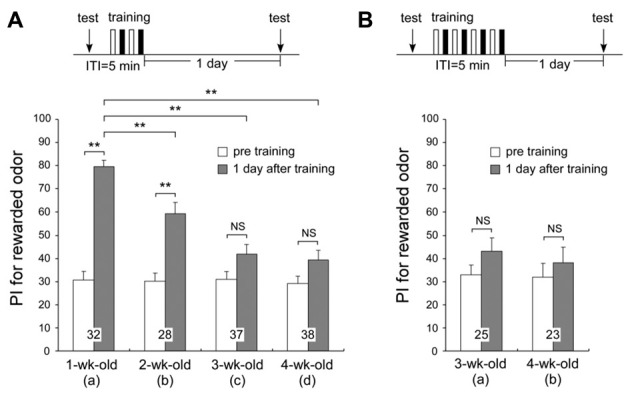
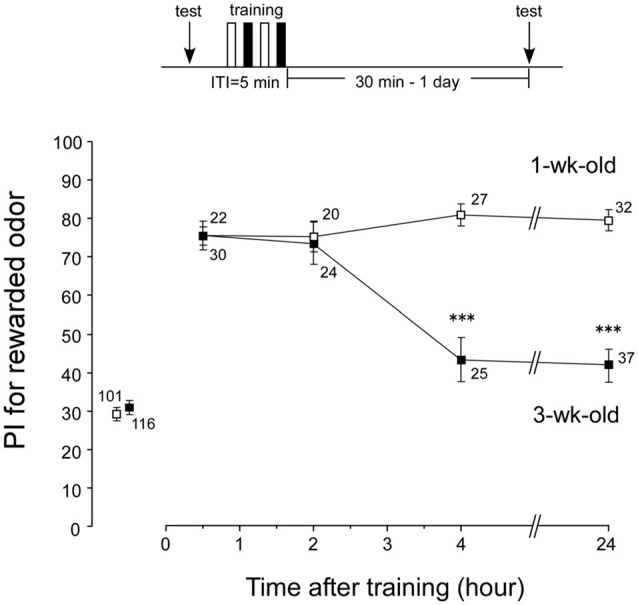
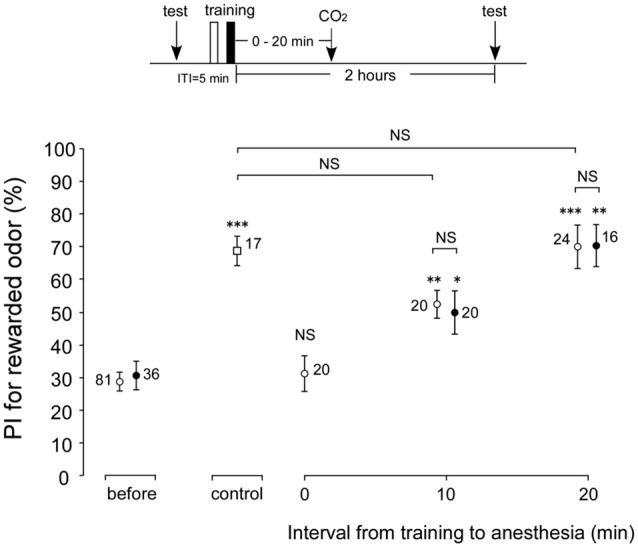
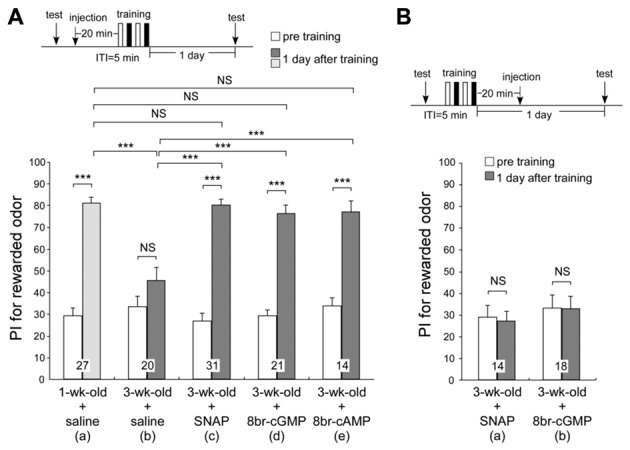
Age-related memory impairment (AMI) is a common feature and a debilitating phenotype of brain aging in many animals. However, the molecular mechanisms underlying AMI are still largely unknown. The cricket Gryllus bimaculatus is a useful experimental animal for studying age-related changes in learning and memory capability; because the cricket has relatively short life-cycle and a high capability of olfactory learning and memory. Moreover, the molecular mechanisms underlying memory formation in crickets have been examined in detail. In the present study, we trained male crickets of different ages by multiple-trial olfactory conditioning to determine whether AMI occurs in crickets. Crickets 3 weeks after the final molt (3-week-old crickets) exhibited levels of retention similar to those of 1-week-old crickets at 30 min or 2 h after training; however they showed significantly decreased levels of 1-day retention, indicating AMI in long-term memory (LTM) but not in anesthesia-resistant memory (ARM) in olfactory learning of crickets. Furthermore, 3-week-old crickets injected with a nitric oxide (NO) donor, a cyclic GMP (cGMP) analog or a cyclic AMP (cAMP) analog into the hemolymph before conditioning exhibited a normal level of LTM, the same level as that in 1-week-old crickets. The rescue effect by NO donor or cGMP analog injection was absent when the crickets were injected after the conditioning. For the first time, an NO donor and a cGMP analog were found to antagonize the age-related impairment of LTM formation, suggesting that deterioration of NO synthase (NOS) or molecules upstream of NOS activation is involved in brain-aging processes.
年龄相关性记忆障碍(AMI)是许多动物大脑衰老的常见特征和使人衰弱的表型。然而,AMI背后的分子机制仍 largely unknown。双斑蟋是研究学习和记忆能力年龄相关变化的有用实验动物;因为蟋蟀具有相对较短的生命周期和较高的嗅觉学习和记忆能力。此外,蟋蟀记忆形成的分子机制已被详细研究。在本研究中,我们通过多次试验嗅觉条件训练对不同年龄的雄性蟋蟀进行训练,以确定蟋蟀是否会出现AMI。最后一次蜕皮后3周的蟋蟀(3周龄蟋蟀)在训练后30分钟或2小时表现出与1周龄蟋蟀相似的记忆保持水平;然而,它们在1天记忆保持水平上显著下降,表明蟋蟀在嗅觉学习中的长期记忆(LTM)而非抗麻醉记忆(ARM)中存在AMI。此外,在条件训练前向3周龄蟋蟀的血淋巴中注射一氧化氮(NO)供体、环鸟苷酸(cGMP)类似物或环腺苷酸(cAMP)类似物,其LTM水平正常,与1周龄蟋蟀相同。当在条件训练后注射时,NO供体或cGMP类似物注射的挽救作用不存在。首次发现NO供体和cGMP类似物可拮抗LTM形成的年龄相关性损伤,表明一氧化氮合酶(NOS)或NOS激活上游分子的退化参与了大脑衰老过程。