Mandavia Amar, Robinson Gabriella G N, Bradley Bekh, Ressler Kerry J, Powers Abigail
Department of Psychiatry and Behavioral Sciences, Emory University School of Medicine, Atlanta, Georgia, USA.
Atlanta VA Medical Center, Atlanta, Georgia, USA.
J Trauma Stress. 2016 Oct;29(5):422-429. doi: 10.1002/jts.22131. Epub 2016 Sep 13.
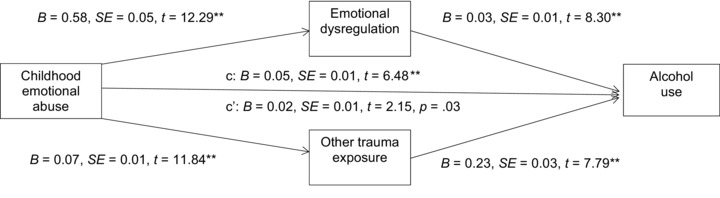
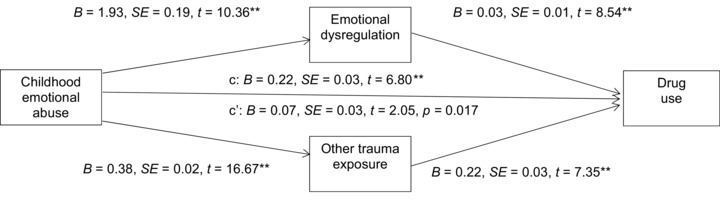
Little is known about how emotion dysregulation (ED) and trauma exposure differentially affect the relationship between abuse in childhood and adult substance use. We examined associations between child abuse, trauma exposure, ED, and current substance use in an already existing dataset. Participants (N = 2,014 adults, 90% African American) had been recruited from an urban hospital for a parent study. Analyses showed that drug and alcohol use was significantly positively correlated with child abuse (emotional, physical, and sexual), later trauma exposure, and ED (all ps < .001). Linear regression showed that exposure to abuse when older than a child was significantly associated with drug and alcohol use independent of child abuse and demographic variables (R Δ = .08, p < .001; R Δ = .04, p < .001). ED was significantly associated with drug and alcohol use independently of child abuse, nonabuse trauma, and demographic variables (R Δ = .02, p < .001; R Δ = .04, p < .001). Multiple mediation analyses showed that ED and later trauma exposure accounted for variance in the association between emotional abuse and substance use (p < .001). A better understanding of vulnerabilities to additional traumatization and emotion-regulation deficits in individuals who have been exposed to child abuse and in addition have comorbid substance use problems may inform treatments that lead to improved outcomes.
关于情绪调节障碍(ED)和创伤暴露如何不同地影响童年期虐待与成人物质使用之间的关系,我们所知甚少。我们在一个现有数据集中研究了儿童虐待、创伤暴露、ED与当前物质使用之间的关联。参与者(N = 2014名成年人,90%为非裔美国人)是从一家城市医院招募来参与一项母体研究的。分析表明,药物和酒精使用与儿童虐待(情感、身体和性虐待)、后期创伤暴露以及ED均呈显著正相关(所有p值均<0.001)。线性回归显示,儿童期之后遭受虐待与药物和酒精使用显著相关,且独立于儿童虐待和人口统计学变量(R变化量 = 0.08,p < 0.001;R变化量 = 0.04,p < 0.001)。ED与药物和酒精使用显著相关,且独立于儿童虐待、非虐待性创伤和人口统计学变量(R变化量 = 0.02,p < 0.001;R变化量 = 0.04,p < 0.001)。多重中介分析表明,ED和后期创伤暴露在情感虐待与物质使用之间的关联中占一定方差(p < 0.001)。更好地理解遭受儿童虐待且同时存在物质使用问题的个体额外遭受创伤和情绪调节缺陷的易感性,可能会为带来更好治疗效果的治疗方法提供依据。