Kowatsch Tobias, Kramer Jan-Niklas, Kehr Flavius, Wahle Fabian, Elser Niklas, Fleisch Elgar
Institute of Technology Management (ITEM), University of St Gallen, St. Gallen, Switzerland.
JMIR Res Protoc. 2016 Sep 13;5(3):e181. doi: 10.2196/resprot.6089.
Research has so far benefited from the use of pedometers in physical activity interventions. However, when public health institutions (eg, insurance companies) implement pedometer-based interventions in practice, people may refrain from participating due to privacy concerns. This might greatly limit the applicability of such interventions. Financial incentives have been successfully used to influence both health behavior and privacy concerns, and may thus have a beneficial effect on the acceptance of pedometer-based interventions.
This paper presents the design and baseline characteristics of a cluster-randomized controlled trial that seeks to examine the effect of financial incentives on the acceptance of and adherence to a pedometer-based physical activity intervention offered by a health insurance company.
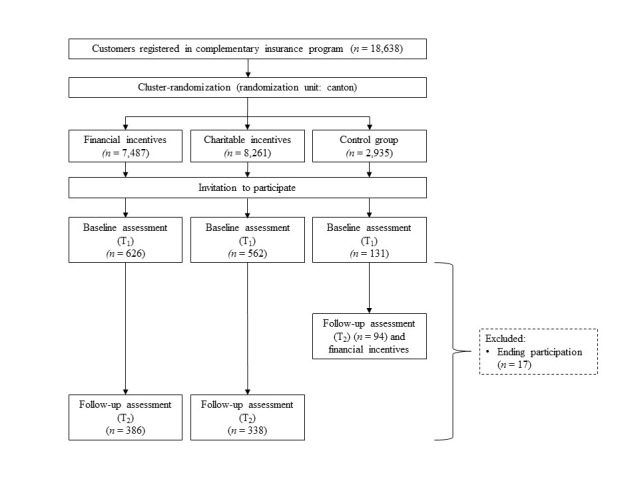
More than 18,000 customers of a large Swiss health insurance company were allocated to a financial incentive, a charitable incentive, or a control group and invited to participate in a health prevention program. Participants used a pedometer to track their daily physical activity over the course of 6 months. A Web-based questionnaire was administered at the beginning and at the end of the intervention and additional data was provided by the insurance company. The primary outcome of the study will be the participation rate, secondary outcomes will be adherence to the prevention program, physical activity, and health status of the participants among others.
Baseline characteristics indicate that residence of participants, baseline physical activity, and subjective health should be used as covariates in the statistical analysis of the secondary outcomes of the study.
This is the first study in western cultures testing the effectiveness of financial incentives with regard to a pedometer-based health intervention offered by a large health insurer to their customers. Given that the incentives prove to be effective, this study provides the basis for powerful health prevention programs of public health institutions that are easy to implement and can reach large numbers of people in need.
到目前为止,研究已从计步器在体育活动干预中的应用中受益。然而,当公共卫生机构(如保险公司)在实际中实施基于计步器的干预措施时,人们可能会因隐私担忧而不愿参与。这可能会极大地限制此类干预措施的适用性。经济激励已成功用于影响健康行为和隐私担忧,因此可能对基于计步器的干预措施的接受度产生有益影响。
本文介绍了一项整群随机对照试验的设计和基线特征,该试验旨在研究经济激励对健康保险公司提供的基于计步器的体育活动干预措施的接受度和依从性的影响。
一家大型瑞士健康保险公司的18000多名客户被分配到经济激励组、慈善激励组或对照组,并被邀请参加一项健康预防计划。参与者使用计步器在6个月的时间里跟踪他们的日常体育活动。在干预开始和结束时进行了基于网络的问卷调查,保险公司还提供了其他数据。该研究的主要结果将是参与率,次要结果将包括对预防计划的依从性、体育活动以及参与者的健康状况等。
基线特征表明,在对该研究的次要结果进行统计分析时,应将参与者的居住地、基线体育活动和主观健康状况用作协变量。
这是西方文化中第一项测试经济激励对大型健康保险公司向其客户提供的基于计步器的健康干预措施有效性的研究。鉴于这些激励措施被证明是有效的,本研究为公共卫生机构易于实施且能惠及大量有需要人群的有力健康预防计划提供了基础。