Kramer Jan-Niklas, Kowatsch Tobias
Center for Digital Health Interventions, Institute of Technology Management, University of St. Gallen, St.Gallen, Switzerland.
J Med Internet Res. 2017 Jun 2;19(6):e192. doi: 10.2196/jmir.7012.
Providing feedback is a technique to promote health behavior that is emphasized by behavior change theories. However, these theories make contradicting predictions regarding the effect of the feedback sign-that is, whether the feedback signals success or failure. Thus, it is unclear whether positive or negative feedback leads to more favorable behavior change in a health behavior intervention.
The aim of this study was to examine the effect of the feedback sign in a health behavior change intervention.
Data from participants (N=1623) of a 6-month physical activity intervention was used. Participants received a feedback email at the beginning of each month. Feedback was either positive or negative depending on the participants' physical activity in the previous month. In an exploratory analysis, change in monthly step count averages was used to evaluate the feedback effect.
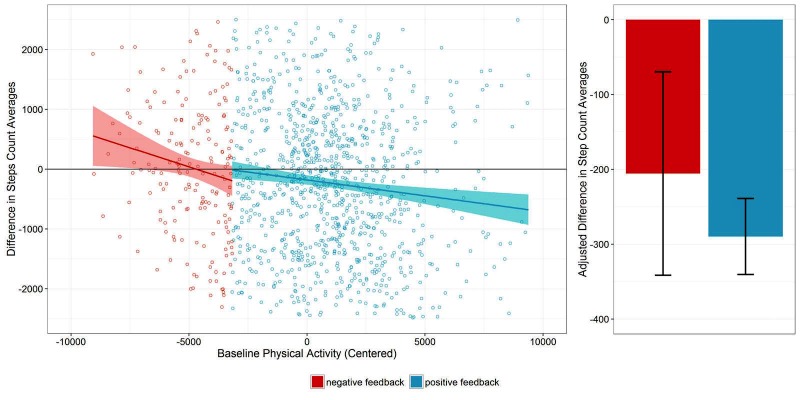
The feedback sign did not predict the change in monthly step count averages over the course of the intervention (b=-84.28, P=.28). Descriptive differences between positive and negative feedback can be explained by regression to the mean.
The feedback sign might not influence the effect of monthly feedback emails sent out to participants of a large-scale physical activity intervention. However, randomized studies are needed to further support this conclusion. Limitations as well as opportunities for future research are discussed.
提供反馈是一种促进健康行为的技术,行为改变理论强调了这一点。然而,这些理论对于反馈信号(即反馈表明成功还是失败)的效果做出了相互矛盾的预测。因此,在健康行为干预中,尚不清楚正面反馈还是负面反馈会导致更有利的行为改变。
本研究旨在探讨健康行为改变干预中反馈信号的效果。
使用了一项为期6个月的体育活动干预参与者(N = 1623)的数据。参与者在每个月开始时收到一封反馈电子邮件。根据参与者前一个月的体育活动情况,反馈为正面或负面。在探索性分析中,使用每月平均步数的变化来评估反馈效果。
在干预过程中,反馈信号并未预测每月平均步数的变化(b = -84.28,P = 0.28)。正面反馈和负面反馈之间的描述性差异可以用均值回归来解释。
反馈信号可能不会影响向大规模体育活动干预参与者发送的每月反馈电子邮件的效果。然而,需要随机研究来进一步支持这一结论。讨论了局限性以及未来研究的机会。