Sultan Benjamin, Gaetani Marco
Sorbonne Universités, Université Pierre et Marie Curie - CNRS-IRD-MNHN, LOCEAN/IPSL Paris, France.
Sorbonne Universités, Université Pierre et Marie Curie - UVSQ-CNRS, LATMOS/IPSL Paris, France.
Front Plant Sci. 2016 Aug 30;7:1262. doi: 10.3389/fpls.2016.01262. eCollection 2016.
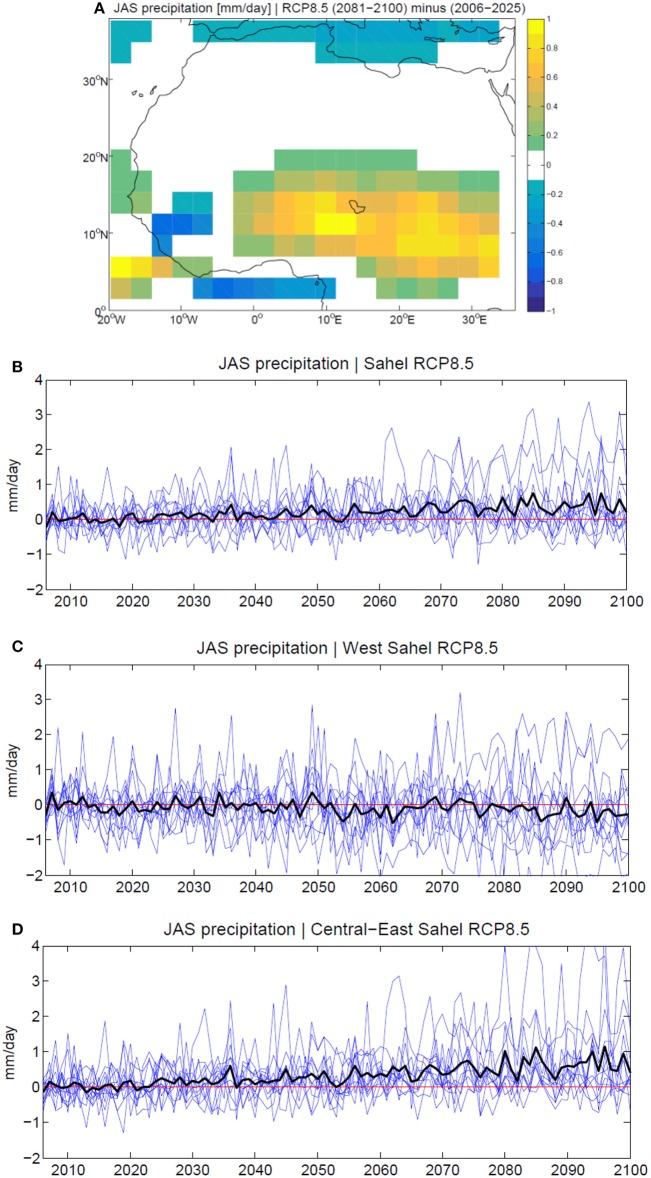
West Africa is known to be particularly vulnerable to climate change due to high climate variability, high reliance on rain-fed agriculture, and limited economic and institutional capacity to respond to climate variability and change. In this context, better knowledge of how climate will change in West Africa and how such changes will impact crop productivity is crucial to inform policies that may counteract the adverse effects. This review paper provides a comprehensive overview of climate change impacts on agriculture in West Africa based on the recent scientific literature. West Africa is nowadays experiencing a rapid climate change, characterized by a widespread warming, a recovery of the monsoonal precipitation, and an increase in the occurrence of climate extremes. The observed climate tendencies are also projected to continue in the twenty-first century under moderate and high emission scenarios, although large uncertainties still affect simulations of the future West African climate, especially regarding the summer precipitation. However, despite diverging future projections of the monsoonal rainfall, which is essential for rain-fed agriculture, a robust evidence of yield loss in West Africa emerges. This yield loss is mainly driven by increased mean temperature while potential wetter or drier conditions as well as elevated CO2 concentrations can modulate this effect. Potential for adaptation is illustrated for major crops in West Africa through a selection of studies based on process-based crop models to adjust cropping systems (change in varieties, sowing dates and density, irrigation, fertilizer management) to future climate. Results of the cited studies are crop and region specific and no clear conclusions can be made regarding the most effective adaptation options. Further efforts are needed to improve modeling of the monsoon system and to better quantify the uncertainty in its changes under a warmer climate, in the response of the crops to such changes and in the potential for adaptation.
由于气候高度多变、对雨养农业高度依赖以及应对气候多变性和变化的经济和机构能力有限,西非被认为特别容易受到气候变化的影响。在这种背景下,更好地了解西非气候将如何变化以及这些变化将如何影响作物生产力,对于制定可能抵消不利影响的政策至关重要。本综述论文基于最近的科学文献,全面概述了气候变化对西非农业的影响。如今,西非正在经历快速的气候变化,其特征是普遍变暖、季风降水恢复以及极端气候事件的发生增加。在中等和高排放情景下,预计观测到的气候趋势在21世纪仍将持续,尽管未来西非气候的模拟仍存在很大不确定性,尤其是关于夏季降水。然而,尽管对于雨养农业至关重要的季风降雨的未来预测存在分歧,但西非出现产量损失的有力证据确凿。这种产量损失主要是由平均温度升高驱动的,而潜在的更湿润或更干燥条件以及二氧化碳浓度升高会调节这种影响。通过基于过程的作物模型选择一系列研究,展示了西非主要作物的适应潜力,以便根据未来气候调整种植系统(品种、播种日期和密度、灌溉、肥料管理的变化)。所引用研究的结果因作物和地区而异,关于最有效的适应方案无法得出明确结论。需要进一步努力改进季风系统的建模,并更好地量化在气候变暖情况下其变化、作物对此类变化的响应以及适应潜力方面的不确定性。