Wensink Maarten J
Max Planck Odense Center on the Biodemography of Aging, University of Southern Denmark, Winsløws Vej 9B, 5000 C Odense, Denmark Institute of Public Health, University of Southern Denmark, Winsløws Vej 9B, 5000 C Odense, Denmark
Proc Biol Sci. 2016 Sep 14;283(1838). doi: 10.1098/rspb.2016.1510.
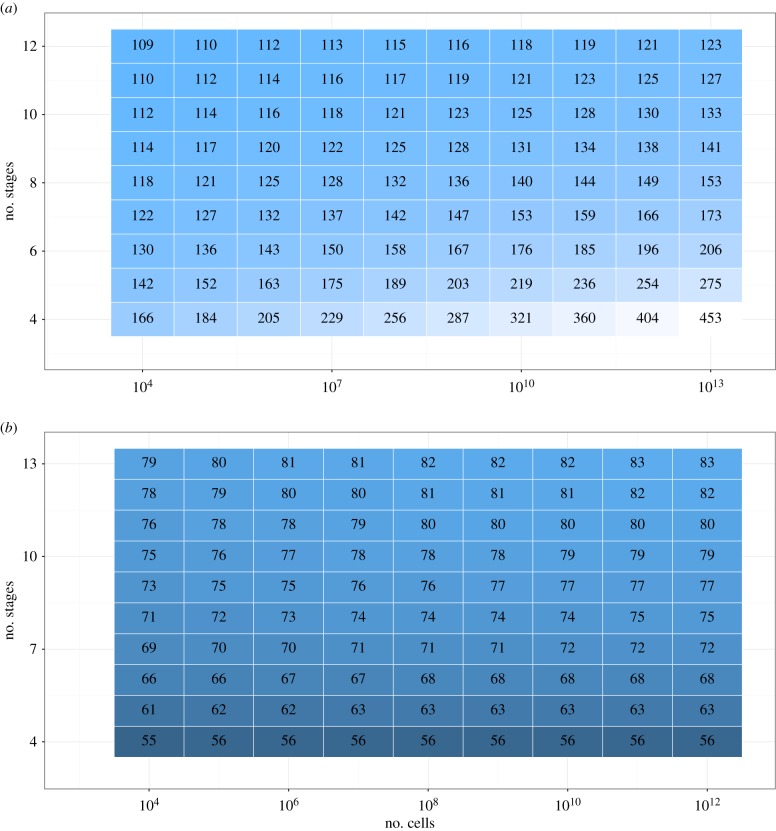
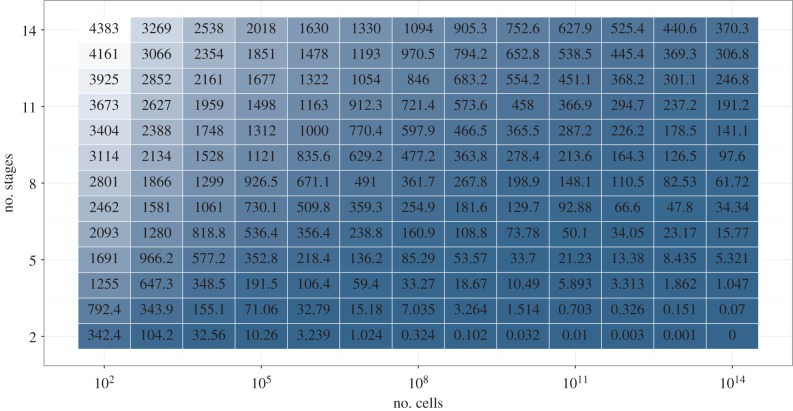
There is significant recent interest in Peto's paradox and the related problem of the evolution of large, long-lived organisms in terms of cancer robustness. Peto's paradox refers to the expectation that large, long-lived organisms have a higher lifetime cancer risk, which is not the case: a paradox. This paradox, however, is circular: large, long-lived organisms are large and long-lived because they are cancer robust. Lifetime risk, meanwhile, depends on the age distributions of both cancer and competing risks: if cancer strikes before competing risks, then lifetime risk is high; if not, not. Because no set of competing risks is generally prevalent, it is instructive to temporarily dispose of competing risks and investigate the pure age dynamics of cancer under the multistage model of carcinogenesis. In addition to augmenting earlier results, I show that in terms of cancer-free lifespan large organisms reap greater benefits from an increase in cellular cancer robustness than smaller organisms. Conversely, a higher cellular cancer robustness renders cancer-free lifespan more resilient to an increase in size. This interaction may be an important driver of the evolution of large, cancer-robust organisms.
近期,人们对佩托悖论以及大型长寿生物体在癌症抗性方面的进化相关问题产生了浓厚兴趣。佩托悖论指的是一种预期,即大型长寿生物体有更高的终生患癌风险,但实际情况并非如此:这是一个悖论。然而,这个悖论是循环的:大型长寿生物体之所以体型大且寿命长,是因为它们具有癌症抗性。与此同时,终生风险取决于癌症和竞争风险的年龄分布:如果癌症在竞争风险之前发生,那么终生风险就高;反之则低。由于没有一组竞争风险普遍存在,暂时抛开竞争风险,研究致癌多阶段模型下癌症的纯粹年龄动态是很有意义的。除了扩展早期结果外,我还表明,就无癌寿命而言,大型生物体比小型生物体从细胞癌症抗性的提高中获益更多。相反,更高的细胞癌症抗性使无癌寿命对体型增大更具弹性。这种相互作用可能是大型、抗癌症生物体进化的一个重要驱动因素。