Yu Jing, Mamerow Loreen, Lei Xu, Fang Lei, Mata Rui
Faculty of Psychology, Southwest UniversityChongqing, China; Department for Cognitive and Decision Sciences, University of BaselBasel, Switzerland; Key Laboratory of Mental Health, Institute of Psychology, Chinese Academy of SciencesBeijing, China.
Department for Cognitive and Decision Sciences, University of Basel Basel, Switzerland.
Front Aging Neurosci. 2016 Aug 31;8:210. doi: 10.3389/fnagi.2016.00210. eCollection 2016.
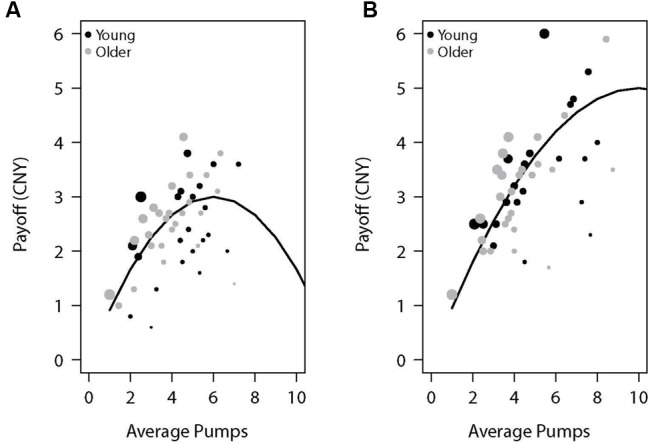
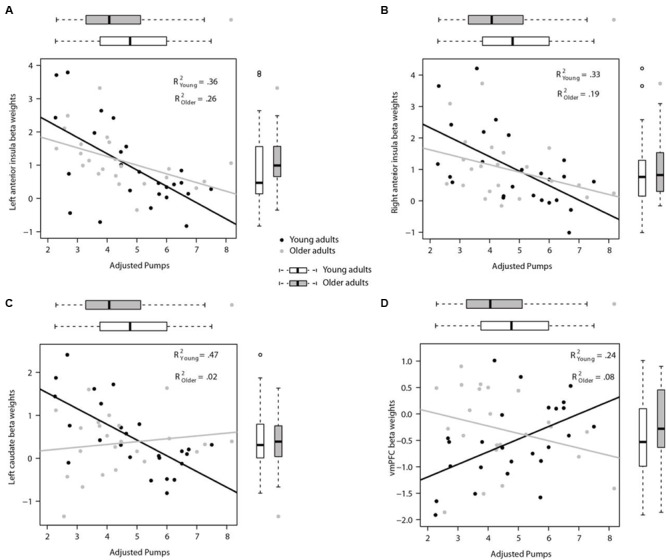
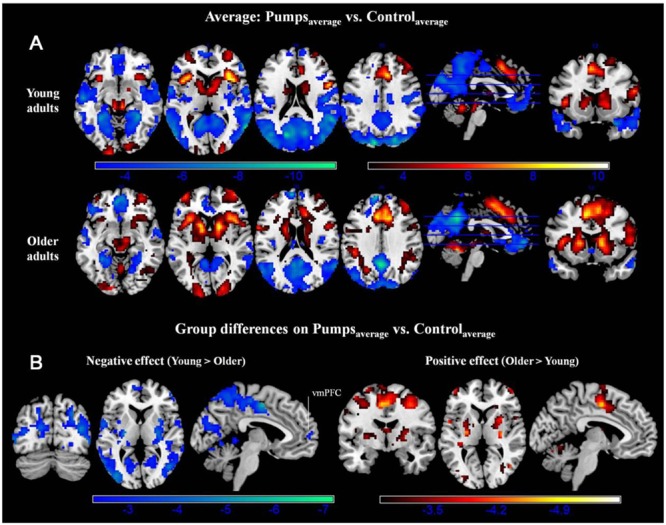
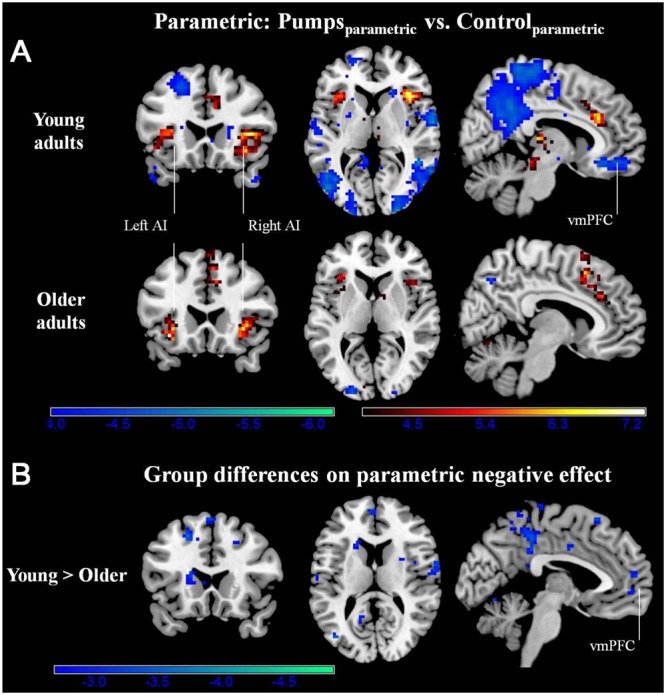
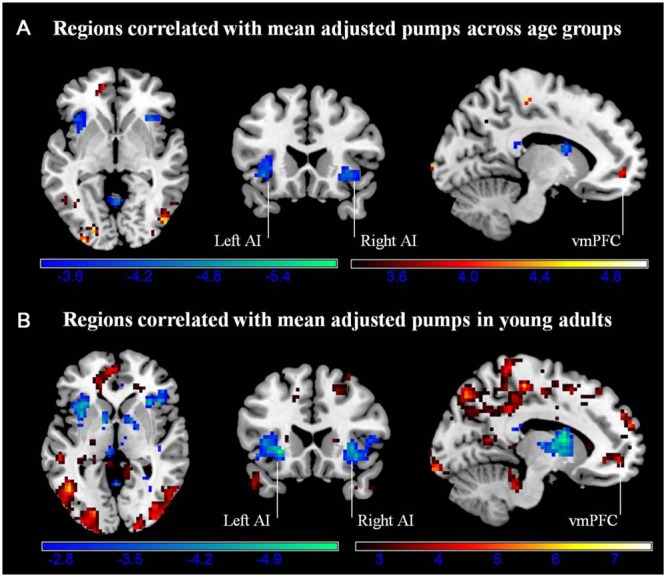
Previous work suggests that aging is associated with changes in risk taking but less is known about their underlying neural basis, such as the potential age differences in the neural processing of value and risk. The goal of the present study was to investigate adult age differences in functional neural responses in a naturalistic risk-taking task. Twenty-six young adults and 27 healthy older adults completed the Balloon Analogue Risk Task while undergoing functional magnetic resonance imaging. Young and older adults showed similar overt risk-taking behavior. Group comparison of neural activity in response to risky vs. control stimuli revealed similar patterns of activation in the bilateral striatum, anterior insula (AI) and ventromedial prefrontal cortex (vmPFC). Group comparison of parametrically modulated activity in response to continued pumping similarly revealed comparable results for both age groups in the AI and, potentially, the striatum, yet differences emerged for regional activity in the vmPFC. At whole brain level, insular, striatal and vmPFC activation was predictive of behavioral risk taking for young but not older adults. The current results are interpreted and discussed as preserved neural tracking of risk and reward in the AI and striatum, respectively, but altered value coding in the vmPFC in the two age groups. The latter finding points toward older adults exhibiting differential vmPFC-related integration and value coding. Furthermore, neural activation holds differential predictive validity for behavioral risk taking in young and older adults.
先前的研究表明,衰老与冒险行为的变化有关,但对于其潜在的神经基础,如价值和风险的神经处理过程中潜在的年龄差异,我们所知甚少。本研究的目的是调查成年人在自然主义冒险任务中功能性神经反应的年龄差异。26名年轻成年人和27名健康的老年人在进行功能磁共振成像时完成了气球模拟风险任务。年轻人和老年人表现出相似的明显冒险行为。对风险刺激与对照刺激的神经活动进行组间比较,结果显示双侧纹状体、前脑岛(AI)和腹内侧前额叶皮层(vmPFC)的激活模式相似。对持续打气时参数调制活动的组间比较同样显示,两个年龄组在AI以及可能在纹状体中的结果相当,但vmPFC的区域活动出现了差异。在全脑水平上,脑岛、纹状体和vmPFC的激活可预测年轻人的行为冒险,但不能预测老年人的行为冒险。当前的结果被解释和讨论为,分别在AI和纹状体中保留了对风险和奖励的神经追踪,但两个年龄组在vmPFC中的价值编码发生了改变。后一个发现表明老年人表现出与vmPFC相关的不同整合和价值编码。此外,神经激活对年轻人和老年人的行为冒险具有不同的预测效度。