Putteeraj Manish, Soga Tomoko, Ubuka Takayoshi, Parhar Ishwar S
Brain Research Institute (BRIMS), Jeffrey Cheah School of Medicine and Health Sciences, Monash University Malaysia , Petaling Jaya , Malaysia.
Front Endocrinol (Lausanne). 2016 Aug 31;7:121. doi: 10.3389/fendo.2016.00121. eCollection 2016.
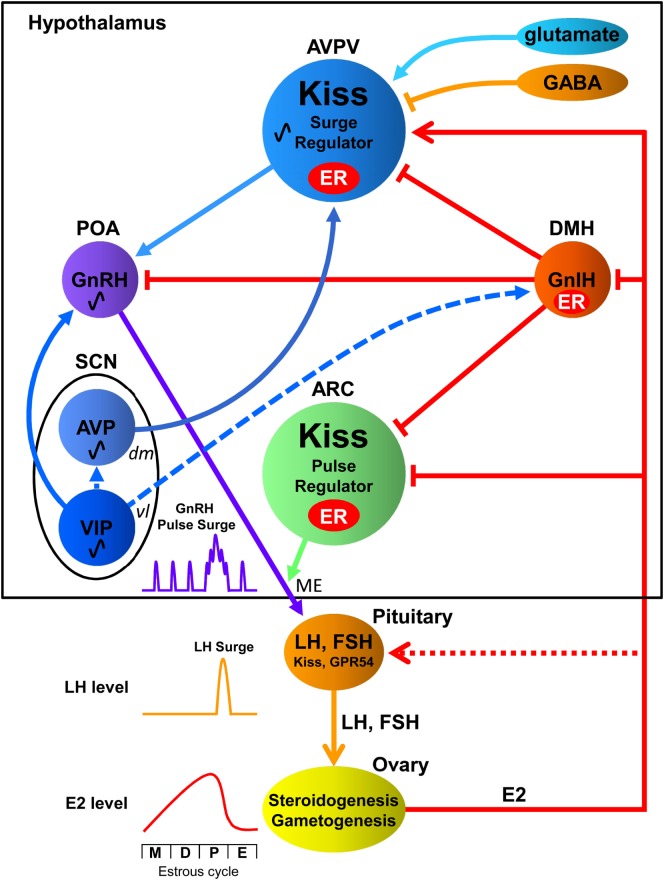
Reproduction is associated with the circadian system, primarily as a result of the connectivity between the biological clock in the suprachiasmatic nucleus (SCN) and reproduction-regulating brain regions, such as preoptic area (POA), anteroventral periventricular nucleus (AVPV), and arcuate nucleus (ARC). Networking of the central pacemaker to these hypothalamic brain regions is partly represented by close fiber appositions to specialized neurons, such as kisspeptin and gonadotropin-releasing hormone (GnRH) neurons; accounting for rhythmic release of gonadotropins and sex steroids. Numerous studies have attempted to dissect the neurochemical properties of GnRH neurons, which possess intrinsic oscillatory features through the presence of clock genes to regulate the pulsatile and circadian secretion. However, less attention has been given to kisspeptin, the upstream regulator of GnRH and a potent mediator of reproductive functions including puberty. Kisspeptin exerts its stimulatory effects on GnRH secretion via its cognate Kiss-1R receptor that is co-expressed on GnRH neurons. Emerging studies have found that kisspeptin neurons oscillate on a circadian basis and that these neurons also express clock genes that are thought to regulate its rhythmic activities. Based on the fiber networks between the SCN and reproductive nuclei such as the POA, AVPV, and ARC, it is suggested that interactions among the central biological clock and reproductive neurons ensure optimal reproductive functionality. Within this neuronal circuitry, kisspeptin neuronal system is likely to "time" reproduction in a long term during development and aging, in a medium term to regulate circadian or estrus cycle, and in a short term to regulate pulsatile GnRH secretion.
生殖与昼夜节律系统相关,这主要是由于视交叉上核(SCN)中的生物钟与调节生殖的脑区之间存在联系,这些脑区包括视前区(POA)、室周前腹侧核(AVPV)和弓状核(ARC)。中央起搏器与这些下丘脑脑区的网络连接部分表现为与特殊神经元(如 kisspeptin 和促性腺激素释放激素(GnRH)神经元)的紧密纤维并置;这解释了促性腺激素和性类固醇的节律性释放。许多研究试图剖析 GnRH 神经元的神经化学特性,这些神经元通过存在时钟基因而具有内在振荡特征,以调节脉冲式和昼夜节律性分泌。然而,对 kisspeptin 的关注较少,它是 GnRH 的上游调节因子,也是包括青春期在内的生殖功能的有力调节因子。Kisspeptin 通过其在 GnRH 神经元上共表达的同源 Kiss-1R 受体对 GnRH 分泌发挥刺激作用。新出现的研究发现,kisspeptin 神经元在昼夜节律基础上振荡,并且这些神经元也表达被认为调节其节律性活动的时钟基因。基于 SCN 与生殖核团(如 POA、AVPV 和 ARC)之间的纤维网络,有人提出中央生物钟与生殖神经元之间的相互作用可确保最佳的生殖功能。在这个神经元回路中,kisspeptin 神经元系统可能在发育和衰老的长期过程中、在调节昼夜节律或发情周期的中期以及在调节 GnRH 脉冲式分泌的短期过程中对生殖进行“定时”。