Simonneaux Valérie, Bahougne Thibault
Institut des Neurosciences Cellulaires et Intégratives, CNRS (UPR 3212) , Strasbourg , France.
Institut des Neurosciences Cellulaires et Intégratives, CNRS (UPR 3212) , Strasbourg , France ; Service d'Endocrinologie et Diabète, Hôpital Civil, Hôpitaux Universitaires de Strasbourg , Strasbourg , France.
Front Endocrinol (Lausanne). 2015 Oct 20;6:157. doi: 10.3389/fendo.2015.00157. eCollection 2015.
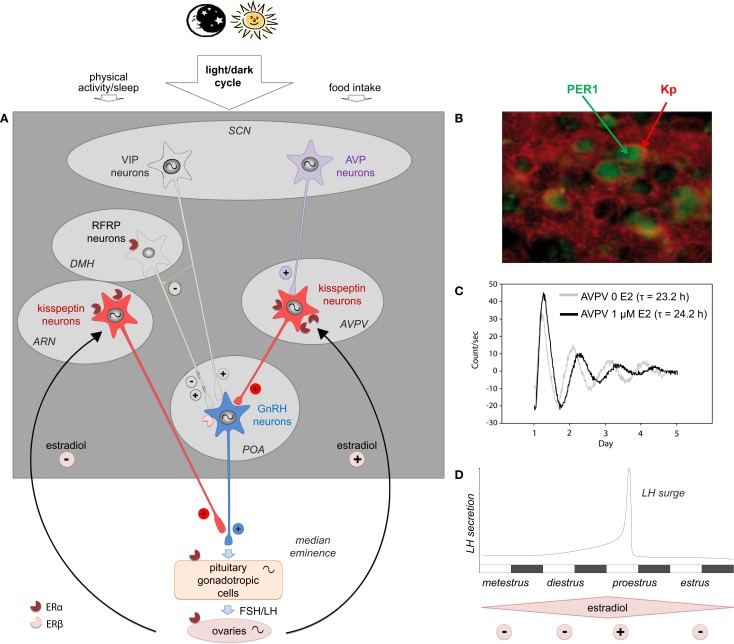
Rhythms in female reproduction are critical to insure that timing of ovulation coincides with oocyte maturation and optimal sexual arousal. This fine tuning of female reproduction involves both the estradiol feedback as an indicator of oocyte maturation, and the master circadian clock of the suprachiasmatic nuclei (SCN) as an indicator of the time of the day. Herein, we are providing an overview of the state of knowledge regarding the differential inhibitory and stimulatory effects of estradiol at different stages of the reproductive axis, and the mechanisms through which the two main neurotransmitters of the SCN, arginine vasopressin, and vasoactive intestinal peptide, convey daily time cues to the reproductive axis. In addition, we will report the most recent findings on the putative functions of peripheral clocks located throughout the reproductive axis [kisspeptin (Kp) neurons, gonadotropin-releasing hormone neurons, gonadotropic cells, the ovary, and the uterus]. This review will point to the critical position of the Kp neurons of the anteroventral periventricular nucleus, which integrate both the stimulatory estradiol signal, and the daily arginine vasopressinergic signal, while displaying a circadian clock. Finally, given the critical role of the light/dark cycle in the synchronization of female reproduction, we will discuss the impact of circadian disruptions observed during shift-work conditions on female reproductive performance and fertility in both animal model and humans.
女性生殖节律对于确保排卵时间与卵母细胞成熟及最佳性唤起相吻合至关重要。女性生殖的这种精细调节涉及作为卵母细胞成熟指标的雌二醇反馈,以及作为一天中时间指标的视交叉上核(SCN)的主生物钟。在此,我们概述了关于雌二醇在生殖轴不同阶段的不同抑制和刺激作用的知识现状,以及SCN的两种主要神经递质——精氨酸加压素和血管活性肠肽将每日时间线索传递至生殖轴的机制。此外,我们将报告关于遍布生殖轴的外周生物钟[促性腺激素释放激素神经元、促性腺细胞、卵巢和子宫中的亲吻素(Kp)神经元]假定功能的最新发现。本综述将指出腹侧脑室前核的Kp神经元的关键地位,其整合了刺激性的雌二醇信号和每日的精氨酸加压素能信号,同时显示出昼夜节律。最后,鉴于光/暗周期在女性生殖同步中的关键作用,我们将讨论在轮班工作条件下观察到的昼夜节律紊乱对动物模型和人类女性生殖性能及生育能力的影响。