Landy Rebecca, Pesola Francesca, Castañón Alejandra, Sasieni Peter
Centre for Cancer Prevention, Wolfson Institute of Preventive Medicine, Bart's & The London School of Medicine, Queen Mary University of London, Charterhouse Square, London EC1M 6BQ, UK.
Br J Cancer. 2016 Oct 25;115(9):1140-1146. doi: 10.1038/bjc.2016.290. Epub 2016 Sep 15.
It is well established that screening can prevent cervical cancer, but the magnitude of the impact of regular screening on cervical cancer mortality is unknown.
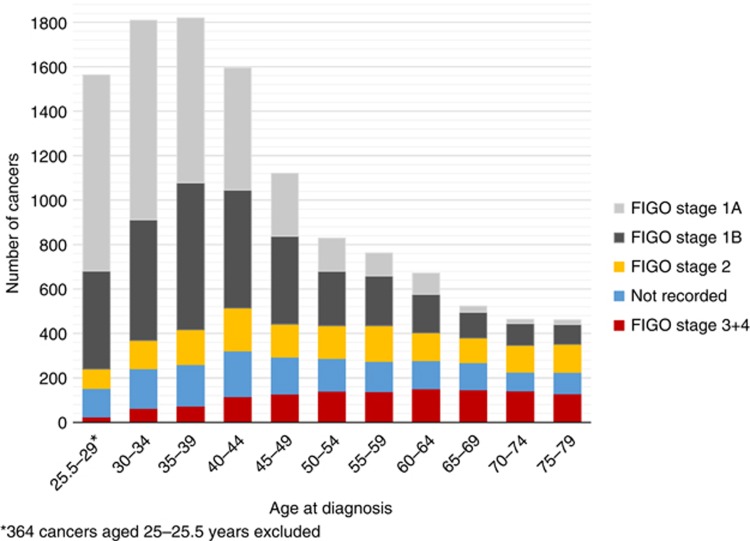
Population-based case-control study using prospectively recorded cervical screening data, England 1988-2013. Case women had cervical cancer diagnosed during April 2007-March 2013 aged 25-79 years (N=11 619). Two cancer-free controls were individually age matched to each case. We used conditional logistic regression to estimate the odds ratio (OR) of developing stage-specific cancer for women regularly screened or irregularly screened compared with women not screened in the preceding 15 years. Mortality was estimated from excess deaths within 5 years of diagnosis using stage-specific 5-year relative survival from England with adjustment for age within stage based on SEER (Surveillance, Epidemiology and End Results, USA) data.
In women aged 35-64 years, regular screening is associated with a 67% (95% confidence interval (CI): 62-73%) reduction in stage 1A cancer and a 95% (95% CI: 94-97%) reduction in stage 3 or worse cervical cancer: the estimated OR comparing regular (⩽5.5yearly) screening to no (or minimal) screening are 0.18 (95% CI: 0.16-0.19) for cancer incidence and 0.08 (95% CI: 0.07-0.09) for mortality. It is estimated that in England screening currently prevents 70% (95% CI: 66-73%) of cervical cancer deaths (all ages); however, if everyone attended screening regularly, 83% (95% CI: 82-84%) could be prevented.
The association between cervical cancer screening and incidence is stronger in more advanced stage cancers, and screening is more effective at preventing death from cancer than preventing cancer itself.
筛查可预防宫颈癌,这一点已得到充分证实,但定期筛查对宫颈癌死亡率的影响程度尚不清楚。
采用前瞻性记录的宫颈筛查数据进行基于人群的病例对照研究,研究对象为1988 - 2013年的英格兰人群。病例组女性在2007年4月至2013年3月期间被诊断为宫颈癌,年龄在25 - 79岁之间(N = 11619)。为每个病例个体匹配两名无癌症的对照,年龄与病例相同。我们使用条件逻辑回归来估计与在过去15年中未进行筛查的女性相比,定期筛查或不定期筛查的女性发生特定阶段癌症的比值比(OR)。根据英格兰特定阶段的5年相对生存率,并基于美国监测、流行病学和最终结果(SEER)数据对阶段内年龄进行调整,从诊断后5年内的超额死亡人数估计死亡率。
在35 - 64岁的女性中,定期筛查与1A期癌症减少67%(95%置信区间(CI):62 - 73%)以及3期或更严重宫颈癌减少95%(95% CI:94 - 97%)相关:将定期(每年≤5.5次)筛查与未(或极少)筛查进行比较,癌症发病率的估计OR为0.18(95% CI:0.16 - 0.19),死亡率的估计OR为0.08(95% CI:0.07 - 0.09)。据估计,在英格兰,目前筛查可预防70%(95% CI:66 - 73%)的宫颈癌死亡(所有年龄段);然而,如果每个人都定期参加筛查,则可预防83%(95% CI:82 - 84%)的宫颈癌死亡。
宫颈癌筛查与发病率之间的关联在更晚期癌症中更强,并且筛查在预防癌症死亡方面比预防癌症本身更有效。