Shahabuddin A S M, Delvaux Thérèse, Utz Bettina, Bardají Azucena, De Brouwere Vincent
Woman and Child Health Research Centre, Department of Public Health, Institute of Tropical Medicine, Antwerp, Belgium ISGlobal, Barcelona Centre for International Health Research (CRESIB), Hospital Clínic-Universitat de Barcelona, Barcelona, Spain Athena Institute for Research on Innovation and Communication in Health and Life Sciences, VU University Amsterdam, Amsterdam, The Netherlands.
Woman and Child Health Research Centre, Department of Public Health, Institute of Tropical Medicine, Antwerp, Belgium.
BMJ Open. 2016 Sep 15;6(9):e012424. doi: 10.1136/bmjopen-2016-012424.
To identify the determinants and measure the trends in health facility-based deliveries and caesarean sections among married adolescent girls in Bangladesh.
In order to measure the trends in health facility-based deliveries and caesarean sections, Bangladesh Demographic Health Survey (BDHS) data sets were analysed (BDHS; 1993-1994, 1996-1997, 1999-2000, 2004, 2007, 2011). The BDHS 2011 data sets were analysed to identify the determinants of health facility-based deliveries and caesarean sections. A total of 2813 adolescent girls (aged 10-19 years) were included for analysis. Bivariate and multivariate analyses were performed.
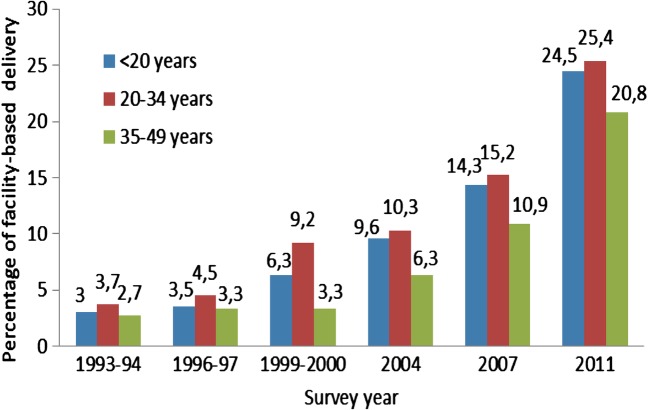
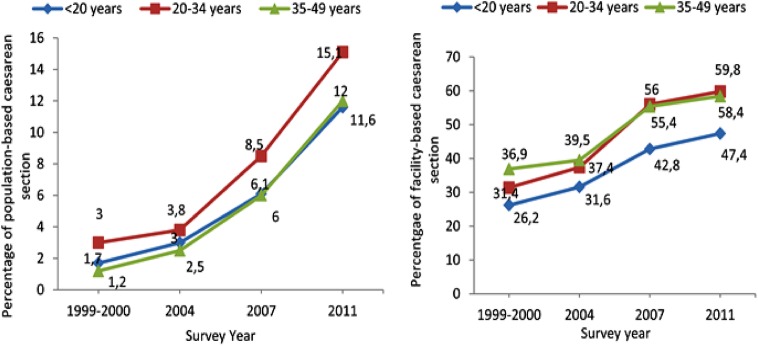
Health facility-based deliveries have continuously increased among adolescents in Bangladesh over the past two decades from 3% in 1993-1994 to 24.5% in 2011. Rates of population-based and facility-based caesarean sections have increased linearly among all age groups of women including adolescents. Although the country's overall (population-based) caesarean section rate among adolescents was within acceptable range (11.6%), a rate of nearly 50% health facility level caesarean sections among adolescent girls is alarming. Among adolescent girls, use of antenatal care (ANC) appeared to be the most important predictor of health facility-based delivery (OR: 4.04; 95% CI 2.73 to 5.99), whereas the wealth index appeared as the most important predictor of caesarean sections (OR: 5.7; 95% CI 2.74 to 12.1).
Maternal health-related interventions should be more targeted towards adolescent girls in order to encourage them to access ANC and promote health facility-based delivery. Rising trends of caesarean sections require further investigation on indication and provider-client-related determinants of these interventions among adolescent girls in Bangladesh.
确定影响因素并衡量孟加拉国已婚少女中基于医疗机构分娩和剖宫产的趋势。
为衡量基于医疗机构分娩和剖宫产的趋势,对孟加拉国人口与健康调查(BDHS)数据集(1993 - 1994年、1996 - 1997年、1999 - 2000年、2004年、2007年、2011年)进行分析。分析2011年BDHS数据集以确定基于医疗机构分娩和剖宫产的影响因素。共纳入2813名年龄在10 - 19岁的少女进行分析。进行了双变量和多变量分析。
在过去二十年中,孟加拉国青少年基于医疗机构的分娩率持续上升,从1993 - 1994年的3%升至2011年的24.5%。包括青少年在内的所有年龄组女性中,基于人群和基于医疗机构的剖宫产率均呈线性上升。尽管该国青少年总体(基于人群)剖宫产率在可接受范围内(11.6%),但少女中近50%的医疗机构剖宫产率令人担忧。在少女中,产前保健(ANC)的使用似乎是基于医疗机构分娩的最重要预测因素(比值比:4.04;95%置信区间2.73至5.99),而财富指数似乎是剖宫产的最重要预测因素(比值比:5.7;95%置信区间2.74至12.1)。
与孕产妇健康相关的干预措施应更有针对性地面向少女,以鼓励她们接受产前保健并促进基于医疗机构的分娩。剖宫产率的上升趋势需要进一步调查孟加拉国少女中这些干预措施的指征以及与提供者 - 服务对象相关的影响因素。