Garrett Leslie A, Growdon Whitfield B, Rueda Bo R, Foster Rosemary
Division of Gynecologic Oncology, Department of OB/GYN, Beth Israel Deaconess Medical Center, 330 Brookline Ave, Kirstein 3rd Floor, Boston, MA, 02215, USA.
Harvard Medical School, Boston, MA, 02114, USA.
J Ovarian Res. 2016 Sep 15;9(1):58. doi: 10.1186/s13048-016-0267-2.
Pre-clinical studies have demonstrated that natural and synthetic histone deacetylase (HDAC) inhibitors can impede the in vitro and in vivo growth of cell lines from a variety of gynecologic and other malignancies. We investigated the anti-tumor activity of panobinostat (LBH589) both in vitro and in vivo as either a single agent or in combination with conventional cytotoxic chemotherapy using patient-derived xenograft (PDX) models of primary serous ovarian tumors.
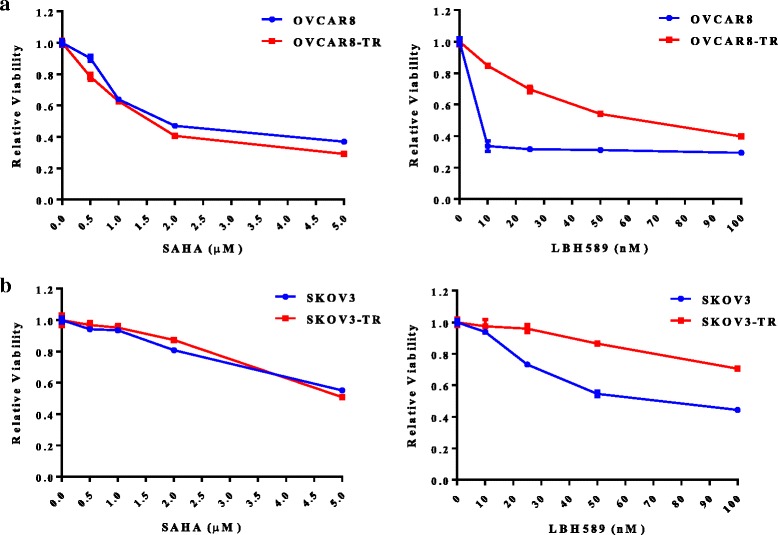
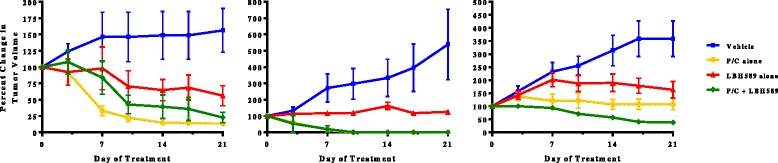
The ovarian cancer cell lines OVCAR8, SKOV3 and their paclitaxel-resistant derivatives OVCAR8-TR and SKOV3-TR were treated with increasing doses of LBH589. The effect of LBH589 on cell viability was assessed using the 3-(4,5-dimethylthiazol-2-yl)-2,5-diphenyltetrazolium bromide (MTT) assay. Serially transplanted primary human high-grade serous ovarian adenocarcinoma tissue was utilized to generate xenografts in 6-week old female NOD/SCID mice. The mice were then randomized into one of 4 treatment groups: (1) vehicle control; (2) paclitaxel and carboplatin (P/C); (3) LBH589; or (4) P/C + LBH589. Mice were treated for 21 days and tumor volumes and mouse weights were obtained every 3 days. These experiments were performed in triplicate with three different patient derived tumors. Wilcoxan rank-sum testing was utilized to assess tumor volume differences.
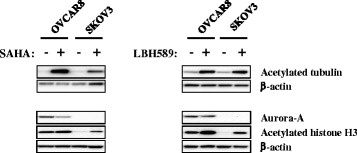
In vitro treatment with LBH589 significantly reduced the viability of both taxol-sensitive and taxol-resistant ovarian cancer cell lines (p < 0.01). In vivo treatment with LBH589 alone appeared tumorstatic and reduced tumor growth when compared to vehicle treatment (p < 0.007) after 21 days. This single agent activity was confirmed in two additional experiments with other PDX tumors (p < 0.03, p < 0.05). A potential additive effect of LBH589 and P/C, manifested as enhanced tumor regression with the addition of LBH589 compared to vehicle (p < 0.02), in one of the three analyzed serous PDX models.
Our findings suggest that pan-HDAC inhibition with panobinostat precludes the growth of ovarian cancer cell lines in vitro and PDXs in vivo. Added benefit of LBH589 to standard P/C therapy was observed in one of three PDX models suggesting improved response in a subset of serous ovarian cancers.
临床前研究表明,天然和合成的组蛋白脱乙酰酶(HDAC)抑制剂可阻碍多种妇科及其他恶性肿瘤细胞系的体外和体内生长。我们使用原发性浆液性卵巢肿瘤的患者来源异种移植(PDX)模型,研究了帕比司他(LBH589)作为单一药物或与传统细胞毒性化疗联合应用时的体外和体内抗肿瘤活性。
用递增剂量的LBH589处理卵巢癌细胞系OVCAR8、SKOV3及其耐紫杉醇衍生物OVCAR8-TR和SKOV3-TR。使用3-(4,5-二甲基噻唑-2-基)-2,5-二苯基四氮唑溴盐(MTT)法评估LBH589对细胞活力的影响。利用连续移植的原发性人类高级别浆液性卵巢腺癌组织在6周龄雌性NOD/SCID小鼠中生成异种移植瘤。然后将小鼠随机分为4个治疗组之一:(1)溶剂对照;(2)紫杉醇和卡铂(P/C);(3)LBH589;或(4)P/C + LBH589。小鼠接受治疗21天,每3天测量肿瘤体积和小鼠体重。这些实验用三种不同的患者来源肿瘤重复进行三次。采用Wilcoxan秩和检验评估肿瘤体积差异。
体外使用LBH589治疗显著降低了紫杉醇敏感和耐药卵巢癌细胞系的活力(p < 0.01)。与溶剂处理相比,单独使用LBH589进行体内治疗在21天后似乎具有肿瘤抑制作用并减少了肿瘤生长(p < 0.007)。在另外两个使用其他PDX肿瘤的实验中也证实了这种单一药物活性(p < 0.03,p < 0.05)。在三个分析的浆液性PDX模型之一中,LBH589和P/C具有潜在的相加作用,表现为与溶剂相比,添加LBH589后肿瘤消退增强(p < 0.02)。
我们的研究结果表明,用帕比司他进行全HDAC抑制可在体外阻止卵巢癌细胞系生长,并在体内阻止PDX生长。在三个PDX模型之一中观察到LBH589加入标准P/C治疗有额外益处,表明一部分浆液性卵巢癌的反应有所改善。