Papa Anselmo, Caruso Davide, Strudel Martina, Tomao Silverio, Tomao Federica
Oncology Unit, Department of Medico-Surgical Sciences and Biotechnologies, University of Rome "Sapienza", Latina, Italy.
Oncology Unit, Department of Radiological Sciences, Oncology and Pathology, University of Rome "Sapienza", Latina, Italy.
J Transl Med. 2016 Sep 15;14:267. doi: 10.1186/s12967-016-1027-1.
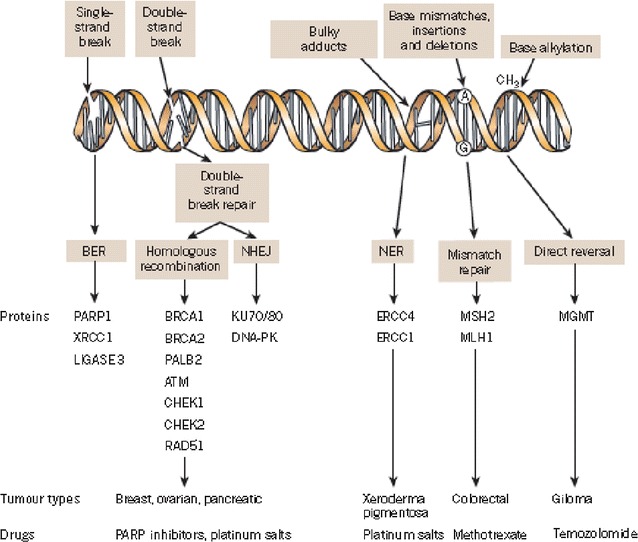
Despite standard treatment for epithelial ovarian cancer (EOC), that involves cytoreductive surgery followed by platinum-based chemotherapy, and initial high response rates to these, up to 80 % of patients experience relapses with a median progression-free survival of 12-18 months. There remains an urgent need for novel targeted therapies to improve clinical outcomes in ovarian cancer. Of the many targeted therapies currently under evaluation, the most promising strategies developed thus far are antiangiogenic agents and Poly(ADP-ribose) polymerase (PARP) inhibitors. Particularly, PARP inhibitors are active in cells that have impaired repair of DNA by the homologous recombination (HR) pathway. Cells with mutated breast related cancer antigens (BRCA) function have HR deficiency, which is also present in a significant proportion of non-BRCA-mutated ovarian cancer ("BRCAness" ovarian cancer). The prevalence of germline BRCA mutations in EOC has historically been estimated to be around 10-15 %. However, recent reports suggest that this may be a gross underestimate, especially in women with high-grade serous ovarian cancer (HGSOC). The emergence of the DNA repair pathway as a rational target in various cancers led to the development of the PARP inhibitors. The concept of tumor-selective synthetic lethality heralded the beginning of an eventful decade, culminating in the approval by regulatory authorities both in Europe as a maintenance therapy and in the United States treatment for advanced recurrent disease of the first oral PARP inhibitor, olaparib, for the treatment of BRCA-mutated ovarian cancer patients. Other PARP inhibitors are clearly effective in this disease and, within the next years, the results of ongoing randomized trials will clarify their respective roles.
This review will discuss the different PARP inhibitors in development and the potential use of this class of agents in the future. Moreover, combination strategies involving PARP inhibitors are likely to receive increasing attention. The utility of PARP inhibitors combined with cytotoxic chemotherapy is of doubtful value, because of enhanced toxicity of this combination; while, more promising strategies include the combination with antiangiogenic agents, or with inhibitors of the P13K/AKT pathway and new generation of immunotherapy.
尽管上皮性卵巢癌(EOC)的标准治疗包括肿瘤细胞减灭术及随后的铂类化疗,且初始反应率较高,但高达80%的患者会复发,无进展生存期的中位数为12至18个月。迫切需要新的靶向治疗来改善卵巢癌的临床结局。在目前正在评估的众多靶向治疗中,迄今为止开发的最有前景的策略是抗血管生成药物和聚(ADP - 核糖)聚合酶(PARP)抑制剂。特别是,PARP抑制剂在通过同源重组(HR)途径进行DNA修复受损的细胞中具有活性。具有突变的乳腺癌相关抗原(BRCA)功能的细胞存在HR缺陷,这在相当比例的非BRCA突变型卵巢癌(“BRCA样”卵巢癌)中也存在。历史上,EOC中胚系BRCA突变的发生率估计约为10%至15%。然而,最近的报告表明,这可能被严重低估,尤其是在高级别浆液性卵巢癌(HGSOC)患者中。DNA修复途径作为各种癌症的合理靶点的出现导致了PARP抑制剂的开发。肿瘤选择性合成致死的概念预示着一个多事之十年的开始,最终欧洲监管机构批准将首个口服PARP抑制剂奥拉帕利作为维持治疗药物,美国批准其用于治疗晚期复发性BRCA突变型卵巢癌患者。其他PARP抑制剂在这种疾病中显然有效,在未来几年内,正在进行的随机试验结果将阐明它们各自的作用。
本综述将讨论正在开发的不同PARP抑制剂以及这类药物在未来的潜在用途。此外,涉及PARP抑制剂的联合策略可能会受到越来越多的关注。PARP抑制剂与细胞毒性化疗联合使用的效用存在疑问,因为这种联合毒性增强;而更有前景的策略包括与抗血管生成药物联合,或与PI3K/AKT途径抑制剂及新一代免疫疗法联合。