Xie Xiaoli, Han Meng, Zhang Liang, Liu Laixing, Gu Zuye, Yang Mei, Yang Hongjun
Dairy Cattle Research Center, Shandong Academy of Agricultural Sciences, Shandong, China.
Jundishapur J Microbiol. 2016 May 30;9(6):e33264. doi: 10.5812/jjm.33264. eCollection 2016 Jun.
Mycobacterium tuberculosis is the major pathogen of tuberculosis, which affects approximately one-third of the world's population. The 6 kDa early secreted antigenic target (ESAT6) and the 10 kDa culture filtrate protein (CFP10), which are secreted by the ESX-1 system in M. tuberculosis, can contribute to mycobacterial virulence.
The aim of this study was to research the effects of M. tuberculosis ESAT6-CFP10 protein on macrophages during a host's was first and second exposures to M. tuberculosis.
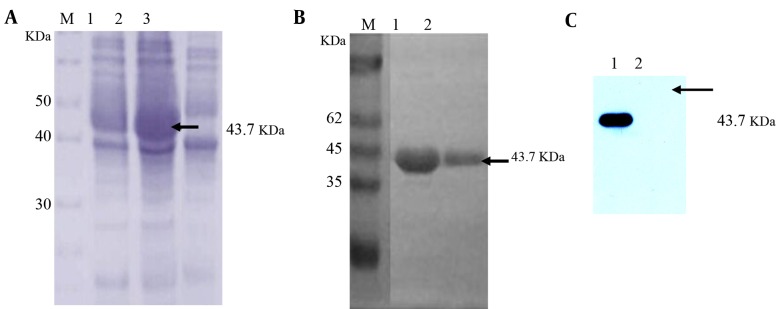
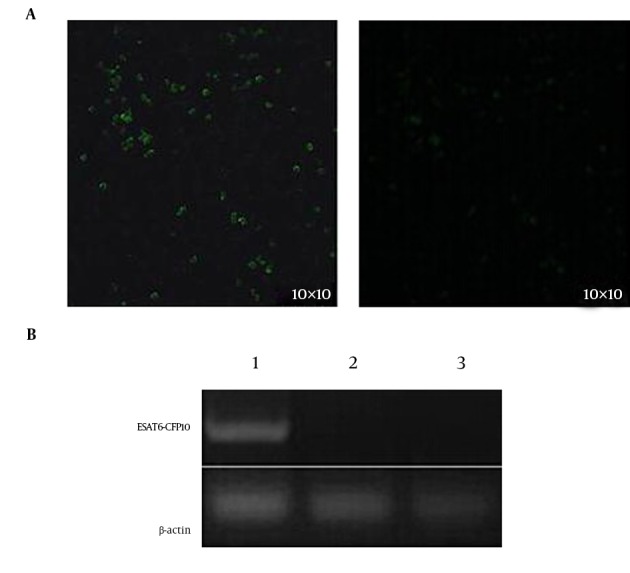
In this study, the ESAT6 and CFP10 genes were amplified to create a fusion gene (ESAT6-CFP10) and cloned into the pET-32a(+) and pEGFP-N1 expression vectors, respectively. The recombinant pET-32a(+)-ESAT6-CFP10 plasmid was transformed into the Escherichia coli Origami strain, and the fusion protein was expressed and confirmed by SDS-PAGE and Western blot analysis. The recombinant pEGFP-N1-ESAT6-CFP10 plasmid was transfected into rat alveolar macrophage cells (NR8383). The cell line expressing the ESAT6-CFP10 protein was selected with RT-PCR and designated as NR8383-EC. Finally, the effects of the ESAT6-CFP10 fusion protein on the NR8383 cell line, as well as on the newly constructed NR8383-EC cells, were further assessed.
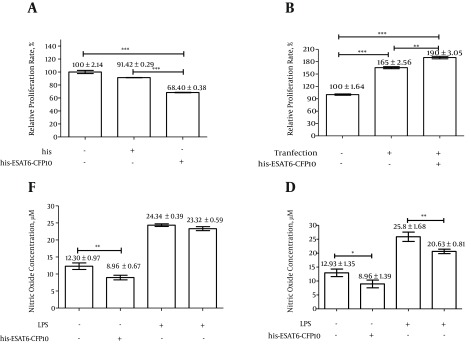
The recombinant ESAT6-CFP10 protein was expressed in E. coli and in NR8383 rat alveolar macrophages. This protein affected the proliferation and nitric oxide (NO) generation of the NR8383 and NR8383-EC cells. Although NO generation was inhibited in both cell lines, proliferation was inhibited in NR8383 while it was increased NR8383-EC.
The data indicate that ESAT6-CFP10 could support the survival of M. tuberculosis in the host through altering the host immune response. It also indicates that the host may gain some level of protection from a second exposure to M. tuberculosis, as evidenced by increased proliferation of NR8383-EC.
结核分枝杆菌是结核病的主要病原体,全球约三分之一的人口受其影响。结核分枝杆菌中由ESX-1系统分泌的6 kDa早期分泌抗原靶点(ESAT6)和10 kDa培养滤液蛋白(CFP10)可增强分枝杆菌的毒力。
本研究旨在探讨结核分枝杆菌ESAT6-CFP10蛋白在宿主初次和再次接触结核分枝杆菌期间对巨噬细胞的影响。
本研究中,扩增ESAT6和CFP10基因以创建融合基因(ESAT6-CFP10),并分别克隆到pET-32a(+)和pEGFP-N1表达载体中。将重组pET-32a(+)-ESAT6-CFP10质粒转化到大肠杆菌Origami菌株中,通过SDS-PAGE和蛋白质免疫印迹分析表达并确认融合蛋白。将重组pEGFP-N1-ESAT6-CFP10质粒转染到大鼠肺泡巨噬细胞(NR8383)中。通过RT-PCR筛选出表达ESAT6-CFP10蛋白的细胞系,并命名为NR8383-EC。最后,进一步评估ESAT6-CFP10融合蛋白对NR8383细胞系以及新构建的NR8383-EC细胞的影响。
重组ESAT6-CFP10蛋白在大肠杆菌和NR8383大鼠肺泡巨噬细胞中均有表达。该蛋白影响NR8383和NR8383-EC细胞的增殖及一氧化氮(NO)的产生。虽然两种细胞系中NO的产生均受到抑制,但NR8383细胞的增殖受到抑制,而NR8383-EC细胞的增殖增加。
数据表明,ESAT6-CFP10可通过改变宿主免疫反应来支持结核分枝杆菌在宿主体内的存活。这也表明,宿主再次接触结核分枝杆菌时可能会获得一定程度的保护,NR8383-EC细胞增殖增加即为证据。