Pereira Dhelio, Daher André, Zanini Graziela, Maia Ivan, Fonseca Lais, Pitta Luciana, Ruffato Rosilene, Marchesini Paola, Fontes Cor Jesus
Tropical Medicine Research Center of Rondônia (CEPEM), Porto Velho, Rondônia, Brazil.
Laboratory of Parasitology, National Institute of Infectious Disease, Oswaldo Cruz Foundation (FIOCRUZ), Rio de Janeiro, Brazil.
Malar J. 2016 Sep 17;15:477. doi: 10.1186/s12936-016-1530-0.
Malaria remains a major public health problem, with half the world population at risk of contracting malaria. The effects of Plasmodium vivax on prosperity and longevity have been highlighted in several recent clinical case reports. The first line of vivax treatment drugs has seen no radical innovation for more than 60 years. This study introduces a subtle incremental innovation to vivax treatment: a chloroquine and primaquine co-blister. The co-blister includes a new chloroquine formulation incorporating coated tablets to mask the drug's bitter taste and user-friendly packaging containing tablets of each drug, which may improve patient adherence and facilitate the appropriate use of the drugs. This new formulation will replace the non-coated chloroquine distributed in Brazil.
Patients were orally treated with 150 mg coated chloroquine tablets for 3 days: an initial 450 mg dose, followed by two 300 mg doses. The patients were treated concomitantly with two 15 mg primaquine tablets for 7-9 days, according to their weight. The primary objective of this study was to prove parasitological and clinical cure rates above 90 % by day 28.
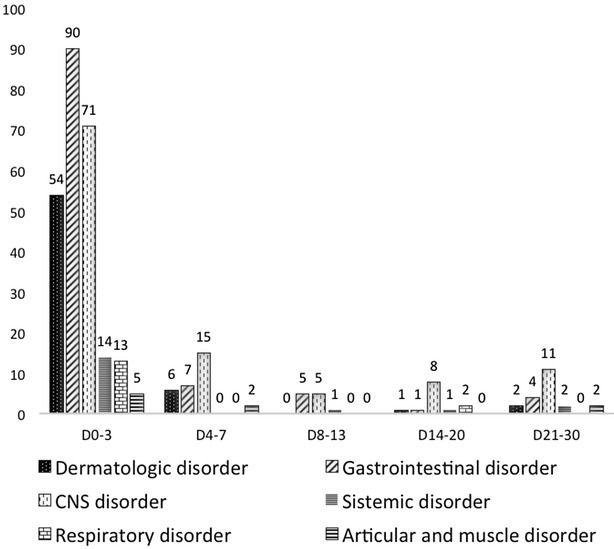
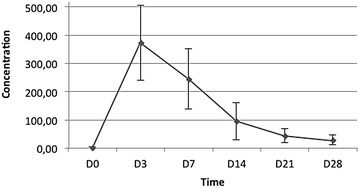
This single-arm open-label non-comparative trial was conducted according to the WHO recommended methodology for the surveillance of anti-malarial drug efficacy in the Brazilian Amazon. On day 28, the parasitological and clinical response was adequate in 98.8 % of patients (CI 95 % 93.4-100 %). The success rate on day 3 was 100 %, and the cumulative success rate by day 28 was 98.8 % (CI 95 % 91.7-99.8 %). There were no serious adverse events, with most adverse events classified as mild. The pharmacokinetic parameters of chloroquine analysed in whole blood dry spot samples showed mean (coefficient of variation) Cmax and AUC0-t values of 374.44 (0.35) and 3700.43 (0.36) ng/mL, respectively.
This study reports an appropriate safety and efficacy profile of a new formulation of coated chloroquine tablets for vivax malaria treatment in the Brazilian Amazon. The cure rates meet the WHO efficacy criteria, supporting current Brazilian guidelines and the use of the formulation for vivax malaria treatment. Nevertheless, further studies should be conducted to address adherence and the effectiveness of the formulation. Trial registration RBR-77q7t3-UTN: U1111-1121-2982. Registered 10th May 2011.
疟疾仍然是一个主要的公共卫生问题,全球一半人口面临感染疟疾的风险。近期的一些临床病例报告强调了间日疟原虫对健康和寿命的影响。间日疟治疗的一线药物在60多年来没有根本性的创新。本研究为间日疟治疗引入了一项细微的渐进式创新:氯喹和伯氨喹复方泡罩包装。该复方泡罩包装包括一种新的氯喹制剂,采用包衣片以掩盖药物的苦味,以及方便用户的包装,其中包含每种药物的片剂,这可能会提高患者的依从性并促进药物的合理使用。这种新制剂将取代巴西分发的非包衣氯喹。
患者口服150毫克包衣氯喹片,持续3天:初始剂量450毫克,随后是两个300毫克剂量。根据患者体重,同时给予两个15毫克伯氨喹片,持续7 - 9天。本研究的主要目的是在第28天证明寄生虫学和临床治愈率高于90%。
这项单臂开放标签非对照试验是根据世界卫生组织推荐的方法在巴西亚马逊地区进行的抗疟药物疗效监测。在第28天,98.8%的患者(95%置信区间93.4 - 100%)的寄生虫学和临床反应良好。第3天的成功率为100%,到第28天的累积成功率为98.8%(95%置信区间91.7 - 99.8%)。没有严重不良事件,大多数不良事件分类为轻度。在全血干斑样本中分析的氯喹药代动力学参数显示,平均(变异系数)Cmax和AUC0 - t值分别为374.44(0.35)和3700.43(0.36)纳克/毫升。
本研究报告了一种用于巴西亚马逊地区间日疟治疗的新的包衣氯喹片制剂具有适当的安全性和疗效。治愈率符合世界卫生组织的疗效标准,支持当前巴西的指南以及该制剂用于间日疟治疗。然而,应进行进一步研究以解决依从性和该制剂的有效性问题。试验注册号RBR - 77q7t3 - UTN:U1111 - 1121 - 2982。2011年5月10日注册。