Cutter Gary R, Knappertz Volker, Sasson Nissim, Ladkani David
Department of Biostatistics, School of Public Health, University of Alabama at Birmingham, Room 327, 1720 2nd Avenue South, Birmingham, AL, 35294, USA.
Department of Neurology and Psychiatry, Heinrich-Heine University, Düsseldorf, Germany.
BMC Neurol. 2016 Sep 17;16:176. doi: 10.1186/s12883-016-0702-4.
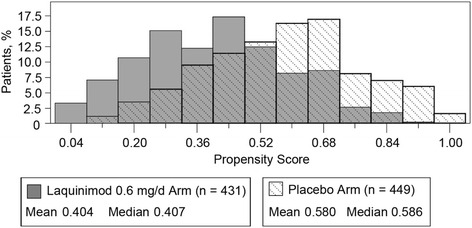
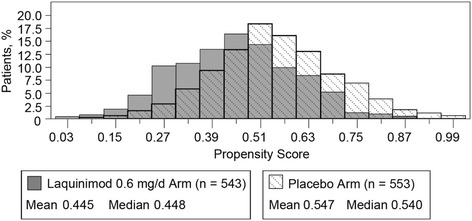
The results of two randomized phase 3 trials that investigated the use of laquinimod in patients with relapsing-remitting multiple sclerosis were analyzed using a propensity score model.
The propensity score in each study was defined as the probability of an individual patient being assigned to either the laquinimod or placebo study arm. The analysis included two main stages: (1) calculation of a propensity score for each patient, given a broad set of baseline covariates that included second-degree interactions, and (2) incorporation of the propensity score as another covariate into the predefined primary analysis model to test the treatment effect of laquinimod (0.6 mg/d) vs placebo on the annualized relapse rate (ARR).
The BRAVO study showed baseline imbalances for T2 volume and the proportion of patients with gadolinium (Gd)-enhancing lesions, both parameters known to correlate with risk of relapse. Adjustment using the propensity score as a categorical variable showed that the estimated difference in ARR between laquinimod and placebo was 0.078, in favor of laquinimod. In ALLEGRO, the baseline Gd-enhancing lesion mean score was higher for placebo vs laquinimod. When the primary analysis model was adjusted for the propensity score as a categorical variable, the covariate adjusted difference in mean ARR between laquinimod and placebo was 0.084, in favor of laquinimod.
Propensity scores addressing differences in baseline characteristics may be helpful to better understand whether observed treatment effect differences in randomized controlled trials are accurate results or result from inherent differences between patients with multiple sclerosis.
采用倾向评分模型分析了两项随机3期试验的结果,这两项试验研究了拉喹莫德在复发缓解型多发性硬化症患者中的应用。
每项研究中的倾向评分定义为个体患者被分配到拉喹莫德或安慰剂研究组的概率。分析包括两个主要阶段:(1)在一组广泛的基线协变量(包括二阶相互作用)的情况下,计算每个患者的倾向评分;(2)将倾向评分作为另一个协变量纳入预定义的主要分析模型,以测试拉喹莫德(0.6mg/d)与安慰剂对年化复发率(ARR)的治疗效果。
BRAVO研究显示,T2体积和钆(Gd)增强病灶患者比例存在基线失衡,这两个参数均与复发风险相关。使用倾向评分作为分类变量进行调整后显示,拉喹莫德与安慰剂之间ARR的估计差异为0.078,有利于拉喹莫德。在ALLEGRO研究中,安慰剂组的基线Gd增强病灶平均评分高于拉喹莫德组。当将主要分析模型针对倾向评分作为分类变量进行调整时,拉喹莫德与安慰剂之间平均ARR的协变量调整差异为0.084,有利于拉喹莫德。
处理基线特征差异的倾向评分可能有助于更好地理解在随机对照试验中观察到的治疗效果差异是准确结果还是由多发性硬化症患者之间的固有差异导致。