Unger Holger W, Ashorn Per, Cates Jordan E, Dewey Kathryn G, Rogerson Stephen J
Department of Medicine at the Doherty Institute, The University of Melbourne, Melbourne, Victoria, Australia.
Simpson Centre for Reproductive Health, Edinburgh Royal Infirmary, Edinburgh, UK.
BMC Med. 2016 Sep 19;14(1):142. doi: 10.1186/s12916-016-0695-2.
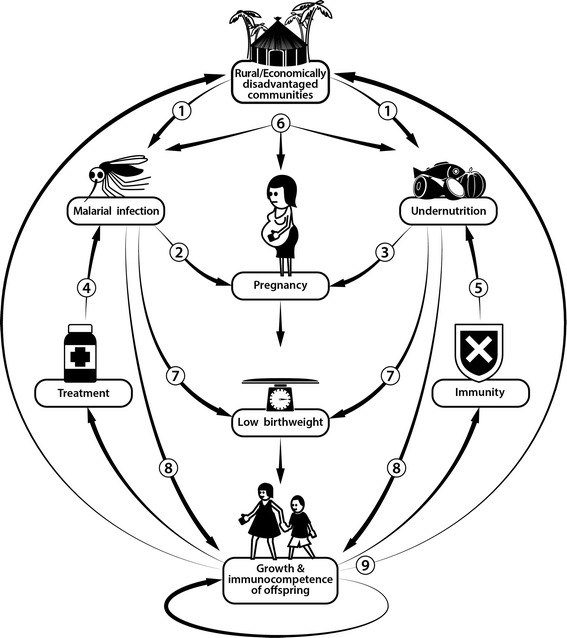
In low-resource settings, malaria and macronutrient undernutrition are major health problems in pregnancy, contributing significantly to adverse pregnancy outcomes such as preterm birth and fetal growth restriction. Affected pregnancies may result in stillbirth and neonatal death, and surviving children are at risk of poor growth and infection in infancy, and of non-communicable diseases in adulthood. Populations exposed to macronutrient undernutrition frequently reside in malaria-endemic areas, and seasonal peaks of low food supply and malaria transmission tend to coincide. Despite these geographic and temporal overlaps, integrated approaches to these twin challenges are infrequent.
This opinion article examines the current evidence for malaria-macronutrition interactions and discusses possible mechanisms whereby macronutrient undernutrition and malaria may interact to worsen pregnancy outcomes. Macronutrient undernutrition dysregulates the immune response. In pregnant women, undernutrition may worsen the already increased susceptibility to malarial infection and could impair development of protective immunity to malaria, and is likely to exacerbate the impact of placental malaria on fetal growth. Malarial infection, in turn, can drive nutritional depletion; poor gestational weight gain and weight loss in pregnancy increases the risk of adverse pregnancy outcomes. Despite a commendable number of studies and trials that, in isolation, attempt to address the challenges of malaria and undernutrition in pregnancy, few dare to venture beyond the 'single disease - single solution' paradigm. We believe that this may be a lost opportunity: researching malaria-nutrition interactions, and designing and implementing integrated interventions to prevent and treat these commonly co-existing and intertwining conditions, may markedly reduce the high burden of preterm birth and fetal growth restriction in affected areas.
We call for more collaboration between researchers studying malaria and nutrition in pregnancy, and propose a research agenda to address this important twin health problem.
在资源匮乏地区,疟疾和宏量营养素营养不良是孕期的主要健康问题,对早产和胎儿生长受限等不良妊娠结局有重大影响。受影响的妊娠可能导致死产和新生儿死亡,存活下来的儿童在婴儿期有生长发育不良和感染的风险,在成年期有患非传染性疾病的风险。暴露于宏量营养素营养不良的人群通常居住在疟疾流行地区,食物供应不足和疟疾传播的季节性高峰往往同时出现。尽管存在这些地理和时间上的重叠,但针对这双重挑战的综合方法却很少见。
这篇观点文章审视了目前关于疟疾与宏量营养素相互作用的证据,并讨论了宏量营养素营养不良和疟疾可能相互作用从而使妊娠结局恶化的潜在机制。宏量营养素营养不良会使免疫反应失调。在孕妇中,营养不良可能会使本就已增加的疟疾感染易感性恶化,并可能损害对疟疾的保护性免疫的发展,而且很可能会加剧胎盘疟疾对胎儿生长的影响。反过来,疟疾感染会导致营养消耗;孕期体重增加不佳和体重减轻会增加不良妊娠结局的风险。尽管有相当数量的研究和试验单独尝试应对孕期疟疾和营养不良的挑战,但很少有研究敢于超越“单一疾病 - 单一解决方案”的模式。我们认为这可能是一个错失的机会:研究疟疾与营养的相互作用,设计并实施综合干预措施来预防和治疗这些常见且相互交织的状况,可能会显著降低受影响地区早产和胎儿生长受限的高负担。
我们呼吁研究孕期疟疾和营养的研究人员之间加强合作,并提出一项研究议程来解决这一重要的双重健康问题。