Gray Stephen, Cohen Paula E
Department of Biomedical Sciences and Center for Reproductive Genomics, Cornell University, Ithaca, New York 14853; email:
Annu Rev Genet. 2016 Nov 23;50:175-210. doi: 10.1146/annurev-genet-120215-035111. Epub 2016 Sep 14.
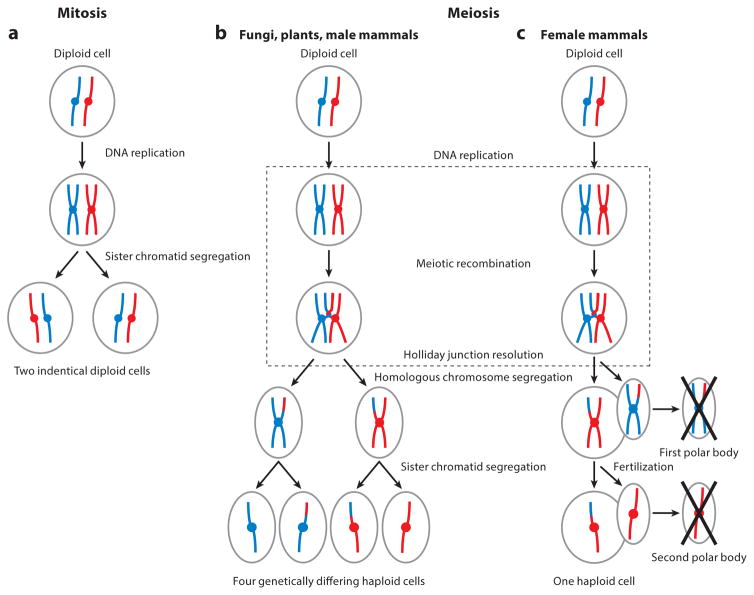
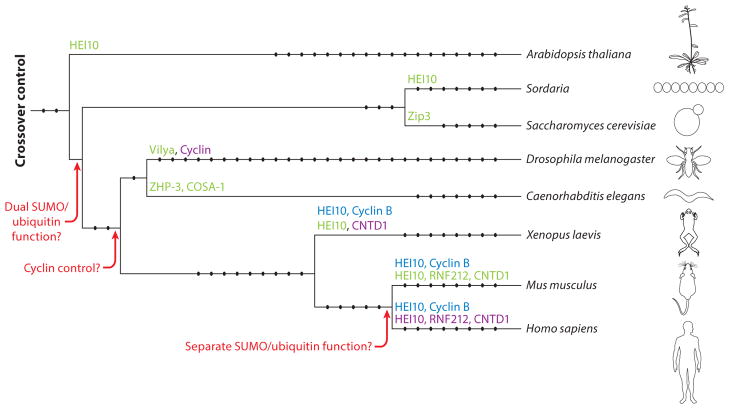
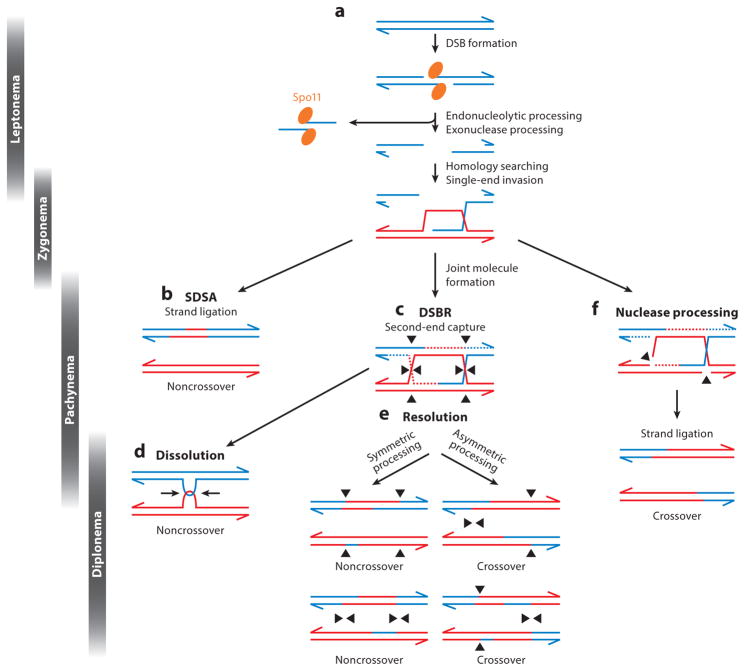
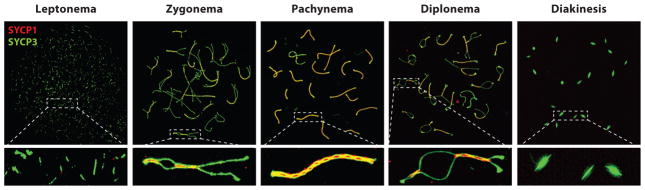
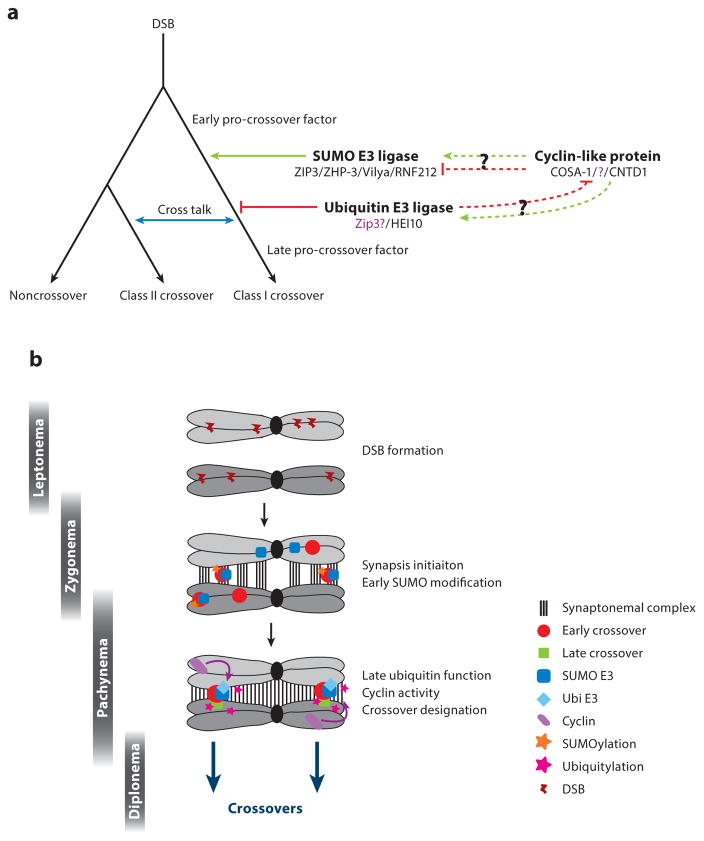
Meiosis, the mechanism of creating haploid gametes, is a complex cellular process observed across sexually reproducing organisms. Fundamental to meiosis is the process of homologous recombination, whereby DNA double-strand breaks are introduced into the genome and are subsequently repaired to generate either noncrossovers or crossovers. Although homologous recombination is essential for chromosome pairing during prophase I, the resulting crossovers are critical for maintaining homolog interactions and enabling accurate segregation at the first meiotic division. Thus, the placement, timing, and frequency of crossover formation must be exquisitely controlled. In this review, we discuss the proteins involved in crossover formation, the process of their formation and designation, and the rules governing crossovers, all within the context of the important landmarks of prophase I. We draw together crossover designation data across organisms, analyze their evolutionary divergence, and propose a universal model for crossover regulation.
减数分裂是产生单倍体配子的机制,是在有性生殖生物中观察到的复杂细胞过程。减数分裂的基础是同源重组过程,即DNA双链断裂被引入基因组,随后被修复以产生非交叉或交叉。虽然同源重组对于前期I的染色体配对至关重要,但产生的交叉对于维持同源物相互作用和在第一次减数分裂时实现准确分离至关重要。因此,交叉形成的位置、时间和频率必须受到精确控制。在这篇综述中,我们讨论了参与交叉形成的蛋白质、它们的形成和指定过程,以及在前期I的重要标志背景下控制交叉的规则。我们汇总了不同生物的交叉指定数据,分析了它们的进化差异,并提出了一个交叉调控的通用模型。