Liang Ying, Yang Wenhui, Zhu Yanhui, Yuan Yulin
Department of Clinical Laboratory, General Hospital of the Yangtze River Shipping, Wuhan, Hubei China.
Department of Clinical Laboratory, The People's Hospital of Guangxi Zhuang Autonomous Region, Nanning, Guangxi China.
Springerplus. 2016 Sep 13;5(1):1538. doi: 10.1186/s40064-016-3225-y. eCollection 2016.
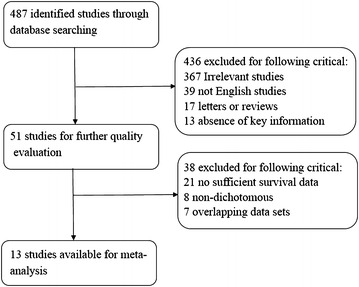
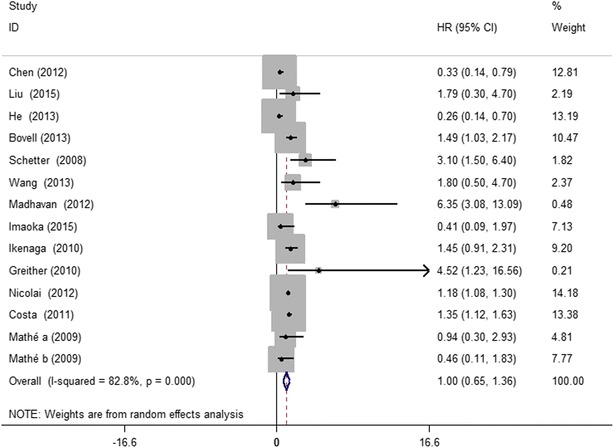
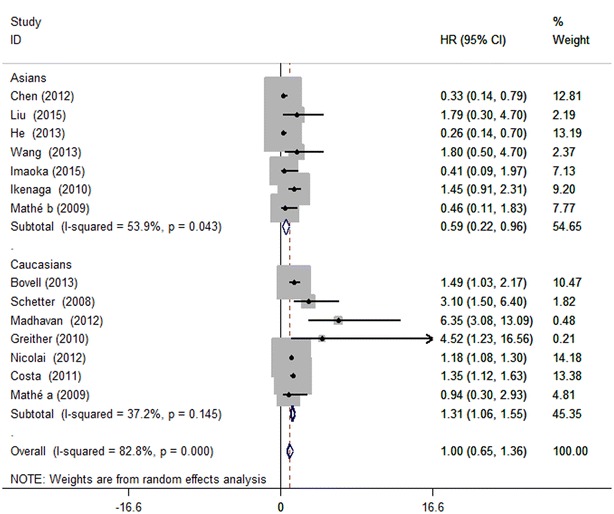
Growing evidence from recent studies has revealed that microRNA-203 (miR-203) might be an attractive prognostic biomarker for cancer. But controversy still remains. The aim of this meta-analysis was to summarize available evidences and clarify the preliminary predictive value of miR-203 for prognosis in cancer patients. Eligible studies were identified through multiple research strategies in PubMed, EMBASE and Web of Science up to October 2015. Key statistics such as pooled hazard ratios (HR) with 95 % confidence intervals (CIs) were utilized to calculate patient survival. 13 eligible studies with 1600 patients were ultimately enrolled in this meta-analysis. Our results failed to show a significant relation between upregulated miR-203 expression and a favorable overall survival (OS) (HR 1.00, 95 % CI 0.65-1.36) in a random effect model. However, in subgroup analysis, we found that high expression of miR-203 was significantly associated with poor OS in Caucasian patients (HR 1.31, 95 % CI 1.06-1.55). In contrast, for Asian patients, over-expression of miR-203 was an independent prognostic factor for better and OS (HR 0.59, 95 % CI 0.22-0.96). It also suggested that cancer types and miRNA assay method were significant associated with prognosis. The over-expression of miR-203 was effectively predictive of worse prognosis in breast cancer (HR 6.35, 95 % CI 1.34-11.36), pancreatic cancer (HR 1.19, 95 % CI 1.08-1.30), ependymoma (HR 1.35, 95 % CI 1.10-1.61), but for glioma patients, elevated miR-203 is a potential biomarker for predicting better progression of cancer (HR 0.26, 95 % CI -0.02 to 0.54). Besides, for direct miRNA profiling studies, over-expression of miR-203 was an independent prognostic factor for worse OS (HR 6.35, 95 % CI 1.34-11.36). This meta-analysis indicated that ethnicity, tumor type and miRNA assay method mainly contributed to heterogeneity. Considering the insufficient evidence, further relevant studies are warranted.
近期研究中越来越多的证据表明,微小RNA-203(miR-203)可能是一种有吸引力的癌症预后生物标志物。但争议仍然存在。本荟萃分析的目的是总结现有证据,并阐明miR-203对癌症患者预后的初步预测价值。通过多种检索策略在PubMed、EMBASE和Web of Science数据库中检索截至2015年10月的相关研究。利用合并风险比(HR)及95%置信区间(CI)等关键统计量计算患者生存率。最终纳入13项符合条件的研究,共1600例患者。在随机效应模型中,我们的结果未能显示miR-203表达上调与良好的总生存期(OS)之间存在显著关联(HR 1.00,95%CI 0.65-1.36)。然而,在亚组分析中,我们发现miR-203高表达与白种人患者较差的OS显著相关(HR 1.31,95%CI 1.06-1.55)。相反,对于亚洲患者,miR-203过表达是更好的OS的独立预后因素(HR 0.59,95%CI 0.22-0.96)。这也表明癌症类型和miRNA检测方法与预后显著相关。miR-203过表达可有效预测乳腺癌(HR 6.35,95%CI 1.34-11.36)、胰腺癌(HR 1.19,95%CI 1.08-1.30)、室管膜瘤(HR 1.35,95%CI 1.10-1.61)预后较差,但对于胶质瘤患者,miR-203升高是预测癌症更好进展的潜在生物标志物(HR 0.26,95%CI -0.02至0.54)。此外,对于直接的miRNA谱分析研究,miR-203过表达是较差OS的独立预后因素(HR 6.35,95%CI 1.34-11.36)。本荟萃分析表明,种族、肿瘤类型和miRNA检测方法是异质性的主要来源。鉴于证据不足,有必要进行进一步的相关研究。