Zambrano Andrea I, Sharma Shekhar, Crowley Kathryn, Dize Laura, Muñoz Beatriz E, Mishra Sailesh K, Rotondo Lisa A, Gaydos Charlotte A, West Sheila K
Wilmer Eye Institute, Johns Hopkins School of Medicine, Baltimore, Maryland.
National Trachoma Program, Nepal Netra Jyoti Sangh (NNJS), Kathmandu, Nepal.
PLoS Negl Trop Dis. 2016 Sep 21;10(9):e0005003. doi: 10.1371/journal.pntd.0005003. eCollection 2016 Sep.
The World Health Organization (WHO) now requires a second surveillance survey for trachoma after an impact assessment has found follicular trachoma (TF) <5% to determine if re-emergence has occurred. Using new WHO guidelines, we undertook surveillance surveys, and determined the prevalence of infection and antibody positivity, in two districts in Nepal.
20 clusters were randomly selected within each district, 15 were randomly selected for antibody testing. In each cluster, we randomly selected 50 children ages 1-9 years and 100 adults ≥15 years. TF and trachomatous trichiasis (TT) were evaluated. Conjunctival swabs to test for chlamydial infection using GenXpert platform were obtained, and dried blood spots were collected to test for antibodies to Chlamydia Trachomatis pgp3 using the Luminex platform.
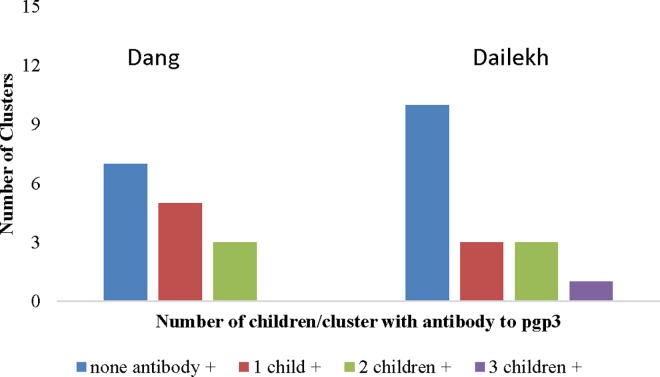
3 cases of TF were found in the two districts, and one case of infection. Pgp3 antibody positivity was 2·4% (95% confidence interval: 1·4%, 3·7%), and did not increase with age (P = 0.24). No clustering of antibody positivity within communities was found. TT prevalence was <1/1,000 population.
The surveillance surveys, as proposed by WHO, showed no evidence for re-emergence of trachoma in two districts of Nepal. The low level and no significant increase by age in seroprevalence of antibodies to C trachomatis pgp3 antigen deserve further investigation as a marker of interruption of transmission.
世界卫生组织(WHO)现要求在影响评估发现滤泡性沙眼(TF)<5%后,对沙眼进行第二次监测调查,以确定是否出现了再次流行。我们依据WHO的新指南,在尼泊尔的两个地区开展了监测调查,并确定了感染率和抗体阳性率。
在每个地区随机选择20个群组,其中15个随机选择用于抗体检测。在每个群组中,我们随机选择50名1 - 9岁的儿童和100名≥15岁的成年人。对TF和沙眼性倒睫(TT)进行评估。使用GeneXpert平台获取结膜拭子以检测衣原体感染,并收集干血斑以使用Luminex平台检测沙眼衣原体pgp3抗体。
在这两个地区发现了3例TF病例和1例感染病例。pgp3抗体阳性率为2.4%(95%置信区间:1.4%,3.7%),且不随年龄增加(P = 0.24)。未发现社区内抗体阳性的聚集情况。TT患病率<1/1000人口。
WHO提议的监测调查显示,尼泊尔两个地区没有沙眼再次流行的证据。沙眼衣原体pgp3抗原抗体血清阳性率水平较低且不随年龄显著增加,作为传播阻断的一个指标值得进一步研究。