Labruna Marcelo B, Nava Santiago, Marcili Arlei, Barbieri Amalia R M, Nunes Pablo H, Horta Mauricio C, Venzal José M
Departamento de Medicina Veterinária Preventiva e Saúde Animal, Faculdade de Medicina Veterinária e Zootecnia, Universidade de São Paulo, Av. Prof. Orlando Marques de Paiva 87, São Paulo, 05508-270, Brazil.
Instituto Nacional de Tecnología Agropecuaria, Estación Experimental Agropecuaria Rafaela and Consejo Nacional de Investigaciones Científicas y Técnicas, CC 22, CP 2300, Rafaela, Santa Fe, Argentina.
Parasit Vectors. 2016 Sep 21;9(1):511. doi: 10.1186/s13071-016-1796-7.
The rock cavy Kerodon rupestris (Wied-Neuwied, 1820) is a rodent species endemic to northeastern Brazil. Earlier studies have associated the argasid tick Ornithodoros talaje (Guérin-Méneville, 1849) with rocky cavy; however, a recent study proposed that O. talaje is not established in Brazil, where previous reports of this species were possibly misidentifications of closely related species, yet to be properly determined. Here, we describe a new species of Ornithodoros Koch, 1844 associated with rock cavies in northeastern Brazil.
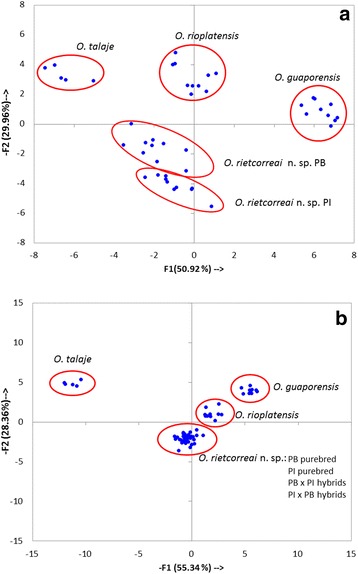
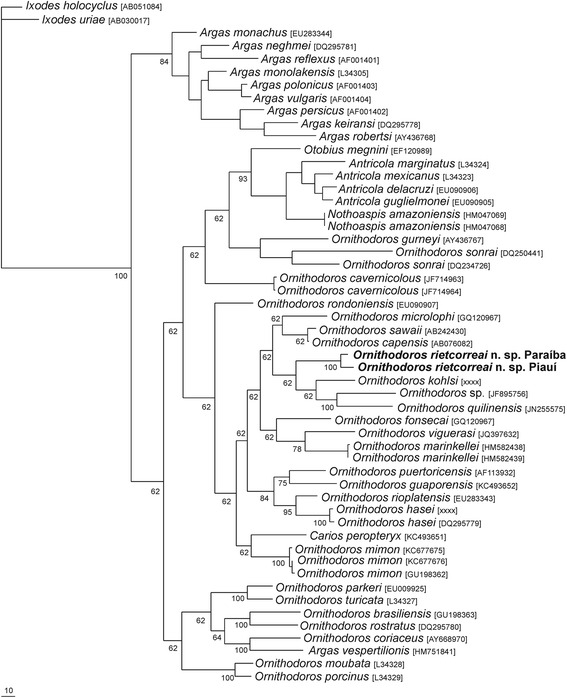
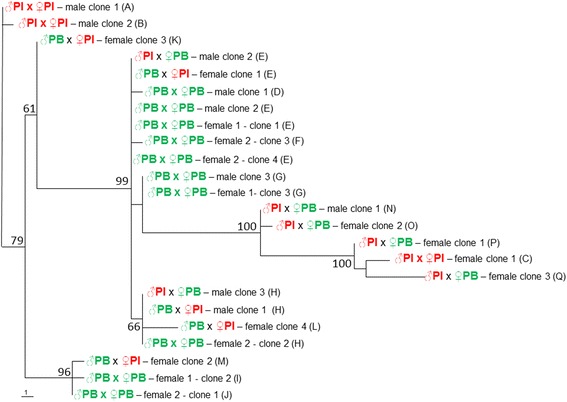
During 2012-2013, Ornithodoros ticks were collected from K. rupestris resting places in Paraíba State (PB) and Piauí State (PI), northeastern Brazil. These ticks were brought alive to the laboratory, and used to form two laboratory colonies (PB and PI ticks). Field-collected adults and laboratory-reared larvae were used for morphological description through light and scanning electron microscopy. DNA sequences of the mitochondrial 16S rRNA gene were generated from nymphal ticks and used to conduct phylogenetic analyses along with other Ornithodoros spp. sequences from GenBank. Reproductive compatibility of crosses between PB and PI adult ticks was evaluated, as well as analyses of hybrid ticks through larval morphology by a principal components analysis (PCA) and DNA sequences of the second internal transcribed spacer (ITS2) region from adult ticks.
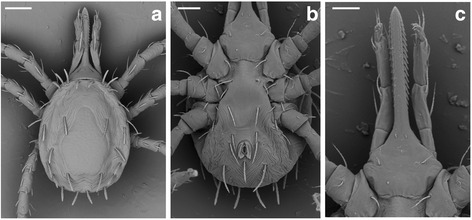
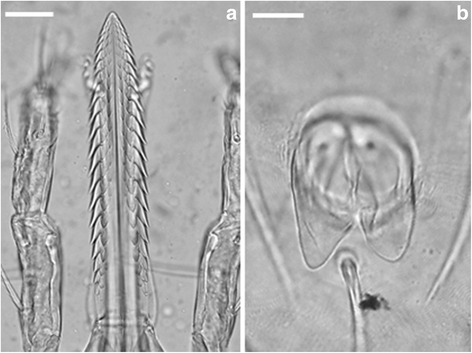
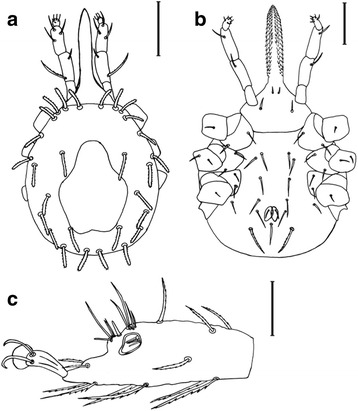
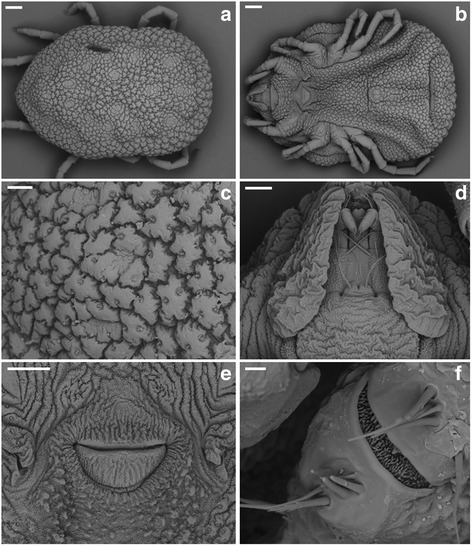
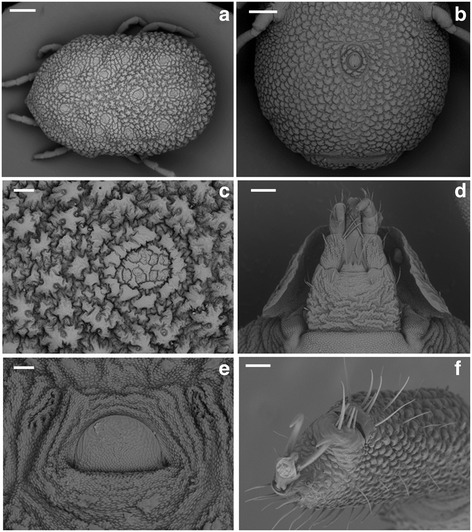
Morphological analysis allowed recognizing these ticks as a new species, Ornithodoros rietcorreai n. sp. The larva of O. rietcorreai is distinct from those of other Ornithodoros spp. by the combination of the following character states: 14 pairs of dorsal setae, dorsal plate pyriform, hypostome with pointed apex and dental formula 3/3 anteriorly, 2/2 posteriorly, and anal valves with long and pointed leaf-shaped ends. There were a few larval morphological differences between PB and PI ticks, and their mitochondrial 16S rDNA sequences diverged by 3.3 %. On the other hand, cross-mating experiments showed that PB and PI ticks were reproductive compatible, indicating that they represent a single species. Analyses of ITS2 sequences and PCA corroborated this assumption.
Ornithodoros rietcorreai is described as a new species associated with K. rupestris in Brazil, increasing the Brazilian tick fauna to 70 species.
岩豚鼠(Kerodon rupestris,维德 - 诺伊维德,1820年)是巴西东北部特有的啮齿动物物种。早期研究将argasid蜱(Ornithodoros talaje,盖兰 - 梅内维尔,1849年)与岩豚鼠联系起来;然而,最近一项研究表明,O. talaje在巴西并未被确认存在,此前关于该物种的报告可能是对密切相关物种的错误鉴定,有待进一步准确判定。在此,我们描述了一种与巴西东北部岩豚鼠相关的1844年命名的新的Ornithodoros Koch蜱种。
2012 - 2013年期间,从巴西东北部帕拉伊巴州(PB)和皮奥伊州(PI)的岩豚鼠栖息地采集Ornithodoros蜱。这些蜱被活体带回实验室,用于建立两个实验室种群(PB蜱和PI蜱)。通过光学显微镜和扫描电子显微镜对野外采集的成虫和实验室饲养的幼虫进行形态学描述。从若蜱中生成线粒体16S rRNA基因的DNA序列,并与来自GenBank的其他Ornithodoros spp.序列一起进行系统发育分析。评估PB和PI成年蜱之间杂交的生殖兼容性,并通过主成分分析(PCA)对杂交蜱的幼虫形态以及成年蜱的第二内部转录间隔区(ITS2)区域的DNA序列进行分析。
形态学分析确认这些蜱为一个新物种,即Ornithodoros rietcorreai n. sp.。Rietcorreai蜱的幼虫与其他Ornithodoros spp.的幼虫不同,具有以下特征组合:14对背毛,背甲梨形,口下板顶端尖锐,齿式前部为3/3,后部为2/2,肛瓣末端为长而尖的叶状。PB蜱和PI蜱的幼虫在形态上存在一些差异,它们的线粒体16S rDNA序列差异为3.3%。另一方面,杂交交配实验表明PB蜱和PI蜱具有生殖兼容性,表明它们代表单一物种。ITS2序列分析和PCA证实了这一假设。
Ornithodoros rietcorreai被描述为一种与巴西岩豚鼠相关的新物种,使巴西蜱类动物群增加到70种。