Research Institute, Fundación Universitaria de Ciencias de la Salud - FUCS, Bogotá, Colombia.
Servicios y Asesorías en Infectología - SAI, Bogotá, Colombia.
Parasit Vectors. 2022 Jun 8;15(1):196. doi: 10.1186/s13071-022-05289-5.
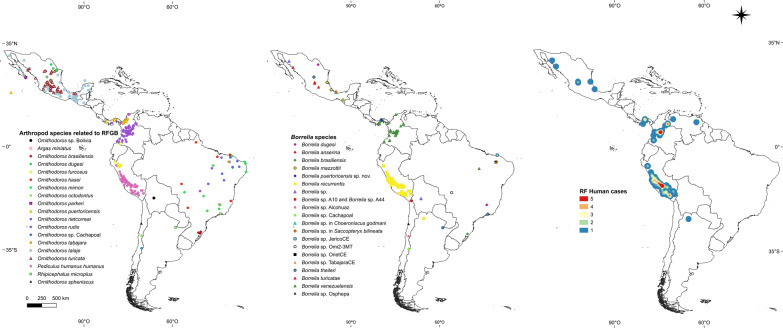
Relapsing fever group Borrelia (RFGB) are motile spirochetes transmitted to mammalian or avian hosts through the bite of hematophagous arthropods, such as soft ticks (Argasidae), hard ticks (Ixodidae) and the human clothing lice. RFGB can infect pets such as dogs and cats, as well as birds, cattle and humans. Borrelia recurrentis, B. anserina and B. theileri are considered to have worldwide distribution, affecting humans, domestic birds and ruminants, respectively. Borrelia spp. associated with soft ticks are transmitted mainly by Ornithodoros ticks and thrive in endemic foci in tropical and subtropical latitudes. Nowadays, human cases of soft tick-borne relapsing fever remain neglected diseases in several countries, and the impact these spirochetes have on the health of wild and domestic animals is largely understudied. Human infection with RFGB is difficult to diagnose, given the lack of distinguishing clinical features (undifferentiated febrile illness). Clinically, soft tick or louse-borne relapsing fever is often confused with other etiologies, such as malaria, typhoid or dengue. In Latin America, during the first half of the twentieth century historical documents elaborated by enlightened physicians were seminal, and resulted in the identification of RFGB and their associated vectors in countries such as Mexico, Panama, Colombia, Venezuela, Peru and Argentina. Almost 80 years later, research on relapsing fever spirochetes is emerging once again in Latin America, with molecular characterizations and isolations of novel RFGB members in Panama, Bolivia, Brazil and Chile. In this review we summarize historical aspects of RFGB in Latin America and provide an update on the current scenario regarding these pathogens in the region. To accomplish this, we conducted an exhaustive search of all the published literature for the region, including old medical theses deposited in libraries of medical academies. RFGB were once common pathogens in Latin America, and although unnoticed for many years, they are currently the focus of interest among the scientific community. A One Health perspective should be adopted to tackle the diseases caused by RFGB, since these spirochetes have never disappeared and the maladies they cause may be confused with etiologies with similar symptoms that prevail in the region.
回归热螺旋体组(RFGB)是一种可运动的螺旋体,通过吸血节肢动物(如软蜱、硬蜱和体虱)的叮咬传播给哺乳动物或禽类宿主。RFGB 可感染宠物(如狗和猫)以及鸟类、牛和人类。伯氏疏螺旋体、安氏疏螺旋体和特氏疏螺旋体被认为具有全球分布,分别影响人类、家禽和反刍动物。与软蜱相关的伯氏疏螺旋体主要通过钝缘蜱传播,并在热带和亚热带地区的地方性流行区中茁壮成长。如今,几个国家仍忽视软蜱传播回归热这种人类疾病,而这些螺旋体对野生动物和家养动物健康的影响在很大程度上仍未得到研究。由于缺乏鉴别特征(非特异性发热性疾病),RFGB 所致人类感染的诊断较为困难。临床上,软蜱或体虱传播的回归热常与其他病因(如疟疾、伤寒或登革热)混淆。在拉丁美洲,20 世纪上半叶,有识之士医生所撰写的历史文献具有重要意义,导致在墨西哥、巴拿马、哥伦比亚、委内瑞拉、秘鲁和阿根廷等国家鉴定出 RFGB 及其相关媒介。近 80 年后,拉丁美洲再次出现对回归热螺旋体的研究,在巴拿马、玻利维亚、巴西和智利对新型 RFGB 成员进行了分子特征分析和分离。在本综述中,我们总结了拉丁美洲 RFGB 的历史方面,并提供了该地区目前关于这些病原体的最新情况。为此,我们对该地区的所有已发表文献进行了全面搜索,包括医学科学院图书馆中保存的旧医学论文。RFGB 曾是拉丁美洲的常见病原体,尽管多年来未被察觉,但它们目前是科学界关注的焦点。应采取一种“同一健康”的视角来应对由 RFGB 引起的疾病,因为这些螺旋体从未消失,而且它们引起的疾病可能与该地区流行的具有类似症状的病因相混淆。