Kim Do-Hyung, Sexton Joseph O, Townshend John R
Global Land Cover Facility, Department of Geographical Sciences University of Maryland College Park Maryland USA.
Geophys Res Lett. 2015 May 16;42(9):3495-3501. doi: 10.1002/2014GL062777. Epub 2015 May 7.
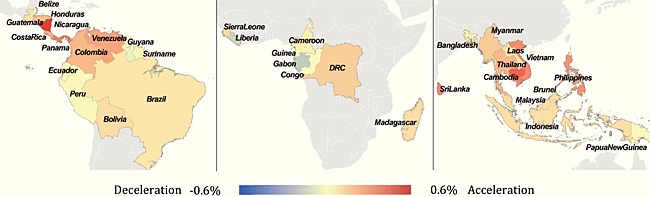
Using a consistent, 20 year series of high- (30 m) resolution, satellite-based maps of forest cover, we estimate forest area and its changes from 1990 to 2010 in 34 tropical countries that account for the majority of the global area of humid tropical forests. Our estimates indicate a 62% acceleration in net deforestation in the humid tropics from the 1990s to the 2000s, contradicting a 25% reduction reported by the United Nations Food and Agriculture Organization Forest Resource Assessment. Net loss of forest cover peaked from 2000 to 2005. Gross gains accelerated slowly and uniformly between 1990-2000, 2000-2005, and 2005-2010. However, the gains were overwhelmed by gross losses, which peaked from 2000 to 2005 and decelerated afterward. The acceleration of humid tropical deforestation we report contradicts the assertion that losses decelerated from the 1990s to the 2000s.
利用一系列连续20年的、基于卫星的30米高分辨率森林覆盖图,我们估算了34个热带国家1990年至2010年的森林面积及其变化,这些国家占全球湿润热带森林面积的大部分。我们的估算结果显示,从20世纪90年代到21世纪初,湿润热带地区的净森林砍伐加速了62%,这与联合国粮食及农业组织森林资源评估报告的25%的减少率相矛盾。森林覆盖的净损失在2000年至2005年达到峰值。1990年至2000年、2000年至2005年以及2005年至2010年期间,森林总增加量缓慢且均匀地加速。然而,森林总增加量被总损失量所掩盖,总损失量在2000年至2005年达到峰值,之后有所减速。我们报告的湿润热带地区森林砍伐加速情况与20世纪90年代到21世纪初森林损失减速的说法相矛盾。