Wang Huaqing, Ke Yanliang, Song Liuyang, Tang Gang, Chen Peng
College of Mechanical & Electrical Engineering, Beijing University of Chemical Technology Chao Yang District, Beijing 100029, China.
Graduate School of Bioresources, Mie University, 1577 Kurimamachiya-cho, Tsu, Mie 514-8507, Japan.
Sensors (Basel). 2016 Sep 19;16(9):1524. doi: 10.3390/s16091524.
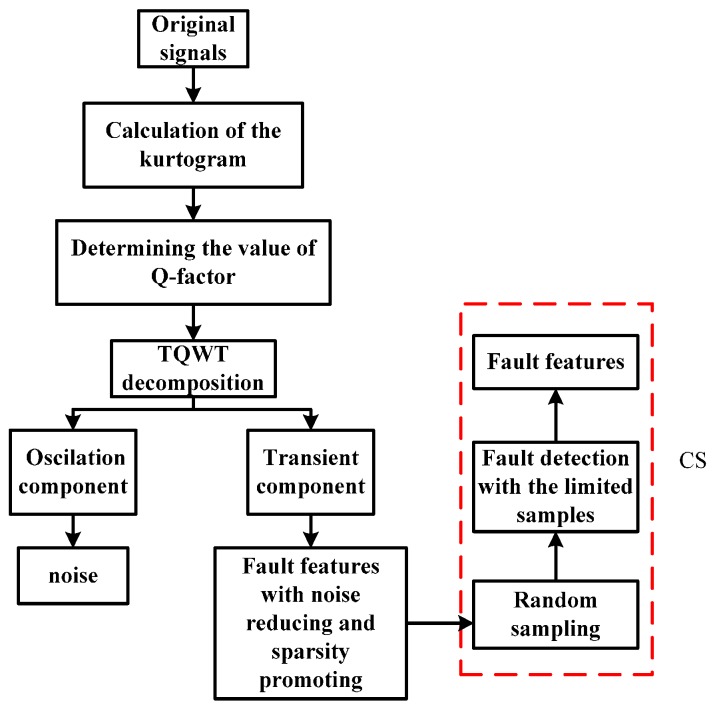
The traditional approaches for condition monitoring of roller bearings are almost always achieved under Shannon sampling theorem conditions, leading to a big-data problem. The compressed sensing (CS) theory provides a new solution to the big-data problem. However, the vibration signals are insufficiently sparse and it is difficult to achieve sparsity using the conventional techniques, which impedes the application of CS theory. Therefore, it is of great significance to promote the sparsity when applying the CS theory to fault diagnosis of roller bearings. To increase the sparsity of vibration signals, a sparsity-promoted method called the tunable Q-factor wavelet transform based on decomposing the analyzed signals into transient impact components and high oscillation components is utilized in this work. The former become sparser than the raw signals with noise eliminated, whereas the latter include noise. Thus, the decomposed transient impact components replace the original signals for analysis. The CS theory is applied to extract the fault features without complete reconstruction, which means that the reconstruction can be completed when the components with interested frequencies are detected and the fault diagnosis can be achieved during the reconstruction procedure. The application cases prove that the CS theory assisted by the tunable Q-factor wavelet transform can successfully extract the fault features from the compressed samples.
传统的滚动轴承状态监测方法几乎总是在香农采样定理条件下实现的,这导致了大数据问题。压缩感知(CS)理论为大数据问题提供了一种新的解决方案。然而,振动信号的稀疏性不足,使用传统技术难以实现稀疏性,这阻碍了CS理论的应用。因此,将CS理论应用于滚动轴承故障诊断时提高其稀疏性具有重要意义。为了增加振动信号的稀疏性,本文采用了一种基于将分析信号分解为瞬态冲击分量和高振荡分量的稀疏性增强方法,即可调Q因子小波变换。前者在消除噪声后比原始信号更稀疏,而后者包含噪声。因此,用分解后的瞬态冲击分量代替原始信号进行分析。应用CS理论在不进行完全重构的情况下提取故障特征,这意味着当检测到感兴趣频率的分量时即可完成重构,并且在重构过程中可以实现故障诊断。应用案例证明,可调Q因子小波变换辅助的CS理论能够成功地从压缩样本中提取故障特征。