Sogawa Kazuyuki, Takano Shigetsugu, Iida Fumie, Satoh Mamoru, Tsuchida Sachio, Kawashima Yusuke, Yoshitomi Hideyuki, Sanda Akihiro, Kodera Yoshio, Takizawa Hirotaka, Mikata Rintaro, Ohtsuka Masayuki, Shimizu Hiroaki, Miyazaki Masaru, Yokosuka Osamu, Nomura Fumio
Department of Biochemistry, School of Life and Environmental Science, Azabu University, Kanagawa 252-0206, Japan.
Department of General Surgery, Graduate School of Medicine, Chiba University, Chiba 260-8670, Japan.
Br J Cancer. 2016 Oct 11;115(8):949-956. doi: 10.1038/bjc.2016.295. Epub 2016 Sep 22.
Pancreatic ductal adenocarcinoma (PDAC) remains a devastating disease due to the lack of specific early diagnostic markers. To improve the outcomes, proteomic approaches are being developed for the discovery of novel biomarkers of PDAC.
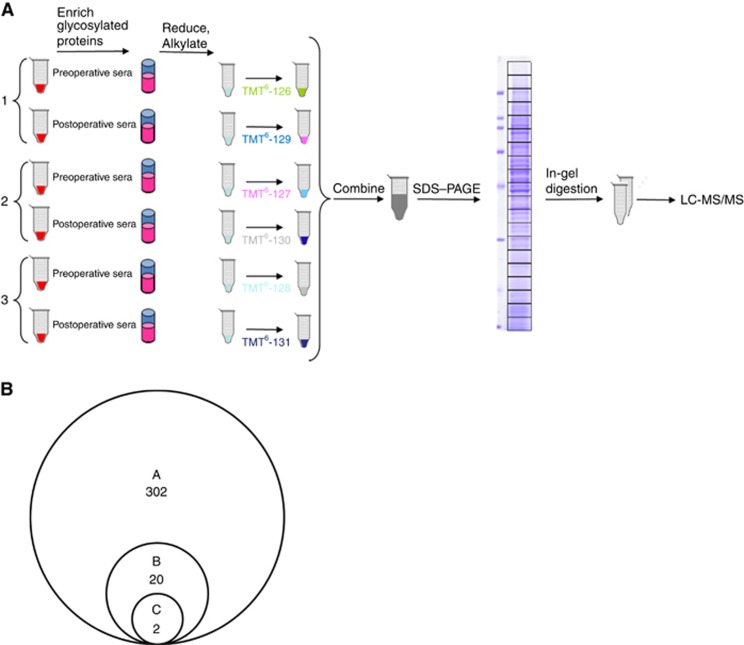
Using tandem mass tag labelling and LC-MS/MS, we performed comparative analyses of pre- and postoperative sera from PDAC patients to identify specific serum biomarkers for PDAC. In validation studies, we evaluated the discriminatory power of candidate proteins.
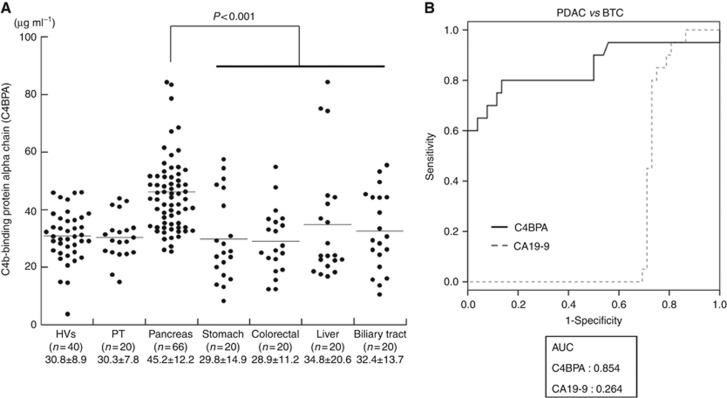
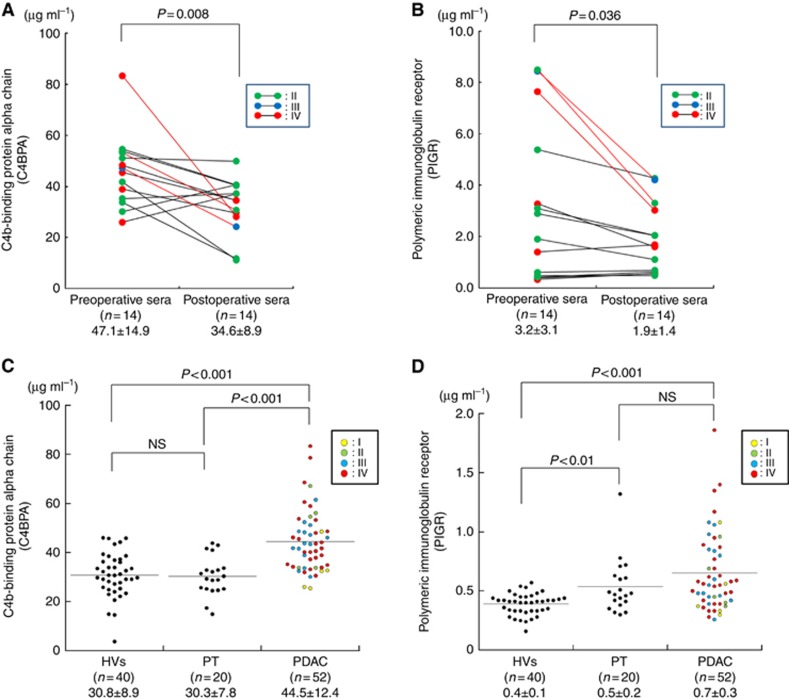
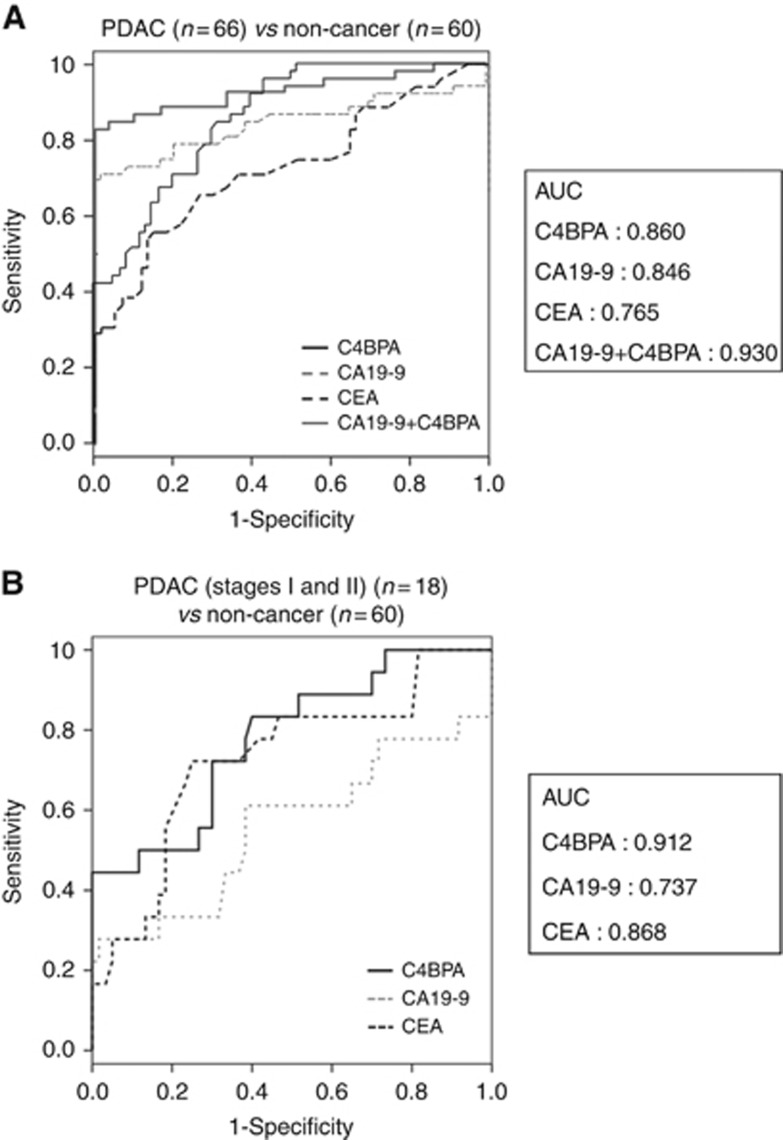
Among the 302 proteins analysed, 20 were identified as potential biomarkers, with C4b-binding protein α-chain (C4BPA) and polymeric immunoglobulin receptor (PIGR) being selected for further analysis. The sera levels of C4BPA and PIGR were significantly higher in the preoperative PDAC patients than in the postoperative ones (P<0.008, P<0.036, respectively). In addition, serum C4BPA levels, but not PIGR, in patients with PDAC were significantly higher than those in healthy controls as well as in patients with pancreatitis and other malignancies including biliary tract cancers (BTC) (P<0.001). The respective area under the receiver operator characteristics (ROC) curve (AUC) was 0.860 for C4BPA, 0.846 for CA19-9 and 0.930 for the combination of C4BPA and CA19-9 in PDAC vs non-cancer individuals. The respective AUC was 0.912 for C4BPA, 0.737 for CA19-9 in Stages I and II of PDAC, 0.854 for C4BPA and 0.264 for CA19-9 in PDAC vs BTC.
We have demonstrated that C4BPA is a novel serum biomarker for detecting early stage PDAC, as well as for distinguishing PDAC from other gastroenterological cancers. Further analysis in large cohort studies will warrant C4BPA as a promising biomarker of PDAC in clinical use.
由于缺乏特异性早期诊断标志物,胰腺导管腺癌(PDAC)仍然是一种极具破坏性的疾病。为改善治疗结果,正在开发蛋白质组学方法以发现PDAC的新型生物标志物。
我们使用串联质谱标签标记和液相色谱-串联质谱法,对PDAC患者术前和术后的血清进行了比较分析,以确定PDAC的特异性血清生物标志物。在验证研究中,我们评估了候选蛋白的鉴别能力。
在分析的302种蛋白质中,有20种被鉴定为潜在生物标志物,其中选择C4b结合蛋白α链(C4BPA)和多聚免疫球蛋白受体(PIGR)进行进一步分析。术前PDAC患者血清中C4BPA和PIGR水平显著高于术后患者(分别为P<0.008,P<0.036)。此外,PDAC患者血清C4BPA水平显著高于健康对照以及胰腺炎患者和包括胆管癌(BTC)在内的其他恶性肿瘤患者,而PIGR水平无显著差异(P<0.001)。在PDAC与非癌症个体的比较中,C4BPA的受试者工作特征曲线(ROC)下面积(AUC)为0.860,CA19-9为0.846,C4BPA与CA19-9联合为0.930。在PDAC的I期和II期,C4BPA的AUC为0.912,CA19-9为0.737;在PDAC与BTC的比较中,C4BPA的AUC为0.854,CA19-9为0.264。
我们已经证明,C4BPA是一种用于检测早期PDAC以及区分PDAC与其他胃肠癌的新型血清生物标志物。在大型队列研究中的进一步分析将使C4BPA成为临床上有前景的PDAC生物标志物。