Tsunoda Fumiyoshi, Lamon-Fava Stefania, Horvath Katalin V, Schaefer Ernst J, Asztalos Bela F
From the Cardiovascular Nutrition Laboratory, Jean Mayer USDA Human Nutrition Research Center on Aging, Tufts University, 711 Washington Street, Boston, MA, 02111, USA.
Lipids Health Dis. 2016 Sep 22;15(1):163. doi: 10.1186/s12944-016-0336-y.
Population studies have shown an inverse association between high-density lipoprotein (HDL) cholesterol levels and risk of coronary heart disease (CHD). HDL has different functions, including the ability to protect biological molecules from oxidation. Our aim was to evaluate the performance of two fluorescence-based assays in assessing the antioxidative capacity of HDL.
We compared the antioxidative capacity of HDL with the phospholipid 2',7'-dichlorodihydrofluorescein (DCF) assay and the dihydrorhodamine 123 (DHR) assay in controls and in subjects at increased risk of CHD, including subjects with established CHD, and subjects with elevated plasma triglycerides (TG), serum amyloid A (SAA), or myeloperoxidase (MPO) levels.
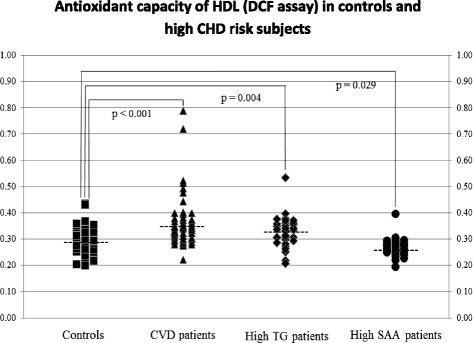
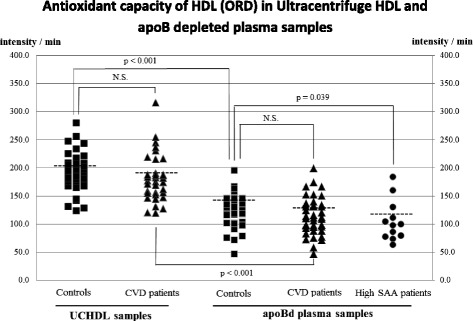
The antioxidative capacity of HDL, as measured by the DCF assay, was significantly lower in both CHD and high-TG patients than in controls (p < 0.001 and p = 0.004, respectively). Interestingly, the mean antioxidative capacity of HDL in high-SAA subjects was significantly higher (p < 0.03), while in high-MPO subjects was similar to controls. When the DHR assay was used we did not find differences in HDL's antioxidative capacity between CHD patients and controls but we found higher antioxidative capacity in high-SAA subjects compared to controls.
Only the DCF assay could detect significant differences in the antioxidative capacity of HDL between controls and CHD subjects. Practical use of both assays for the assessment of antioxidative capacity of HDL is limited by the large overlap in values among groups. The antioxidative activity of HDL in patients who have elevated SAA levels needs to be reassessed.
人群研究表明,高密度脂蛋白(HDL)胆固醇水平与冠心病(CHD)风险呈负相关。HDL具有多种功能,包括保护生物分子免受氧化的能力。我们的目的是评估两种基于荧光的检测方法在评估HDL抗氧化能力方面的性能。
我们在对照组以及冠心病风险增加的受试者中,包括已确诊冠心病的受试者、血浆甘油三酯(TG)、血清淀粉样蛋白A(SAA)或髓过氧化物酶(MPO)水平升高的受试者,比较了HDL与磷脂2',7'-二氯二氢荧光素(DCF)检测法和二氢罗丹明123(DHR)检测法的抗氧化能力。
通过DCF检测法测得,HDL的抗氧化能力在冠心病患者和高TG患者中均显著低于对照组(分别为p < 0.001和p = 0.004)。有趣的是,高SAA受试者中HDL的平均抗氧化能力显著更高(p < 0.03),而高MPO受试者中的抗氧化能力与对照组相似。当使用DHR检测法时,我们未发现冠心病患者和对照组之间HDL抗氧化能力的差异,但发现高SAA受试者的抗氧化能力高于对照组。
只有DCF检测法能够检测出对照组和冠心病受试者之间HDL抗氧化能力的显著差异。由于各组间数值存在大量重叠,这两种检测方法在实际用于评估HDL抗氧化能力方面受到限制。SAA水平升高患者中HDL的抗氧化活性需要重新评估。