Weeks Jillian J, Carlson Lauren J, Radabaugh Hannah L, de la Tremblaye Patricia B, Bondi Corina O, Kline Anthony E
Physical Medicine & Rehabilitation, University of Pittsburgh, Pittsburgh, PA, 15213, United States; Safar Center for Resuscitation Research, University of Pittsburgh, Pittsburgh, PA, 15213, United States; Center for Neuroscience, University of Pittsburgh, Pittsburgh, PA, 15213, United States.
Physical Medicine & Rehabilitation, University of Pittsburgh, Pittsburgh, PA, 15213, United States; Safar Center for Resuscitation Research, University of Pittsburgh, Pittsburgh, PA, 15213, United States.
Behav Brain Res. 2018 Mar 15;340:159-164. doi: 10.1016/j.bbr.2016.09.049. Epub 2016 Sep 21.
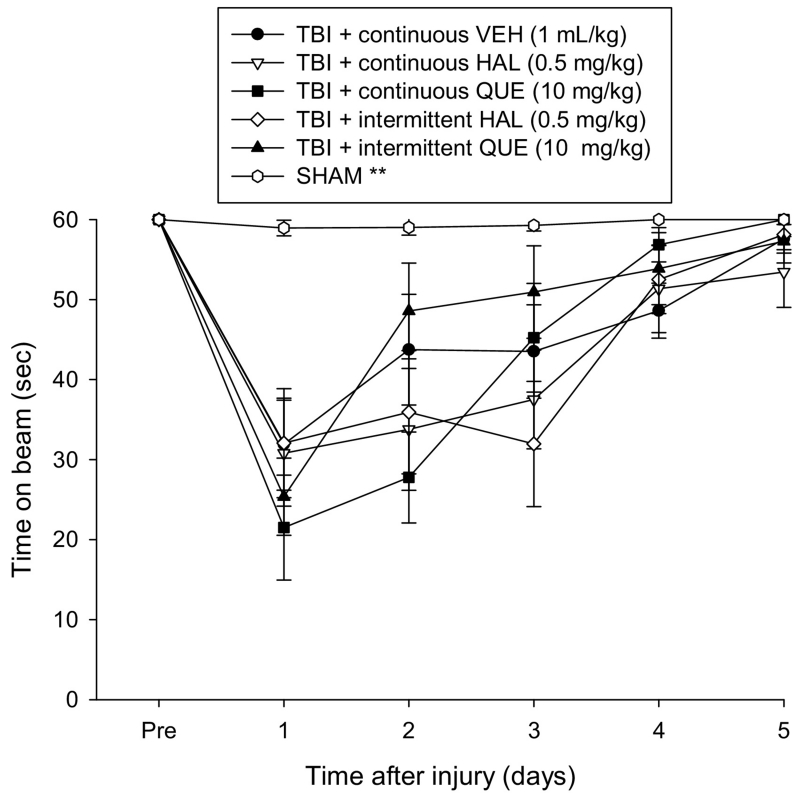
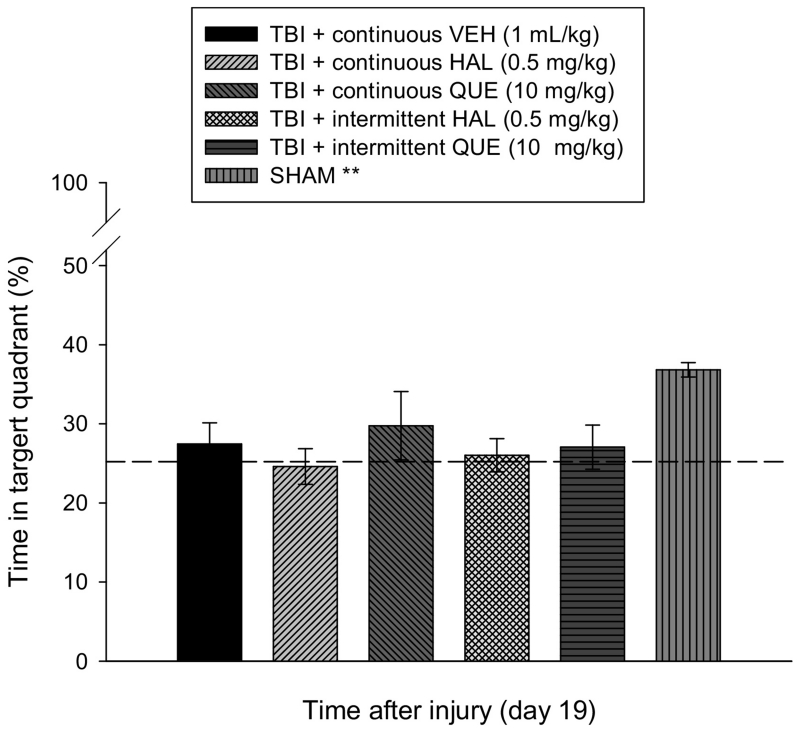
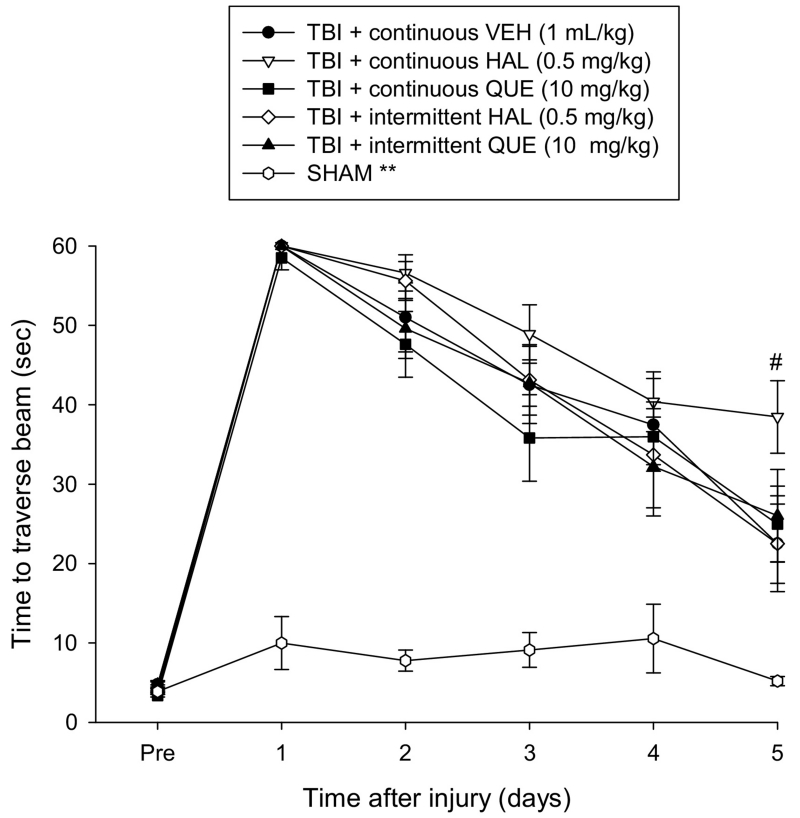
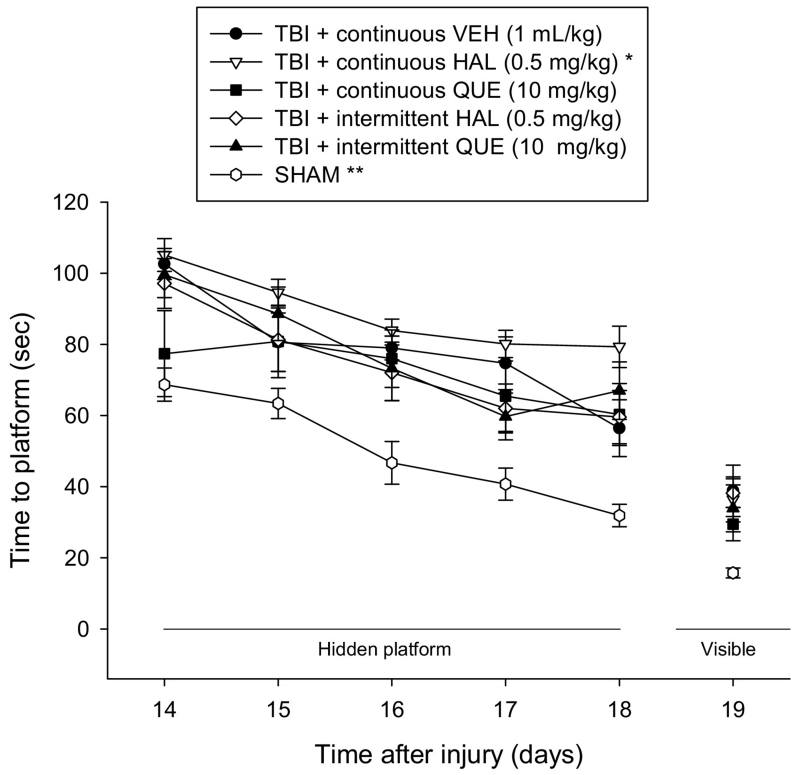
Traumatic brain injury (TBI)-induced agitation and aggression pose major obstacles to clinicians in the acute hospital and rehabilitation settings. Thus, management of these symptoms is crucial. Antipsychotic drugs (APDs) are a common treatment approach for alleviating these symptoms. However, previous preclinical TBI studies have indicated that daily and chronic administration of these drugs (e.g., haloperidol; HAL) can exacerbate cognitive and motor deficits. Quetiapine (QUE) is an atypical APD that differs from many typical APDs, such as HAL, in its relatively rapid dissociation from the D receptor. The goal of this study was to test the hypotheses that intermittent HAL and QUE would not hinder recovery of cognitive and motor function following TBI and that daily QUE would also not impair functional recovery, which would be in contrast to HAL. Seventy anesthetized male rats received either a controlled cortical impact or sham injury and were then randomly assigned to TBI and sham groups receiving HAL (0.5mg/kg) or QUE (10mg/kg) intraperitoneally once per day or once every other day and compared to each other and vehicle (VEH) controls. Motor function was assessed by beam balance/walk tests on post-operative days 1-5 and cognitive function was evaluated with a Morris water maze task on days 14-19. No differences were revealed among the sham groups in any task, and hence the data were pooled. No overall differences were detected among the TBI groups, regardless of treatment or administration paradigm [p>0.05], but all were impaired vs. SHAM controls [p<0.05]. The SHAM controls also performed significantly better in the cognitive test vs. all TBI groups [p<0.05]. Moreover, the TBI+continuous HAL group performed worse than the TBI+continuous VEH, TBI+continuous QUE, and TBI+intermittent QUE groups [p<0.05], which did not differ from one another. Overall, the data suggest that QUE does not exacerbate TBI-induced cognitive and motor deficits, which supports the hypothesis. QUE may prove useful as an alternative APD treatment for management of agitation and aggression after clinical TBI. HAL may also be safe, but only if used sparingly.
创伤性脑损伤(TBI)所致的激越和攻击行为给急症医院和康复机构的临床医生带来了重大障碍。因此,对这些症状的管理至关重要。抗精神病药物(APD)是缓解这些症状的常用治疗方法。然而,先前的临床前TBI研究表明,每日及长期使用这些药物(如氟哌啶醇;HAL)会加重认知和运动功能障碍。喹硫平(QUE)是一种非典型APD,与许多典型APD(如HAL)不同,它与D受体的解离相对较快。本研究的目的是检验以下假设:间歇性使用HAL和QUE不会妨碍TBI后认知和运动功能的恢复,且每日使用QUE也不会损害功能恢复,这与HAL相反。70只麻醉的雄性大鼠接受了控制性皮质撞击或假手术损伤,然后随机分为TBI组和假手术组,分别每日或隔日腹腔注射HAL(0.5mg/kg)或QUE(10mg/kg),并与溶剂(VEH)对照组进行比较。在术后第1 - 5天通过平衡木/行走测试评估运动功能,在第14 - 19天用莫里斯水迷宫任务评估认知功能。假手术组在任何任务中均未显示出差异,因此将数据合并。无论治疗或给药模式如何,TBI组之间均未检测到总体差异[p>0.05],但与假手术对照组相比均受损[p<0.05]。假手术对照组在认知测试中的表现也明显优于所有TBI组[p<0.05]。此外,TBI + 持续HAL组的表现比TBI + 持续VEH组、TBI + 持续QUE组和TBI + 间歇性QUE组更差[p<0.05],而后三组之间没有差异。总体而言,数据表明QUE不会加重TBI诱导的认知和运动功能障碍,这支持了假设。QUE可能被证明是临床TBI后管理激越和攻击行为的一种替代性APD治疗方法。HAL可能也是安全的,但前提是要谨慎使用。